LECTURE NOTES ON APPLIED MATHEMATICS
Jun 17, 2009 · 2. Constitutive equations The conservation law (1.2) is not a closed equation for the density u. Typically, we supplement it with constitutive equations that relate the ux ~qand the source density ˙to uand its derivatives. While the conservation law expresses a gen-eral physical principle, constitutive equations describe the response of a ...
Download LECTURE NOTES ON APPLIED MATHEMATICS

Information
Domain:
Source:
Link to this page:
Documents from same domain

LECTURE 5 - UC Davis Mathematics
www.math.ucdavis.eduLECTURE 5. STOCHASTIC PROCESSES 133 We say that random variables X 1;X 2;:::X n: !R are jointly continuous if there is a joint probability density function p(x
A concise introduction to quantum probability, …
www.math.ucdavis.eduA concise introduction to quantum probability, quantum mechanics, and ... precepts of quantum mechanics are sometimes called ... This article is a concise introduction to quantum probability theory, quantum mechanics, and quan-tum computation for the mathematically prepared
An introduction to quantum probability, quantum …
www.math.ucdavis.eduAn introduction to quantum probability, quantum mechanics, and quantum computation Greg Kuperberg∗ UC Davis (Dated: October 8, 2007) Quantum mechanics is one of the most surprising

Linear Algebra in Twenty Five Lectures
www.math.ucdavis.eduThese linear algebra lecture notes are designed to be presented as twenty ve, fty minute lectures suitable for sophomores likely to use the material for applications but still requiring a solid foundation in this fundamental branch
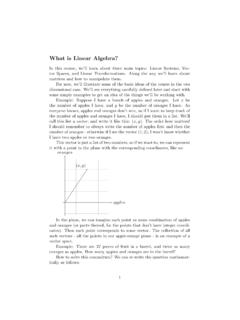
What is Linear Algebra? - University of California, …
www.math.ucdavis.eduWhat is Linear Algebra? In this course, we’ll learn about three main topics: Linear Systems, Vec-tor Spaces, and Linear Transformations. Along the way we’ll learn about
Twenty problems in probability - UC Davis …
www.math.ucdavis.eduTwenty problems in probability This section is a selection of famous probability puzzles, job interview questions (most high- tech companies ask their applicants math questions) and math competition problems.
Complex Analysis Lecture Notes - UC Davis Mathematics
www.math.ucdavis.edu\entropy"), and lots of applications to things that seem unrelated to complex numbers, for example: Solving cubic equations that have only real roots (historically, this was the

David Cherney, Tom Denton, Rohit Thomas and Andrew …
www.math.ucdavis.eduLinear algebra is the study of vectors and linear functions. In broad terms, vectors are things you can add and linear functions are functions of vectors that respect vector addition.
Power Series - UC Davis Mathematics :: Home
www.math.ucdavis.eduThe power series in Definition 6.1 is a formal expression, since we have not said anything about its convergence. By changing variables x→ ( x−c ), we can assume

Math 22B, Homework #8 - UC Davis Mathematics
www.math.ucdavis.eduMath 22B, Homework #8 4 Plugging y p and its derivatives into the ODE we get u0 1 e t+ u0 2 = 2(1 t)e t (2) Putting (1) and (2) together we have et t et 1 u0 1 u0 2 = 0 2(1 tt)e Inverting gives u0 1 u0 2 = 2te 2t 2e t Thus, after integrating, we get
Related documents

Introduction to CFD Basics - Cornell University
dragonfly.tam.cornell.educonservation equations are applied to the control volume defined by a cell to get the discrete equations for the cell. The integral form of the continuity equation for steady, incompressible flow is Z S V~ ·nˆ dS = 0 (5) The integration is over the surface S of the control volume and nˆ is the outward normal at the surface.

Chapter 7 First-order Differential Equations
www.sjsu.eduApplication of First-order Differential Equations ... * Based on the book of “Applied Engineering Analysis”, by Tai-Ran Hsu, published by John Wiley & Sons, 2018 Applied Engineering Analysis - slides for class teaching* Chapter Learning Objectives ... The law of conservation of mass, (2) The law of conservation of energy, and ...
Derivation of the Navier–Stokes equations - Wikipedia, the ...
www.math.ucdavis.eduThe equations are derived from the basic principles of conservation of mass, momentum, and energy. For that matter, sometimes it is necessary to consider a finite arbitrary volume, called a control volume, over which these principles can be applied. This finite volume is denoted by and its bounding surface . The control
Chapter 2 Governing Equations of Fluid Dynamics
eng.auburn.edufundamental physical principles are applied to just the fluid element itself. This ap- ... (left side of Fig. 2.1b) are again the conservation form of the equations. The partial differential equations obtained directly from the moving fluid element (right side of Fig. 2.1b) are again called the non-conservation form of the equations.

Lecture 28 3D Rigid Body dynamics: Equations of Motion ...
ocw.mit.eduThe governing equations are those of conservation of linear momentum L = Mv G and angular momentum, H = [I]ω, where we have written the moment of ... applied to the x axis, with corresponding components of ω sketched at the y and z axes. At this instant of time, the change in H will be due to actual time rate of change H˙ plus the effect of ...
Partial Differential Equations (PDEs)
www.ees.nmt.eduform of these equations is called the Navier-Stokes equation, representing Newton’s second law. It is more complicated than the equations here, and highly non-linear. Recall Newton’s second law, “the rate of change of momentum equals the sum of applied forces.” Its nearest relative above is the advection-diffusion equation (3).

Chapter 5 MASS, BERNOULLI AND ENERGY EQUATIONS
opencourses.emu.edu.trconservation of mass, conservation of energy, and conservation of momentum. Historically, the conservation laws are first applied to a fixed quantity of matter called a . closed system. or just a . system, and then extended to regions in space called . control volumes. The conservation relations are also called . balance equations. since any ...

The Equation of Conservation of Mass - Clarkson University
web2.clarkson.eduother words, it is conserved. This is termed the Principle of Conservation of Mass. This principle is applied to a fixed volume in space of arbitrary shape that contains fluid. This volume is called a “Control Volume.” Fluid is permitted to enter or leave the control volume. A control volume . V is shown in the sketch.