LECTURE NOTES ON APPLIED MATHEMATICS
Jun 17, 2009 · Lecture 4. Sturm-Liouville Eigenvalue Problems 95 1. Vibrating strings 96 2. The one-dimensional wave equation 99 3. Quantum mechanics 103 4. The one-dimensional Schr odinger equation 106 5. The Airy equation 116 6. Dispersive wave propagation 118 7. Derivation of the KdV equation for ion-acoustic waves 121 i
Download LECTURE NOTES ON APPLIED MATHEMATICS

Information
Domain:
Source:
Link to this page:
Documents from same domain

LECTURE 5 - UC Davis Mathematics
www.math.ucdavis.eduLECTURE 5. STOCHASTIC PROCESSES 133 We say that random variables X 1;X 2;:::X n: !R are jointly continuous if there is a joint probability density function p(x
A concise introduction to quantum probability, …
www.math.ucdavis.eduA concise introduction to quantum probability, quantum mechanics, and ... precepts of quantum mechanics are sometimes called ... This article is a concise introduction to quantum probability theory, quantum mechanics, and quan-tum computation for the mathematically prepared
An introduction to quantum probability, quantum …
www.math.ucdavis.eduAn introduction to quantum probability, quantum mechanics, and quantum computation Greg Kuperberg∗ UC Davis (Dated: October 8, 2007) Quantum mechanics is one of the most surprising
Linear Algebra in Twenty Five Lectures
www.math.ucdavis.eduThese linear algebra lecture notes are designed to be presented as twenty ve, fty minute lectures suitable for sophomores likely to use the material for applications but still requiring a solid foundation in this fundamental branch
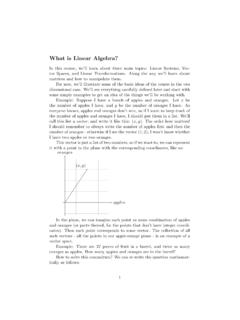
What is Linear Algebra? - University of California, …
www.math.ucdavis.eduWhat is Linear Algebra? In this course, we’ll learn about three main topics: Linear Systems, Vec-tor Spaces, and Linear Transformations. Along the way we’ll learn about
Twenty problems in probability - UC Davis …
www.math.ucdavis.eduTwenty problems in probability This section is a selection of famous probability puzzles, job interview questions (most high- tech companies ask their applicants math questions) and math competition problems.
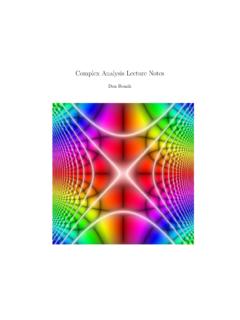
Complex Analysis Lecture Notes - UC Davis Mathematics
www.math.ucdavis.edu\entropy"), and lots of applications to things that seem unrelated to complex numbers, for example: Solving cubic equations that have only real roots (historically, this was the
David Cherney, Tom Denton, Rohit Thomas and Andrew …
www.math.ucdavis.eduLinear algebra is the study of vectors and linear functions. In broad terms, vectors are things you can add and linear functions are functions of vectors that respect vector addition.
Power Series - UC Davis Mathematics :: Home
www.math.ucdavis.eduThe power series in Definition 6.1 is a formal expression, since we have not said anything about its convergence. By changing variables x→ ( x−c ), we can assume

Math 22B, Homework #8 - UC Davis Mathematics
www.math.ucdavis.eduMath 22B, Homework #8 4 Plugging y p and its derivatives into the ODE we get u0 1 e t+ u0 2 = 2(1 t)e t (2) Putting (1) and (2) together we have et t et 1 u0 1 u0 2 = 0 2(1 tt)e Inverting gives u0 1 u0 2 = 2te 2t 2e t Thus, after integrating, we get
Related documents

Differential Equations and Boundary Value Problems
dl.konkur.inEigenvalue Methods and Boundary Value Problems 635 10.1 Sturm–Liouville Problems and Eigenfunction Expansions 635 10.2 Applications of Eigenfunction Series 647 10.3 Steady Periodic Solutions and Natural Frequencies 657 10.4 Cylindrical Coordinate Problems 666 10.5 Higher-Dimensional Phenomena 681 References for Further Study 698

Chebyshev and Fourier Spectral Methods
depts.washington.eduChebyshev and Fourier Spectral Methods Second Edition John P. Boyd University of Michigan Ann Arbor, Michigan 48109-2143 email: jpboyd@engin.umich.edu
Instructor’s Manual MATHEMATICAL METHODS FOR …
textbooks.elsevier.comPage 916 Exercise 18.5.10 Change (n−1 2)! to Γ(n+ 1 2). Page 916 Exercise 18.5.12 Here nmust be an integer. Page 917 Eq. (18.142) In the last term change Γ(−c) to Γ(2 −c). Page 921 Exercise 18.6.9 Change bto c(two occurrences). Page 931 Exercise 18.8.3 The arguments of Kand Eare m. Page 932 Exercise 18.8.6 All arguments of Kand Eare k2 ...

Vibration of Continuous Systems - K. N. Toosi University ...
wp.kntu.ac.ir6.4 Sturm–Liouville Problem 154 6.4.1 Classification of Sturm–Liouville Problems 155 6.4.2 Properties of Eigenvalues and Eigenfunctions 160 6.5 General Eigenvalue Problem 163 6.5.1 Self-Adjoint Eigenvalue Problem 163 6.5.2 Orthogonality of Eigenfunctions 165 6.5.3 Expansion Theorem 166 6.6 Solution of Nonhomogeneous Equations 167

GREEN’S FUNCTIONS WITH APPLICATIONS Second Edition
www.routledge.comsolving (in the case of Sturm-Liouville problem) d dx % f(x) dg dx & +p(x)g = −δ(x−ξ)(1.1.7) with homogeneous boundary conditions, where δ(x − ξ) was the recently in-troduced delta function by Dirac. The advantage of this formulation was that the powerful techniques of eigenvalue expansions and transform methods