LECTURE NOTES ON APPLIED MATHEMATICS
Jun 17, 2009 · The conductivity tensor Ain (1.3) is usually symmetric and positive-de nite, in which case (1.4) is a parabolic PDE; the corresponding PDE for equilibrium density distributions u(~x) is then an elliptic equation r(Aru) = 0: In general, the conductivity tensor may depend upon ~xin a nonuniform system, and on uin non-linearly di usive systems.
Download LECTURE NOTES ON APPLIED MATHEMATICS

Information
Domain:
Source:
Link to this page:
Documents from same domain

LECTURE 5 - UC Davis Mathematics
www.math.ucdavis.eduLECTURE 5. STOCHASTIC PROCESSES 133 We say that random variables X 1;X 2;:::X n: !R are jointly continuous if there is a joint probability density function p(x
A concise introduction to quantum probability, …
www.math.ucdavis.eduA concise introduction to quantum probability, quantum mechanics, and ... precepts of quantum mechanics are sometimes called ... This article is a concise introduction to quantum probability theory, quantum mechanics, and quan-tum computation for the mathematically prepared
An introduction to quantum probability, quantum …
www.math.ucdavis.eduAn introduction to quantum probability, quantum mechanics, and quantum computation Greg Kuperberg∗ UC Davis (Dated: October 8, 2007) Quantum mechanics is one of the most surprising
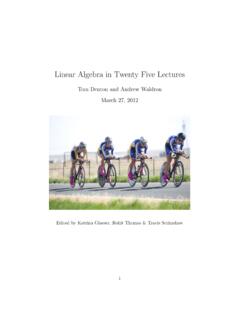
Linear Algebra in Twenty Five Lectures
www.math.ucdavis.eduThese linear algebra lecture notes are designed to be presented as twenty ve, fty minute lectures suitable for sophomores likely to use the material for applications but still requiring a solid foundation in this fundamental branch
What is Linear Algebra? - University of California, …
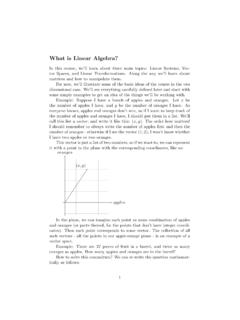
www.math.ucdavis.eduWhat is Linear Algebra? In this course, we’ll learn about three main topics: Linear Systems, Vec-tor Spaces, and Linear Transformations. Along the way we’ll learn about
Twenty problems in probability - UC Davis …
www.math.ucdavis.eduTwenty problems in probability This section is a selection of famous probability puzzles, job interview questions (most high- tech companies ask their applicants math questions) and math competition problems.
Complex Analysis Lecture Notes - UC Davis Mathematics
www.math.ucdavis.edu\entropy"), and lots of applications to things that seem unrelated to complex numbers, for example: Solving cubic equations that have only real roots (historically, this was the
David Cherney, Tom Denton, Rohit Thomas and Andrew …
www.math.ucdavis.eduLinear algebra is the study of vectors and linear functions. In broad terms, vectors are things you can add and linear functions are functions of vectors that respect vector addition.
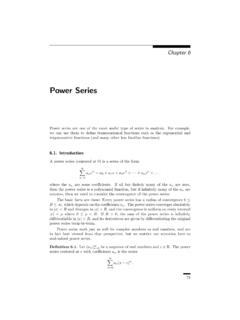
Power Series - UC Davis Mathematics :: Home
www.math.ucdavis.eduThe power series in Definition 6.1 is a formal expression, since we have not said anything about its convergence. By changing variables x→ ( x−c ), we can assume

Math 22B, Homework #8 - UC Davis Mathematics
www.math.ucdavis.eduMath 22B, Homework #8 4 Plugging y p and its derivatives into the ODE we get u0 1 e t+ u0 2 = 2(1 t)e t (2) Putting (1) and (2) together we have et t et 1 u0 1 u0 2 = 0 2(1 tt)e Inverting gives u0 1 u0 2 = 2te 2t 2e t Thus, after integrating, we get
Related documents

4.4 Electrical conductivity of minerals and rocks
appliedgeophysics.berkeley.edu4.4 Electrical conductivity of minerals and rocks Electronic conduction in metallic minerals and graphite ... in these materials is carried by ions in the pore solutions. A subset of minerals, principally metallic sulfides (ore minerals), are electronic semiconductors. A form of carbon, graphite, is a metallic conductor which is found

TYPES OF SOLUTIONS
mymission.lamission.eduSolutions containing ions are conductors of electricity and those that contain molecules are non-conductors. Substances that dissolve in water to form ions are called electrolytes. The ions formed from these substances conduct electric current in solution, and can be tested using a conductivity apparatus (diagram below).
GEOPHYSICAL METHODS IN EXPLORATION AND MINERAL ...
pubs.usgs.govrespectively. In contrast, electrical and seismic methods can detect vertical, as well as lateral, contrasts of resistivity and velocity or reflectivity. Applications of gravity to mineral deposit environmental considerations includes identification of lithologies, structures, and, at times, orebodies themselves (Wright, 1981).

RO3000® Series Circuit Materials
rogerscorp.comThermal Conductivity 0.50 0.50 0.79 0.95 - W/m/K 50°C ASTM D5470 Coefficient of Thermal Expansion (-55 to 288 °C) 17 16 25 17 17 24 17 17 24 13 11 16 X Y Z ppm/°C 23°C/50% RH IPC-TM-650 2.4.41 Td 500 500 500 500 °C TGA ASTM D3850 Density 2.1 2.1 2.6 2.8 gm/cm3 23°C ASTM D792 Copper Peel Strength 12.7 10.2 7.1 9.4 lb/in 1 oz. EDC After ...

A Guide to Working With Copper and Copper Alloys
www.copper.orgConductivity Of all common metals, copper possesses the highest rating for both electrical and thermal conductivity. High conductiv-ity coupled with intrinsic strength, formability and corrosion resistance make copper alloys unique as conductors of electricity – making them ideal for connectors and other electrical/electronic products. Strength
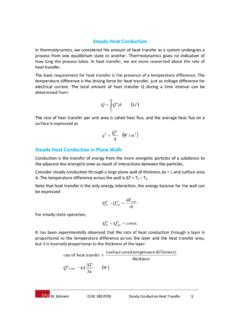
Staedy Conduction Heat Transfer
www.sfu.caelectrical current. ... thermal conductivity is defined as the rate of heat transfer through a unit thickness of material per unit area per unit temperature difference. ... approximate solutions can be obtained by assuming one dimensional heat transfer (using ...
Interpreting Drinking Water Quality Results
www.uwsp.eduConductivity is a measure of the ability of water to conduct an electrical current. It is related to the amount of dissolved substances (or ions) in water, but does not give an indication of which minerals are present. Conductivity (measured in umhos/cm at 25 ° C) is about twice the total hardness value (mg/L CaCO 3) in most uncontaminated waters.