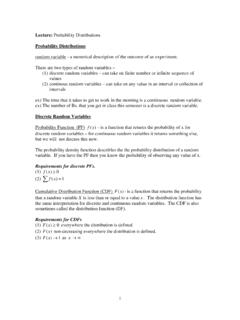
Lecture: Probability Distributions
discrete random variables – for continuous random variables it returns something else, but we will not discuss this now. f(x) The probability density function describles the the probability distribution of a random variable. If you have the PF then you know the probability of observing any value of x. Requirements for discrete PFs. (1) fx ...
Download Lecture: Probability Distributions

Information
Domain:
Source:
Link to this page:
Documents from same domain

IQ - University of Wisconsin–Madison
www.ssc.wisc.eduIQ There were a variety of errors in iq variables used prior to February 1998. These variables - XIQ XIQGD XIQRAW XIQSCOR XIQYR - have been moved to the

Forecasting in STATA: Tools and Tricks
www.ssc.wisc.eduForecasting in STATA: Tools and Tricks Introduction This manual is intended to be a reference guide for time‐series forecasting in STATA.

Time Series and Forecasting Lecture 3 Forecast …
www.ssc.wisc.eduTime Series and Forecasting Lecture 3 Forecast Intervals, Multi-Step Forecasting Bruce E. Hansen Summer School in Economics and Econometrics University of Crete
ECONOMETRICS - ssc.wisc.edu
www.ssc.wisc.eduECONOMETRICS Bruce E. Hansen °c 2000, 20181 University of Wisconsin Department of Economics This Revision: January 2018 Comments Welcome 1This manuscript may be printed and reproduced for individual or instructional use, but may not be printed for commercial purposes.
Intermediate Macroeconomic Theory - SSCC
www.ssc.wisc.eduThe textbook is Olivier Blanchard, Macroeconomics, 5th Edition update (Prentice Hall, 2010) available at the University Bookstore. Note that older editions of the textbook are only

POWER AND PLENTY - University of Wisconsin–Madison
www.ssc.wisc.eduPower and Plenty: Trade, War, and the World Economy in the Second Millennium, by Ronald Findlay and Kevin H. O'Rourke Power over Peoples: Technology, Environments, and Western Imperialism, 1400 to the Present, by Daniel R. Headrick l ~··· POWER AND PLENTY

4 Absorbing Markov Chains - SSCC - Home
www.ssc.wisc.edu4 Absorbing Markov Chains So far, we have focused on regular Markov chains for which the transition matrix P is primitive. Because primitivity requires P(i,i) < 1 for every state i, regular chains never get “stuck” in a particular state. However, other Markov chains may have one

1 Markov Chains - University of Wisconsin–Madison
www.ssc.wisc.edu1 Markov Chains A Markov chain process is a simple type of stochastic process with many social sci-ence applications. We’ll start with an abstract description before moving to analysis of short-run and long-run dynamics. This chapter also introduces one sociological
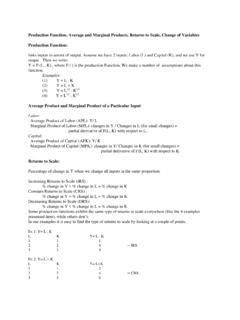
Production Function: Y = F (L , K) , where F ( ) is the ...
www.ssc.wisc.eduProduction Function, Average and Marginal Products, Returns to Scale, Change of Variables Production Function: links inputs to amont of output.
African Americans rev07.ppt - ssc.wisc.edu
www.ssc.wisc.edu2 Whites, Blacks, and the Racial State Sociology 220 Pamela Oliver Slavery enshrined in the Constitution of 1789. Invention of cotton gin gives new profitability to slave plantations 1808 importation of slaves ends after a huge wave if importation in the last decade. Henceforth, slaves are all
Related documents

CHAPTER 3: Random Variables and Probability Distributions
homepage.divms.uiowa.eduA discrete random variable is a random variable whose possible values either constitute a nite set or else can be listed in an in nite sequence. A random variable is continuous if its set of possible values consists of an entire interval on the number line. Many random variables, such as weight of an item, length of life of a motor etc., can ...

Random Variables and Probability Distributions
link.springer.com356 Appendix A Random Variables and Probability Distributions whereW 1 isacontinuous random variable. Ifthedistribution of W 1 isexponential with parameter 1, then the distribution function of W is F(x) = 0, if x < , 1 2 + 1 2 1 −e −x = 1 − 1 2 e , if x ≥ 0. This distribution function is neither continuous (since it has a discontinuity at x = 0) nor discrete (since it increases ...

18.440: Lecture 18 Uniform random variables
ocw.mit.eduUniform random variables and percentiles. Toss n = 300 million Americans into a hat and pull one out. uniformly at random. Is the height of the person you choose a uniform random variable? Maybe in an approximate sense? No. Is the percentile of the person I choose uniformly random? In. other words, let p be the fraction of people left in the hat

Discrete and Continuous Random Variables
ocw.mit.edu15.063 Summer 2003 1616 Continuous Random Variables A continuous random variable can take any value in some interval Example: X = time a customer spends waiting in line at the store • “Infinite” number of possible values for the random variable.

Chapter 4 RANDOM VARIABLES
www.kent.ac.ukDEFINITION: A random variable is said to be continuous if its cdf is a continuous function (see later). This is an important case, which occurs frequently in practice. EXAMPLE: The Exponential Distribution Consider the rv Y with cdf FY (y) = 0, y < 0, 1 − e−y, y ≥ 0. This meets all the requirements above, and is not a step function.

Transformations of Random Variables
www.math.arizona.edu2 Continuous Random Variable The easiest case for transformations of continuous random variables is the case of gone-to-one. We rst consider the case of gincreasing on the range of the random variable X. In this case, g 1 is also an increasing function. To compute the cumulative distribution of Y = g(X) in terms of the cumulative distribution ...

6 Jointly continuous random variables
www.math.arizona.eduRecall that X is continuous if there is a function f(x) (the density) such that P(X ≤ t) = Z t −∞ fX(x)dx We generalize this to two random variables. Definition 1. Two random variables X and Y are jointly continuous if there is a function fX,Y (x,y) on R2, called the joint probability density function, such that P(X ≤ s,Y ≤ t) = Z Z ...

Chapter 3 Continuous Random Variables
www.pnw.eduRandom variable Xis continuous if probability density function (pdf) fis continuous at all but a nite number of points and possesses the following properties: f(x) 0, for all x, R 1 1 f(x) dx= 1, P(a<X b) = R b a f(x) dx The (cumulative) distribution function (cdf) for random variable Xis F(x) = P(X x) = Z x 1 f(t) dt; and has properties lim x ...