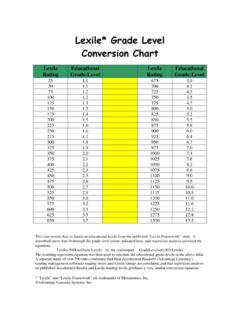
Lexile* Grade Level Conversion Chart
Lexile=500Ln(Grade Level) or, the counterpart GradeLevel=e0.002(Lexile) The resulting regression equation was then used to calculate the educational grade-levels in the above table. A separate study of over 700 titles confirmed that their Accelerated Reader© (Advantage Learning’s reading management software) reading levels and Lexile ratings ...
Download Lexile* Grade Level Conversion Chart

Information
Domain:
Source:
Link to this page:
Documents from same domain
SAMPLE LESSON FOR PRONOUNS RELATIVE ... - …
languageartsreading.dadeschools.netSAMPLE LESSON FOR PRONOUNS RELATIVE PRONOUNS Quick Explanation: Pronouns stand in the place of the noun or nouns. This reduces the number of …
Elementary LAFS Question Task Cards Grade 3 …
languageartsreading.dadeschools.netElementary LAFS Question Task Cards Grade 3 1 Office of Academics and Transformation, Department of English Language Arts, 2014-2015 Literary Informational
WHAT WILL YOUR CHILD LEARN?
languageartsreading.dadeschools.netWHAT WILL YOUR CHILD LEARN? Grade Level Expectations Building the stamina and skills to read challeng-ing fiction, nonfiction, and other materials
Text Reading Efficiency Procedures - Grade 7
languageartsreading.dadeschools.net3 Examiner’s Copy Oral Reading Fluency– Becoming a Firefighter- Grade 7 Script: I would like you to read out loud for me.I will use my stopwatch to tell me when I …
SAMPLE LESSON FOR NOUNS SINGULAR, PLURAL …
languageartsreading.dadeschools.netSAMPLE LESSON FOR NOUNS SINGULAR, PLURAL & COLLECTIVE NOUNS Quick Explanation: Nouns A noun is the part of speech that names a person, place, thing, or an idea. o People, places, and things can be described using one or more of the five senses.
SAMPLE LESSON FOR PRONOUNS POSSESSIVE …
languageartsreading.dadeschools.netSAMPLE LESSON FOR PRONOUNS POSSESSIVE PRONOUNS Quick Explanation: Pronouns stand in the place of the noun or nouns. This reduces the number of times the noun is repeated. There are many forms of pronouns.Among them are:
SAMPLE LESSON FOR SHOW NOT TELL SHOW …
languageartsreading.dadeschools.netSAMPLE LESSON FOR SHOW NOT TELL SHOW NOT TELL Quick Explanation: To create an interesting story, the writer needs to show not tell the reader about people, places, and things they are writing about.
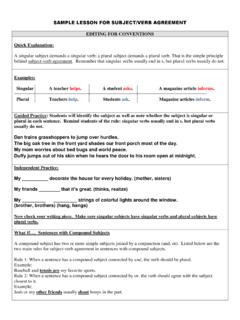
EDITING FOR CONVENTIONS Quick Explanation: …
languageartsreading.dadeschools.netEDITING FOR CONVENTIONS Quick Explanation: A singular subject demands a singular verb; a plural subject demands a plural verb. That is the simple principle behind subject-verb agreement. Remember that singular verbs usually end in s, but plural verbs usually do not. Examples:

10 Things You Need to Know about the Maasai.
languageartsreading.dadeschools.netStudents need to be engaged in some aspect of the writing process (prewriting, drafting, writing, revising, and editing) on a daily basis Collecting a handful of mentor
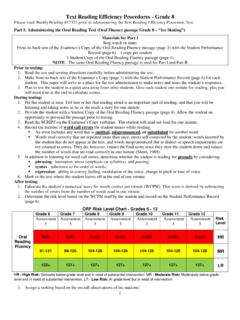
Text Reading Efficiency Procedures - Grade 8
languageartsreading.dadeschools.netreading silently and answering a few questions about the passage previously read. 2. Give the student 5 – 8 minutes to silently read the passage and answer the comprehension questions on a separate
Related documents
Assessment For The California Mathematics Standards Grade 1
www.csun.eduGrade 1 GRADE ONE By the end of grade one, students learn to understand and use the concept of ones and tens in the place value number system. Students add and subtract small numbers with ease. They measure with simple units and locate objects in space. They describe data and analyze and solve simple problems. Introduction: Summary of Goals i.
Grade 3 Mathematics - .NET Framework
capubstore.blob.core.windows.netGrade 3 Mathematics Student At-Home Activity Packet This At-Home Activity Packet includes 26 sets of practice problems that align to important math concepts your student has worked with so far this year. We recommend that your student completes one …

Grade Boundaries - Pearson qualifications
qualifications.pearson.comCreated Date: 20210125100302Z

Grade boundaries - February 2020 - BTEC Tech Awards
qualifications.pearson.comTitle: Grade boundaries - February 2020 - BTEC Tech Awards Created Date: 20200331105348Z

2 STAFF SELECTION COMMISSION
ssc.nic.inStenographer Grade ‘C’ and ‘D’ Examination – 2020 The Computer Based Examination for Stenographer Grade ‘C’ and ‘D’ Examination 2020 was held on 11.11.2021, 12.11.2021 and 15.11.2021 at different centres all over the country. 2. The candidates’ Response Sheets along with the Tentative Answer Keys are
First Grade Math
uploads-ssl.webflow.comSecond Grade Math-Subraction-24 worksheets Download Bubbletime Math in the Apple App Store. Directions: Use in conjunction with the Bubbletime Math app. Two-digit Subtraction with Regrouping Solve the problems below. T O 4 6 - 1 8 T O 8 2 - 6 5 T O 3 8 - 1 9 T O 6 7 - 4 8 ...
Grade 11 Mathematics Practice Test
www.education.ne.govDirections: On the following pages are multiple-choice questions for the Grade 11 Practice Test, a practice opportunity for the Nebraska State Accountability–Mathematics (NeSA–M). Each question will ask you to select an answer from among four choices.

Mathematics Florida Standards (MAFS) Grade 3
www.fldoe.orggrade with the supporting clusters. STANDARD CODE STANDARD MAFS.3.OA.2.5 Apply properties of operations as strategies to multiply and divide. Examples: If 6 × 4 = 24 is known, then 4 × 6 = 24 is also known. (Commutative property of multiplication.) 3 × 5 × 2 can be found by 3 × 5 = 15, then 15 × 2 = 30, or by 5 × 2 = 10, then 3 × 10 = 30.