Linear Algebra in Twenty Five Lectures
Linear Algebra in Twenty Five Lectures Tom Denton and Andrew Waldron March 27, 2012 Edited by Katrina Glaeser, Rohit Thomas & Travis Scrimshaw 1
Download Linear Algebra in Twenty Five Lectures

Information
Domain:
Source:
Link to this page:
Documents from same domain

LECTURE 5 - UC Davis Mathematics
www.math.ucdavis.eduLECTURE 5. STOCHASTIC PROCESSES 133 We say that random variables X 1;X 2;:::X n: !R are jointly continuous if there is a joint probability density function p(x
A concise introduction to quantum probability, …
www.math.ucdavis.eduA concise introduction to quantum probability, quantum mechanics, and ... precepts of quantum mechanics are sometimes called ... This article is a concise introduction to quantum probability theory, quantum mechanics, and quan-tum computation for the mathematically prepared
An introduction to quantum probability, quantum …
www.math.ucdavis.eduAn introduction to quantum probability, quantum mechanics, and quantum computation Greg Kuperberg∗ UC Davis (Dated: October 8, 2007) Quantum mechanics is one of the most surprising
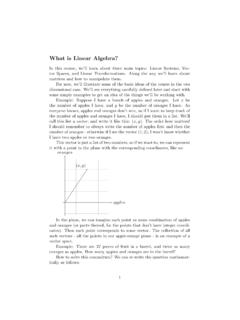
What is Linear Algebra? - University of California, …
www.math.ucdavis.eduWhat is Linear Algebra? In this course, we’ll learn about three main topics: Linear Systems, Vec-tor Spaces, and Linear Transformations. Along the way we’ll learn about
Twenty problems in probability - UC Davis …
www.math.ucdavis.eduTwenty problems in probability This section is a selection of famous probability puzzles, job interview questions (most high- tech companies ask their applicants math questions) and math competition problems.
Complex Analysis Lecture Notes - UC Davis Mathematics
www.math.ucdavis.edu\entropy"), and lots of applications to things that seem unrelated to complex numbers, for example: Solving cubic equations that have only real roots (historically, this was the
David Cherney, Tom Denton, Rohit Thomas and Andrew …
www.math.ucdavis.eduLinear algebra is the study of vectors and linear functions. In broad terms, vectors are things you can add and linear functions are functions of vectors that respect vector addition.
Power Series - UC Davis Mathematics :: Home
www.math.ucdavis.eduThe power series in Definition 6.1 is a formal expression, since we have not said anything about its convergence. By changing variables x→ ( x−c ), we can assume
LECTURE NOTES ON APPLIED MATHEMATICS
www.math.ucdavis.eduLECTURE 1 Introduction The source of all great mathematics is the special case, the con-crete example. It is frequent in mathematics that every instance

Math 22B, Homework #8 - UC Davis Mathematics
www.math.ucdavis.eduMath 22B, Homework #8 4 Plugging y p and its derivatives into the ODE we get u0 1 e t+ u0 2 = 2(1 t)e t (2) Putting (1) and (2) together we have et t et 1 u0 1 u0 2 = 0 2(1 tt)e Inverting gives u0 1 u0 2 = 2te 2t 2e t Thus, after integrating, we get
Related documents

The Geometry of Linear Equations - MIT OpenCourseWare
ocw.mit.eduThe geometry of linear equations The fundamental problem of linear algebra is to solve n linear equations in n unknowns; for example: 2x − y = 0 −x + 2y = 3. In this first lecture on linear algebra we view this problem in three ways. The system above is two dimensional (n = 2). By adding a third variable z
Matrix Theory and LINEAR ALGEBRA - Dalhousie University
www.mathstat.dal.caMatrix Theory and Linear Algebra is an introduction to linear algebra for students in the first or second year of university. The book contains enough material for a 2-semester course.

Linear Algebra Abridged
linear.axler.netLinear algebra is the study of linear maps on finite-dimensional vector spaces. Eventually we will learn what all these terms mean. In this chapter we will define vector spaces and discuss their elementary properties. In linear algebra, better theorems and more insight emerge if complex numbers are investigated along with real numbers.

Linear Maps - University of California, Davis
www.math.ucdavis.eduThe linear map T : P(F) → P(F) given by T(p(z)) = z2p(z) is injective since nullT = {0}. 3 RANGES 5 3 Ranges Definition 4. Let T : V → W be a linear map. The range of T, denoted by rangeT, is the subset of vectors of W that are in the image of T

Tutorial on Linear Algebra - Massachusetts Institute of ...
cbmm.mit.eduLinear Algebra When is a matrix invertible In general, for an inverse matrix −1to exist, has to be square and its’ columns have to form a linearly independent set of vectors –no column can be a linear combination of the others. A necessary and sufficient condition is that det ≠0.

2 Laboratory Manual for Linear Electronics
www2.mvcc.eduLaboratory Manual 5for Linear Electronics Introduction This manual is intended for use in a linear semiconductor devices course and is appropriate for two and four year electrical engineering technology curriculums. The manual contains sufficient exercises for a typical 15 week course using a two to three hour practicum period.

7 - Linear Transformations
www.ms.uky.eduIn linear algebra we call these functions or maps linear transformations. Definition Let V and W be vector spaces over the real numbers. Suppose that T is a function from V to W, T:V 6 W. T is linear (or a linear transformation) provided that T preserves vector addition

4.5 Linear Dependence and Linear Independence
www.math.purdue.eduthe linear span of these three vectors is the whole of this plane. Furthermore, the same plane is generated if we consider the linear span of v1 and v2 alone. As in the previous example, the reason that v3 does not add any new vectors to the linear span of {v1,v2} is that it is already a linear combination of v1 and v2. It is not possible ...
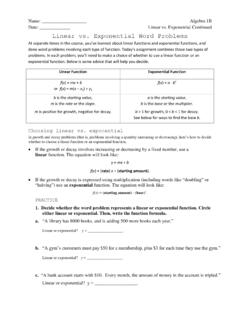
Name: Algebra 1B Date: Linear vs. Exponential Continued ...
www.mayfieldschools.orgChoosing linear vs. exponential ,QJURZWKDQGGHFD\SUREOHPV WKDWLV SUREOHPVLQYROYLQJDTXDQWLW \LQFUHDVLQJRUGHFUHDVLQJ KHUH¶VKRZWRGHFLGH whether to choose a linear function or an exponential function. x If the growth or decay involves increasing or decreasing by a fixed number, use a linear function. …