
Linear Equations in Two Variables
has slope 8 7. The second equation in this system, 3x5y =3,isrepresented by a line that has slope 3 5 = 3 5. Since the two slopes are not equal, the lines have to intersect in exactly one point. That one point will be the unique solution. As we’ve seen before, x =3andy =2isasolutionofthissystem. It is the unique solution. Example. The system ...
Download Linear Equations in Two Variables

Information
Domain:
Source:
Link to this page:
Documents from same domain
Systems of Differential Equations - Math
www.math.utah.edu522 Systems of Differential Equations Let x1(t), x2(t), x3(t) denote the amount of salt at time t in each tank. We suppose added to tank A water containing no salt. Therefore, the salt in all the tanks is eventually lost from the drains.
Laplace Transform - Home - Math
www.math.utah.eduLaplace Transform The Laplace transform can be used to solve di erential equations. Be-sides being a di erent and e cient alternative to variation of parame-ters and undetermined coe cients, the Laplace method is particularly advantageous for input terms that are piecewise-de ned, periodic or im-
Vector Calculus - Math
www.math.utah.eduCHAPTER 18 Vector Calculus In this chapter we develop the fundamental theorem of the Calculus in two and three dimensions. This begins with a slight reinterpretation of that theorem.
Second Order Linear Differential Equations
www.math.utah.edu12.2 Behavior of the Solutions 179 Example 12.6 Find the solution y y x of y 2y 5y 0, with the initial values y 0 2 y 0 1. The auxiliary equation r2 2r 5 0 has the solutions r
Second Order Linear Differential Equations - Math
www.math.utah.eduSecond Order Linear Differential Equations 12.1. Homogeneous Equations A differential equation is a relation involvingvariables x y y y . A solution is a function f x such that the substitution y f x y f x y f x gives an identity. The differential equation is

Quadratic Equations By Factoring - Math
www.math.utah.eduSolving Quadratic Equations By Factoring Date_____ Period____ Solve each equation by factoring. 1) (3 n − 2)(4n ... If a quadratic equation cannot be factored then it will have at least one imaginary solution. False (Example, x2 = 10 )-2-Title: Quadratic Equations By Factoring

Magic Squares and Modular Arithmetic - Math
www.math.utah.eduIntroductory problems 1. Find a magic square of order three whose first row is 0 8 4 2. Find a magic square of order three whose first row is 1 8 3

Multivariable Mathematics with Maple
www.math.utah.eduMultivariable Mathematics with Maple Linear Algebra, Vector Calculus and Difierential Equations by James A. Carlson and Jennifer M. Johnson °c 1996 Prentice-Hall

LECTURE NOTES ON DONSKER’S THEOREM - Math
www.math.utah.eduLECTURE NOTES ON DONSKER’S THEOREM DAVARKHOSHNEVISAN ABSTRACT.Some course notes on Donsker’s theorem. These are for Math7880-1(“TopicsinProbability”),taughtattheDeparmentofMath-

9.3 Geometric Sequences and Series - math.utah.edu
www.math.utah.edu9.3 Geometric Sequences and Series In sections 9.3 you will learn to: • Recognize, write and find the nth terms of geometric sequences. ... • Use geometric sequences to model and solve real-life problems. A sequence a 1, a 2, a 3, ... ,a n is said to be geometric is the ratio between consecutive terms remains constant.
Related documents
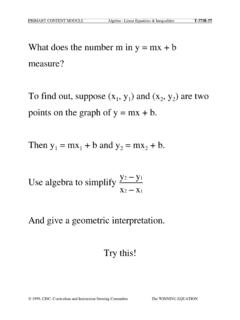
PRIMARY CONTENT MODULE Algebra - Linear Equations ...
www.csun.eduPoint-Slope Formula The equation of the line of slope, m, whose graph contains the point (x 1, y1) is y – y 1 = m(x –x 1) Example: Find the equation of the line whose graph contains the point (2,3) and whose slope is 4. y – 3 = 4(x – 2) y – 3 = 4x – 8 y = 4x – 5
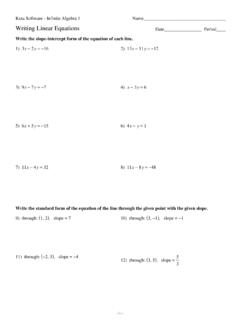
Writing Linear Equations
cdn.kutasoftware.comB Worksheet by Kuta Software LLC Kuta Software - Infinite Algebra 1 Name_____ Writing Linear Equations Date_____ Period____ Write the slope-intercept form of the equation of each line. ... Write the point-slope form of the equation of the line described. 17) through: (4, 2), parallel to y = ...
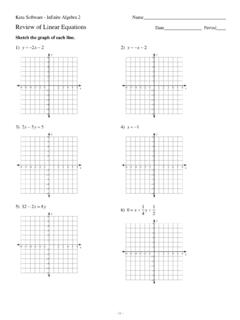
Review Linear Equations.ks-ia2
cdn.kutasoftware.comWrite the standard form of the equation of the line through the given point with the given slope. 15) through: ( , ), slope = x y 16) through: ( , ), slope = x y Write the standard form of the equation of the line through the given points.

Chapter 2 Resource Masters - KTL MATH CLASSES
ktlmathclass.weebly.com©Glencoe/McGraw-Hill iv Glencoe Algebra 2 Teacher’s Guide to Using the Chapter 2 Resource Masters The Fast FileChapter Resource system allows you to conveniently file the resources you use most often. The Chapter 2 Resource Mastersincludes the core materials needed for Chapter 2. These materials include worksheets, extensions, and assessment options.

Algebra I Point-Slope Form Worksheet
spot.pcc.eduAlgebra I Point-Slope Form Worksheet Give an equation in point-slope form that satisfies the given information. 1. Passes through (2, 3) and has slope of –½ . 2. Passes through (-1, 4) and m = 4. 3. Passes through (0, 2) and has slope of –5/3. 4. Passes through (4, -2) and m = 0. 5. Passes through (-4, 6) and (-2, 5) 6.

Parallel and Perpendicular lines
www.dunkerton.k12.ia.usSince ( -1 - (-1) ) = 0 and the division by 0 is not defined, the slope of the line is undefined and the line is vertical. (parallel to the y axis). Solution to Q5: In what follows, m1 is the slope of line L1 and m2 is the slope of line L2. a. Find the slope m1 of line L1 and the slope m2 of line L1 m1 = ( 1 - 2 ) / ( 3 - 1 ) = -1 / 2