Linear Transformation Exercises
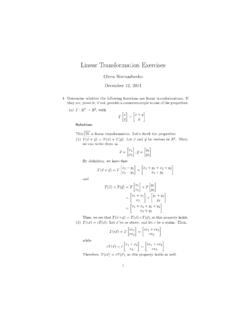
Linear Transformation Exercises Olena Bormashenko December 12, 2011 1. Determine whether the following functions are linear transformations. If they are, prove it; if not, provide a counterexample to one of the properties: (a) T : R2!R2, with T x y = x+ y y Solution: This IS a linear transformation. Let’s check the properties:
Download Linear Transformation Exercises

Information
Domain:
Source:
Link to this page:
Documents from same domain
Introduction to Stochastic Processes - Lecture Notes
web.ma.utexas.eduIntroduction to Stochastic Processes - Lecture Notes (with 33 illustrations) Gordan Žitković Department of Mathematics The University of Texas at Austin
M383C: Methods of Applied Mathematics - web.ma.utexas.edu
web.ma.utexas.eduMethods of Applied Mathematics Arun Debray December 12, 2015 Source: ... The professor is an applied mathematician, doing numerical analysis, and more specifically, approximation of differential equations. Functional analysis is useful for that, but also plenty of other
Methods of Applied Mathematics
web.ma.utexas.eduMethods of Applied Mathematics Todd Arbogast and Jerry L. Bona Department of Mathematics, and Institute for Computational Engineering and Sciences The University of Texas at Austin ... In applying mathematics, real phenomena or objects are conceptualized as abstract mathematical objects. Collections of such objects are called sets.
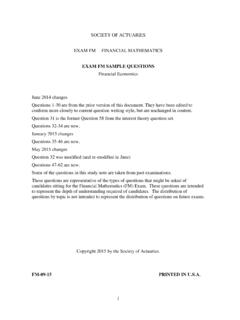
EXAM FM SAMPLE QUESTIONS - web.ma.utexas.edu
web.ma.utexas.eduEXAM FM SAMPLE QUESTIONS Financial Economics June 2014 changes Questions 1-30 are from the prior version of this document. They have been edited to conform more closely to current question writing style, but are unchanged in content. Question 31 is the former Question 58 …

Introduction to Real Analysis M361K - web.ma.utexas.edu
web.ma.utexas.eduIntroduction to Real Analysis M361K. Preface These notes are for the basic real analysis class. (The more advanced class is M365C.) They were writtten, used, revised and revised again and again over the past five years. The course has been taught 12 times by eight different instructors. Contributors to
Introduction to Real Analysis M361K - web.ma.utexas.edu
web.ma.utexas.eduCHAPTER 1 Introduction 1. Goals The purpose of this course is three-fold: (1) to provide an introduction to the basic definitions and theo-rems of calculus and real analysis.
Introduction to Exotic Options. Asian Options.
web.ma.utexas.eduIntroduction to Exotic Options. Asian Options. 1 Introduction to Exotic Options 2 Asian Options. De nition ... in convertible bonds as it is based on the stock price over a 20-day period at the end of the bonds life Asian options are less valuable than otherwise identical ordinary options.
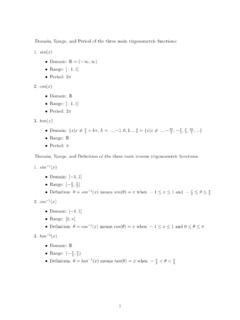
Domain, Range, and Period of the three main trigonometric ...
web.ma.utexas.eduor subtract the period until I get an angle that is in the range of tan 1(x). For Sin and Cos, I add or subtract 2ˇbecause that is their period. For Tan, I add or subtract ˇ, the period of tan(x). ... Created Date: 4/10/2009 7:51:06 AM ...
Stochastic partial di⁄erential equations and portfolio choice
web.ma.utexas.eduStochastic partial di⁄erential equations and portfolio choice Marek Musielayand Thaleia Zariphopoulouz Dedicated to Eckhard Platen on the occasion of his 60th birthday December 13, 2009 Abstract We introduce a stochastic partial di⁄erential equation which describes
Stochastic partial di⁄erential equations and portfolio choice
web.ma.utexas.eduStochastic partial di⁄erential equations and portfolio choice M. Musiela and T. Zariphopoulouy BNP Paribas, London and the University of Texas at Austin
Related documents
21. Orthonormal Bases
www.math.ucdavis.eduThen as a linear transformation, P i w iw T i = I n xes every vector, and thus must be the identity I n. De nition A matrix Pis orthogonal if P 1 = PT. Then to summarize, Theorem. A change of basis matrix P relating two orthonormal bases is an orthogonal matrix. i.e. P 1 = PT: Example Consider R3 with the orthonormal basis S= 8 >> < >>: u 1 = 0 ...
5.3 ORTHOGONAL TRANSFORMATIONS AND ORTHOGONAL …
staff.csie.ncu.edu.twA linear transformation T from Rn to Rn is called orthogonal if it preserves the length of vectors: kT(~x)k = k~xk, for all ~x in Rn. If T(~x) = A~x is an orthogonal transformation, we say that A is an orthogonal matrix. 1
Linear Algebra Problems - Penn Math
www2.math.upenn.edug) The linear transformation T A: Rn!Rn de ned by Ais onto. h) The rank of Ais n. i) The adjoint, A, is invertible. j) detA6= 0. 14. Call a subset S of a vector space V a spanning set if Span(S) = V. Suppose that T: V !W is a linear map of vector spaces. a) Prove that a linear map T is 1-1 if and only if T sends linearly independent sets