Linear Transformations - Stanford University
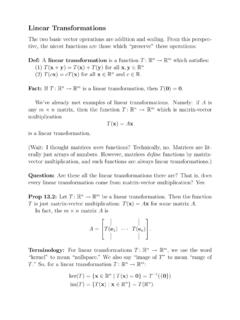
Linear Transformations The two basic vector operations are addition and scaling. From this perspec-tive, the nicest functions are those which \preserve" these operations: Def: A linear transformation is a function T: Rn!Rm which satis es: (1) T(x+ y) = T(x) + T(y) for all x;y 2Rn (2) T(cx) = cT(x) for all x 2Rn and c2R.
Download Linear Transformations - Stanford University

Information
Domain:
Source:
Link to this page:
Documents from same domain

SPECTRAL SEQUENCES: FRIEND OR FOE? - Stanford University
math.stanford.eduSPECTRAL SEQUENCES: FRIEND OR FOE? RAVI VAKIL Spectral sequences are a powerful book-keeping tool for proving things involving com-plicated commutative diagrams. They were introduced by Leray in the 1940’s at the same time as he introduced sheaves. They have a …

Outline of Galois Theory Development - Stanford University
math.stanford.edu10. De ne E=Fto be a Galois extension if and only if Eis separable AND normal over F. (This is the ’right’ de nition, because the conditions separable and normal are easily understood in terms of individual
Math 110 Problem Set 2 Solutions - Stanford University
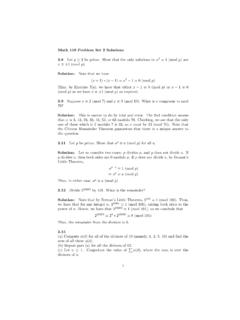
math.stanford.eduMath 110 Problem Set 2 Solutions ... the Chinese Remainder Theorem guarantees that there is a unique answer to the question. 3.11 Let p be prime. Show that ap · a (mod p) for all a. Solution: Let us consider two cases: p divides a, and p does not divide a. If p divides a, then both sides are 0 modulo p.
Laplace Transform: Examples - Stanford University
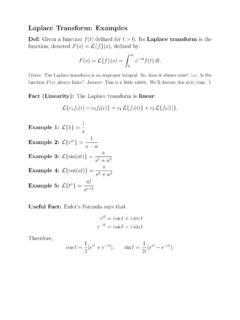
math.stanford.eduLaplace Transform: Existence Recall: Given a function f(t) de ned for t>0. Its Laplace transform is the function de ned by: F(s) = Lffg(s) = Z 1 0 e stf(t)dt: Issue: The Laplace transform …
Math 210C. Clifford algebras and spin groups
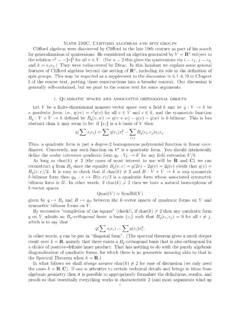
math.stanford.eduClifford algebras For our initial construction of the Cli ord algebra associated to (V;q) we make no non-degeneracy hypothesis; the best properties occur only when (V;q) is non-degenerate, but for the purpose of some early examples the case q= 0 (with V 6= 0!) is worth keeping in mind.

Homework 3 Solutions - Stanford University
math.stanford.eduHomework 3 Solutions Math 171, Spring 2010 Please send corrections to henrya@math.stanford.edu 17.4. Let fa ngbe a sequence with positive terms such that lim n!1a n= L>0.Let xbe a real number. Prove that lim n!1a x= Lx. Solution.
THE RISING SEA Foundations of Algebraic Geometry
math.stanford.eduTHE RISING SEA Foundations of Algebraic Geometry math216.wordpress.com November 18, 2017 draft ⃝c 2010–2017 by Ravi Vakil. Note to reader: the index and formatting have yet to be properly dealt with.

The Topology of Fiber Bundles Lecture Notes
math.stanford.edumatics. A fiber bundle with base space Band fiber F can be viewed as a parameterized family of objects, each “isomorphic” to F, where the family is parameterized by points in B. For example a vector bundle over a space Bis a parameterized …

1. Math 113 Homework 3 Solutions
math.stanford.edu1. Math 113 Homework 3 Solutions By Guanyang Wang, with edits by Prof. Church. Exercises from the book. Exercise 3B.2 Suppose V is a vector space and S;T2L(V;V) are such that
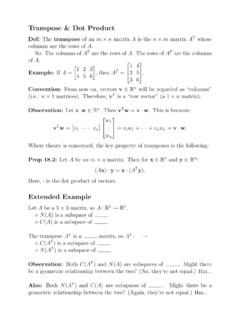
Transpose & Dot Product - Stanford University
math.stanford.eduDef: Let Q: Rn!R be a quadratic form. We say Qis positive de nite if Q(x) >0 for all x 6= 0. We say Qis negative de nite if Q(x) <0 for all x 6= 0. We say Qis inde nite if there are vectors x for which Q(x) >0, and also vectors x for which Q(x) <0. Def: Let Abe a symmetric matrix. We say Ais positive de nite if Q A(x) = xTAx >0 for all x 6= 0.
Related documents
Schaum's Outline of Linear Algebra
www.astronomia.edu.uyLinear Combinations, Spanning Sets 4.5 Subspaces 4.6 Linear Spans, Row Space of a Matrix 4.7 Linear Dependence and Independence 4.8 Basis and Dimension 4.9 Application to Matrices, Rank of a Matrix 4.10 Sums and Direct Sums 4.11 Coordinates CHAPTER 5 Linear Mappings 164 5.1 Introduction 5.2 Mappings, Functions 5.3 Linear Mappings (Linear
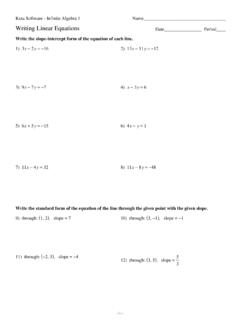
Writing Linear Equations
cdn.kutasoftware.comWriting Linear Equations Date_____ Period____ Write the slope-intercept form of the equation of each line. 1) 3 x − 2y = −16 2) 13 x − 11 y = −12 3) 9x − 7y = −7 4) x − 3y = 6 5) 6x + 5y = −15 6) 4x − y = 1 7) 11 x − 4y = 32 8) 11 x − 8y = −48
ELEMENTARY DIFFERENTIAL EQUATIONS WITH BOUNDARY …
ramanujan.math.trinity.eduFunctions 430 8.6 Convolution 440 8.7 Constant Cofficient Equationswith Impulses 452 8.8 A Brief Table of Laplace Transforms Chapter 9 Linear Higher Order Equations 9.1 Introduction to Linear Higher Order Equations 465 9.2 Higher Order Constant Coefficient Homogeneous Equations 475 9.3 Undetermined Coefficients for Higher Order Equations 487
Linear Algebra Review and Reference - Stanford University
cs229.stanford.eduJun 20, 2020 · Linear algebra provides a way of compactly representing and operating on sets of linear equations. For example, consider the following system of equations: 4x 1 5x 2 = 13 2x 1 + 3x 2 = 9: This is two equations and two variables, so as you know from high school algebra, you can nd a unique solution for x 1 and x 2 (unless the equations are ...
INTRODUCTION TO THE SPECIAL FUNCTIONS OF …
www.physics.wm.eduA simple first order linear differential equation 29 ... Modified Bessel functions of the second kind 190 ... The course begins with review of infinite series and complex analysis, then covers Gamma and Elliptic functions in some de-tail, before turning to the main theme of …

Review of Likelihood Theory - Princeton University
data.princeton.eduReview of Likelihood Theory This is a brief summary of some of the key results we need from likelihood theory. A.1 Maximum Likelihood Estimation Let Y 1,...,Y n be n independent random variables (r.v.’s) with probability density functions (pdf) f i(y i;θ) depending on a vector-valued parameter θ. A.1.1 The Log-likelihood Function
CHAPTER 6 Power Series Solutions to Second Order Linear …
math.wvu.eduLINEAR ORDINARY DIFFERENTIAL EQUATIONS (ODE"s) CHAPTER 6 Power Series Solutions to Second Order Linear ODE’s 1. Review of Linear Theory and Motivation for Using Power Series 2. Functions Defined by Power Series 3. The Interval of Convergence of a Power Series 4. Taylor and MaClaurin Series 5. Power Series Solution of Second Order Linear ODE’s
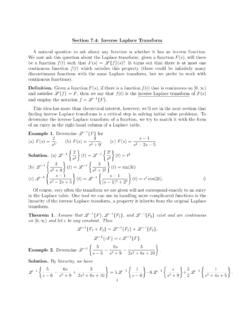
Section 7.4: Inverse Laplace Transform - University of Florida
people.clas.ufl.eduReview of Partial Fractions A rational function P(s)=Q(s), where P(s);Q(s) are polynomials with the degree of P less than the degree of Q, has a partial fraction expansion based on the factorization of Q. There are three main cases to consider, the easiest being that of nonrepeated linear factors. If Q(s) is a product of distinct linear factors,

LINEAR FIRST ORDER Ordinary Differential Equations
web.iit.edua review of the direct method to solve linear first-order differential equations, jump ahead to the direct method on slide 14. The Property ... the obtained functions will be solutions of the associated homogenous equation of the original differential equation; and

Chapter 4 Equations of Linear Functions - Commack Schools
www.commackschools.orgEquations of Linear Functions Before you begin Chapter 4 • Read each statement. • Decide whether you Agree (A) or Disagree (D) with the statement. • Write A or D in the first column OR if you are not sure whether you agree or disagree, write NS (Not Sure). After you complete Chapter 4