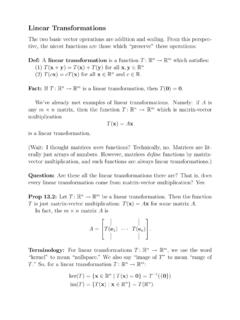
Linear Transformations - Stanford University
Two Examples of Linear Transformations (1) Diagonal Matrices: A diagonal matrix is a matrix of the form D= 2 6 6 6 4 d 1 0 0 0 d 2 0. .. 0 0 0 d n 3 7 7 7 5: The linear transformation de ned by Dhas the following e ect: Vectors are...
Download Linear Transformations - Stanford University

Information
Domain:
Source:
Link to this page:
Documents from same domain

SPECTRAL SEQUENCES: FRIEND OR FOE? - Stanford University
math.stanford.eduSPECTRAL SEQUENCES: FRIEND OR FOE? RAVI VAKIL Spectral sequences are a powerful book-keeping tool for proving things involving com-plicated commutative diagrams. They were introduced by Leray in the 1940’s at the same time as he introduced sheaves. They have a …

Outline of Galois Theory Development - Stanford University
math.stanford.edu10. De ne E=Fto be a Galois extension if and only if Eis separable AND normal over F. (This is the ’right’ de nition, because the conditions separable and normal are easily understood in terms of individual
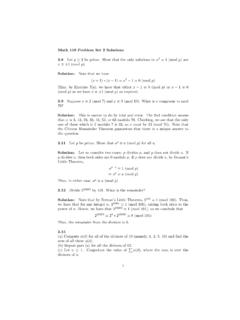
Math 110 Problem Set 2 Solutions - Stanford University
math.stanford.eduMath 110 Problem Set 2 Solutions ... the Chinese Remainder Theorem guarantees that there is a unique answer to the question. 3.11 Let p be prime. Show that ap · a (mod p) for all a. Solution: Let us consider two cases: p divides a, and p does not divide a. If p divides a, then both sides are 0 modulo p.
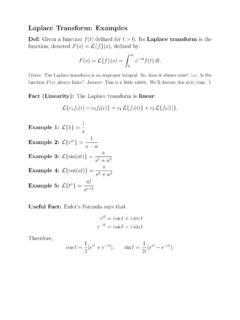
Laplace Transform: Examples - Stanford University
math.stanford.eduLaplace Transform: Existence Recall: Given a function f(t) de ned for t>0. Its Laplace transform is the function de ned by: F(s) = Lffg(s) = Z 1 0 e stf(t)dt: Issue: The Laplace transform …
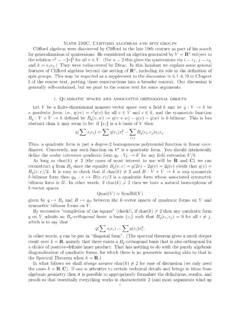
Math 210C. Clifford algebras and spin groups
math.stanford.eduClifford algebras For our initial construction of the Cli ord algebra associated to (V;q) we make no non-degeneracy hypothesis; the best properties occur only when (V;q) is non-degenerate, but for the purpose of some early examples the case q= 0 (with V 6= 0!) is worth keeping in mind.

Homework 3 Solutions - Stanford University
math.stanford.eduHomework 3 Solutions Math 171, Spring 2010 Please send corrections to henrya@math.stanford.edu 17.4. Let fa ngbe a sequence with positive terms such that lim n!1a n= L>0.Let xbe a real number. Prove that lim n!1a x= Lx. Solution.
THE RISING SEA Foundations of Algebraic Geometry
math.stanford.eduTHE RISING SEA Foundations of Algebraic Geometry math216.wordpress.com November 18, 2017 draft ⃝c 2010–2017 by Ravi Vakil. Note to reader: the index and formatting have yet to be properly dealt with.

The Topology of Fiber Bundles Lecture Notes
math.stanford.edumatics. A fiber bundle with base space Band fiber F can be viewed as a parameterized family of objects, each “isomorphic” to F, where the family is parameterized by points in B. For example a vector bundle over a space Bis a parameterized …

1. Math 113 Homework 3 Solutions
math.stanford.edu1. Math 113 Homework 3 Solutions By Guanyang Wang, with edits by Prof. Church. Exercises from the book. Exercise 3B.2 Suppose V is a vector space and S;T2L(V;V) are such that
Transpose & Dot Product - Stanford University
math.stanford.eduDef: Let Q: Rn!R be a quadratic form. We say Qis positive de nite if Q(x) >0 for all x 6= 0. We say Qis negative de nite if Q(x) <0 for all x 6= 0. We say Qis inde nite if there are vectors x for which Q(x) >0, and also vectors x for which Q(x) <0. Def: Let Abe a symmetric matrix. We say Ais positive de nite if Q A(x) = xTAx >0 for all x 6= 0.
Related documents
Lesson 5.2: Transformations of Sinusoidal Functions (Sine ...
holyspiritmath3200.weebly.comLesson 5.2 Transformations of sine and cosine function 6 Think about the equations: Since the function is periodic, there are several equations that can correspond to a given graph where the phase shift is different. The value that is chosen for the …
Transformations of Linear Functions - MR. JONES
cjonesmath.weebly.comThe graph of g(x) = (x + 12) is a translation of the graph of the parent function 12 units . Example 3 Multiple Translations of Linear Functions Describe the translation in g(x) = (x - 6) + 3 as it relates to the graph of the parent function. Graph the parent graph for linear functions. Since f(x) = 0x, where and . g(x) = (x - 6) + 3 →

Chapter 9: Transformations
www.west-jefferson.k12.oh.usChapter 9 Transformations 461 Transformations Make this Foldable to help you organize the types of transformations. Begin with one sheet of notebook paper. Label each tab with a vocabulary word from this chapter. reflection translation rotation dilation Cut the flap on every third line. Fold a sheet of notebook paper in half lengthwise.

Graphing Standard Function & Transformations
tutoring.asu.eduThe graph of y = f (-x) is the graph of y = f (x) reflected about the y-axis. Here is a picture of the graph of g(x) =(0.5x)3+1. It is obtained from the graph of f(x) = 0.5x3+1 by reflecting it in the y-axis. Summary of Transformations To graph Draw the graph of f and: Changes in the equation of y = f(x) Vertical Shifts y = f (x) + c

Graph the image of the figure using the transformation given.
cdn.kutasoftware.comAll Transformations Date_____ Period____ Graph the image of the figure using the transformation given. 1) rotation 90° counterclockwise about the origin x y J Z L 2) translation: 4 units right and 1 unit down x y Y F G 3) translation: 1 unit right and 1 unit up x y E J T M 4) reflection across the x-axis x y M C J K

Graph Transformations - University of Utah
www.math.utah.eduTransformations “after” the original function Suppose you know what the graph of a function f(x) looks like. Suppose d 2 R is some number that is greater than 0, and you are asked to graph the function f(x)+d. The graph of the new function is easy to describe: just take every point in the graph of f(x), and move it up a distance of d. That

Transformations of Exponential Functions - MRS. POWER
mrsspower.weebly.comComplete the table of values to show what happens to the given points under the transformations Sketch the graph of the base function and the transformed function. a. Describe the effects on the domain, range, equation of the horizontal asymptote, and intercepts Complete each table of values and sketch the graph of the function 1 3 4 3

Transformations of Functions - Alamo Colleges District
www.alamo.eduTransformations of Functions . An alternative way to graphing a function by plotting individual points is to perform transformations to the graph of a function you already know. Library Functions: In previous sections, we learned the graphs of some basic functions. Collectively, these are known as the graphs of the . library functions.