Local Exhaust Ventilation Testing Protocols
NIH, ORS, Division of Occupational Health and Safety June 2011 Local Exhaust Ventilation Testing Protocols 2 Downdraft sinks that meet the performance testing criteria identified in part II of the test are considered to
Download Local Exhaust Ventilation Testing Protocols

Information
Domain:
Source:
Link to this page:
Documents from same domain
HVAC Duct Cleaning - National Institutes of Health
ors.od.nih.govDivision of Occupational Health and Safety . The dirty filter/vent above indicate a cleaning is needed and should be performed by a professional . DOHS Fact Sheet on . HVAC Duct Cleaning . National Institutes of Health • Office of Research Services (ORS) • Division of Occupational Health and Safety (DOHS) • Technical Assistance Branch (TAB)
Contractor Health and Safety Requirements
ors.od.nih.gova. Contractor Safety Program Assessment: The NIH is committed to providing a safe environment for its employees, guests, and patients. Safety, as demonstrated during previous contracts, may be used in the past performance evaluation of a Contractor. Contractors are required to enroll in the Contractor Safety Assessment Program (CSAP).
Guidance for the Selection of Laboratory Coats
ors.od.nih.govThis reference document provides a general overview for selection of laboratory coats. It does not alter or determine compliance responsibilities in OSHA standards or NIH’s Manual Chapter 1340. Because interpretations and policy may change over time, you should your consult with your Institute's Safety and Health Specialist.
Protocol for Use and Maintenance of Oxygen Monitoring …
ors.od.nih.govdisplacement of oxygen. At a minimum, the following factors should be used in determining if a device should be installed: manufacturer (e.g., magnet) guidance, volume of gas used, location of gas, and air changes/hour in the room/area. The 2008 NIH DRM notes that both ‘carbon dioxide manifold rooms…
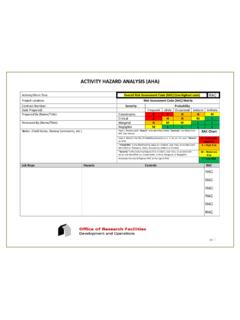
ACTIVITY HAZARD ANALYSIS (AHA)
ors.od.nih.govACTIVITY HAZARD ANALYSIS (AHA) Activity/Work Task: Overall Risk Assessment Code (RAC) (Use highest code) Project Location: Risk Assessment Code (RAC) Matrix . ... " is the likelihood to cause an incident, near miss, or accident and identified as: Frequent, Likely, Occasional, Seldom or Unlikely . H = High Risk "
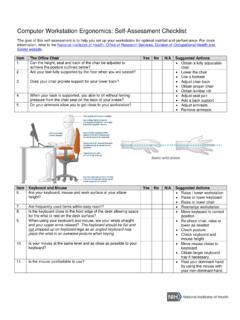
Computer Workstation Ergonomics: Self-Assessment Checklist
ors.od.nih.govSelf Assessment Computer Workstation Ergonomics: Self-Assessment Checklist . The goal of this self-assessment is to help you set up your workstation for optimal comfort and performance. For more information, refer to the . National Institutes of Health, Office of Research Services, Division of Occupational Health and Safety website.
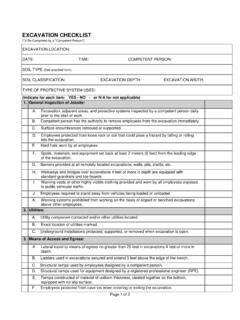
EXCAVATION CHK LST
ors.od.nih.govinto the excavation. rolling E. Hard hats worn by all employees. F. Spoils, materials, and equipment set back at least of the excavation. 2 meters (6 feet) from the leading edge G. Barriers provided at all remotely located excavations, wells, pits, shafts, etc. H. Walkways and bridges over excavations 4 feet or more in depth are equipped
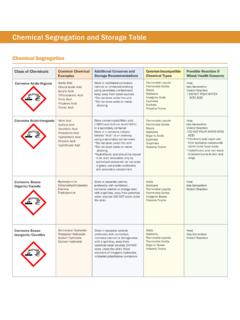
Chemical Segregation Table
ors.od.nih.govChemical Segregation. Common Chemical Additional Concerns and Common Incompatible Possible Reaction if Examples Storage Recommendations Chemicals Types Mixed/Health Concerns . Class of Chemicals . Flammable Liquids . Ethanol, Ethyl Acetate, Methanol, Acetone, Benzene, Xylene, Toluene Diethyl Ether Tetrahydrofuran Acetonitrile Glacial Acetic Acid
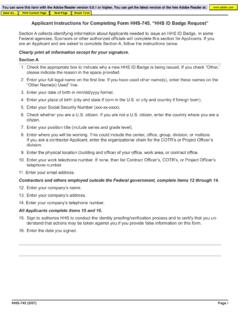
Applicant Instructions for Completing Form HHS-745, “HHS ...
ors.od.nih.govApplicant Instructions for Completing Form HHS-745, “HHS ID Badge Request” Section A collects identifying information about Applicants needed to issue an HHS ID Badge. In some Federal agencies, Sponsors or other authorized offi cials will complete this section for Applicants. If …
NIH Chemical Hygiene Plan
ors.od.nih.govBSC Biological Safety Cabinets CFH Chemical Fume Hood CFR Code of Federal Regulations CHO Chemical Hygiene Officer ... eyes, or mucus membranes. Physical hazards include, but are not limited to, chemicals which are explosive, flammable, or corrosive. (Definition listed in . Appendix F “Glossary of Terms.”) III.
Related documents

Third edition - WHO
www.who.intBiosafety level designations are based on a composite of the design features, construction, containment facilities, equipment, practices and operational procedures required for working with agents from the various risk groups. Table 2 relates but
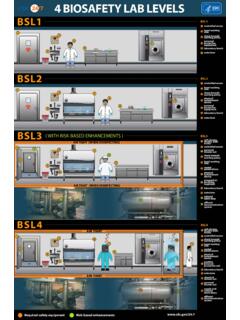
Biosafety | CDC
www.cdc.govBIOSAFETY LAB LEVELS sf.RVICEs. BSLI controlled access hatd washing sharA2 hazares war Ing po Icy personal protective equipment laboratory bench autoclave BSL2 controlled access washing sharp hazards warning policy physical containment device personal protective equipment laboratory bench autoclave BSI-3 access controlled access personal shower out

CARTAGENA PROTOCOL ON BIOSAFETY TO THE …
www.cbd.intan international legally binding instrument to address the issue of biosafety. At its second meeting, held in November 1995, the Conference of the Parties to the Convention established an Open-ended Ad Hoc Working Group on Biosafety to develop a draft protocol on biosafety, focusing specifically on transboundary
Biosafety in Microbiological and Biomedical Laboratories ...
www.cdc.goviv Biosafety in Microbiological and Biomedical Laboratories We hope you find the sixth edition of Biosafety in Microbiological and Biomedical Laboratories complete, timely, and most of all, easy to use. Thank you for your patience and understanding during the long and comprehensive revision process.
LABORATORY BIOSAFETY LEVEL 2 CRITERIA
sc.eduBiosafety in Microbiological and Biomedical Laboratories (BMBL) 6th Edition Section IV . Biosafety Level 2 Biosafety Level 2 (BSL-2) builds upon BSL-1. BSL-2 is suitable for work with agents associated with human disease and pose moderate hazards to personnel and the environment. BSL2 differs from BSL- -
Biosafety Level 3 (BSL-3) Laboratory Design Standards
www.ucop.eduthe UC Biosafety Level 3 Design Standards has incorporated input from several of these sources, including the following: • CDC Biosafety in Microbiological and Biomedical Laboratories (BMBL), 5th Edition, 2009 • NIH Design Requirements Manual for Biomedical Laboratories and Animal Research Facilities (DRM), 2019

Biosecurity and Biosafety - World Health Organization
www.who.intBiosafety and Biosecurity Background Biosafety Biosafety refers to “the containment principles, technologies and practices that are implemented to prevent unintentional exposure to pathogens and toxins, or their accidental release”.1 In the context of influenza research and the development and production of influenza products, ...