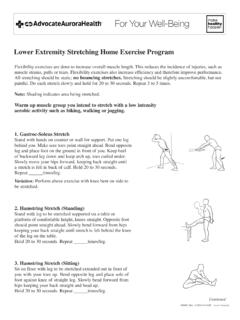
Lower Extremity Stretching Home Exercise Program
10. Quadriceps Stretch (Standing) Stand close to a wall or chair for support with the leg to be . stretched extended behind you. Knee of opposite leg slightly bent. Hold foot of leg to be stretched with your hand, gently pulling the heel toward the buttock until a stretch is felt in the front of the thigh. Do not allow back to arch. Hold 20 to ...
Download Lower Extremity Stretching Home Exercise Program

Information
Domain:
Source:
Link to this page:
Documents from same domain

Lower Extremity Strengthening Exercises in Supine
ahc.aurorahealthcare.orgLower Extremity Strengthening Exercises in Supine, Page 2 X19572bc (Rev. 04/10) ©AHC Lower Extremity The information presented is intended for general information and educational purposes.

Relaxation Exercises - Aurora Health Care
ahc.aurorahealthcare.orgX26017 (07/06) ©AHC Breathing/Relaxation Relaxation Exercises The information presented is intended for general information and educational purposes. It is not intended to replace the advice of your health care provider. Contact your health care provider if you believe you have a health problem.

Hip: Straight Leg Raise – Supine 4-Way - Aurora Health Care
ahc.aurorahealthcare.orgHip: Straight Leg Raise – Supine 4-Way Straight leg raise – flexion 1. Lie on your back. 2. Bend uninvolved knee and put foot on floor. 3. Slowly tighten the thigh muscle of the involved leg, performing a quad set. 4. Flex foot of involved leg toward nose. 5. Slowly lift entire leg 12 to 18 inches off floor.
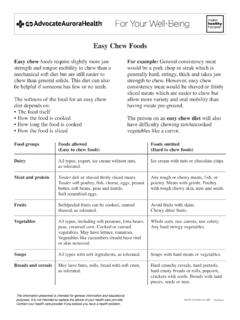
Easy Chew Foods - Aurora Health Care
ahc.aurorahealthcare.orgEasy Chew Foods. Easy chew foods require slightly more jaw strength and tongue mobility to chew than a mechanical soft diet but are still easier to chew than general solids. This diet can also be helpful if someone has few or no teeth. The softness of the food for an easy chew

“D (Rh) Type” and “D Variant” Antigen
ahc.aurorahealthcare.org“D (Rh) Type” and “D Variant” Antigen What is the D antigen? D antigen is a protein with many parts, found on the surface of red blood cells. The D antigen is also known as the “Rh factor” and it tells us your blood type. People are either D (Rh) negative or D (Rh) positive. If your blood type is D negative, your red

Vestibular Rehabilitation Exercises – Level 1
ahc.aurorahealthcare.orgVestibular Rehabilitation Exercises – Level 1, page 3 X20521 (Rev. 12/2019) ©AAHC Vertigo/Vestibular. The information presented is intended for general information and educational purposes. It is not intended to replace the advice of your health care provider. Contact your health care provider if you believe you have a health problem. 6.

Shoulder: Rotator Cuff Isometric Program – Standing
ahc.aurorahealthcare.orgX08252 (Rev. 11/2019) ©AAHC \OT Shoulder/Scapula Shoulder: Rotator Cuff Isometric Program – Standing. Isometric exercises are muscle tightening exercises performed with no joint movement. Their action is to increase circulation for healing and strengthening muscles with minimal joint irritation.
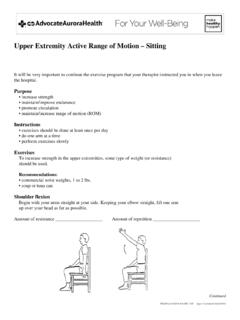
Upper Extremity Active Range of Motion – Sitting
ahc.aurorahealthcare.orgTo increase strength in the upper extremities, some type of weight (or resistance) should be used. Recommendations: • commercial wrist weights, 1 to 2 lbs. • soup or tuna can . Shoulder flexion Begin with your arms straight at your side. Keeping your elbow straight, lift one arm . up over your head as far as possible.
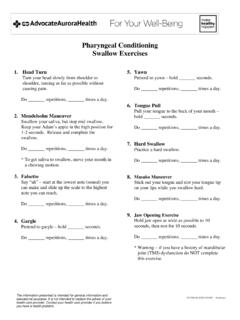
Pharyngeal Conditioning Swallow Exercises
ahc.aurorahealthcare.orgSwallow your saliva, but stop mid swallow. Keep your Adam’s apple in the high position for 1-2 seconds. Release and complete the swallow. Do _____ repetitions, _____ times a day. * To get saliva to swallow, move your mouth in a chewing motion. 3. Falsetto 8. Say “ah” – start at the lowest note (sound) you

Cervical Range of Motion and Isometrics Home Exercise …
ahc.aurorahealthcare.org3. Neck Flexion. Slowly bend your head forward, return to the starting position. Hold . Perform . seconds. Repeat times per day. times. 4. Neck Sidebending. Slowly tilt your head toward one shoulder, then slowly repeat . to the opposite side while keeping your face straight ahead. Hold . Perform . seconds. Repeat times per day. times. 5. Neck ...
Related documents

Glossary of commonly used Physical Therapy terms
www.alternatives4children.orgQuadriceps - A large muscle group on the anterior/front surface of the thigh responsible for knee extension Range of Motion - A measure of the amount of movement/motion available at any given joint of the body Recurvatum - A backward bending, frequently referring to the knees Reflex - An involuntary/automatic response to a stimulus

IACUC Policy for Dose Volumes in Laboratory Animals
research.iu.eduMay 23, 2017 · should be used. 6. No more than 2 IM sites should be used per day. In small rodents (mice, voles and hamsters) the IM route is not preferred because of the mouse’s small muscle mass and possibility of side effects, such as paresis, paralysis, muscle necrosis, localized muscle sloughing and self-biting of injected areas. 7.

MODULE THREE WELLNESS PLAN - Coach Matt Pryer 515-599 …
pryer-sva-hope.weebly.comshoulder stretches are e˚ective, but I don’t feel the muscle lengthening like when I do my legs. Finding a way to make arm and shoulder stretching more e˚ective is probably my biggest stretch challenge. I spend more time on legs, and that shows in my log.