
LS.6 Solution Matrices - MIT Mathematics
LS.6 Solution Matrices In the literature, solutions to linear systems often are expressed using square matrices rather than vectors. You need to get used to the terminology. As before, we state the definitions and results for a 2×2 system, but they generalize immediately to n×n systems. 1. Fundamental matrices. We return to the system (1) x ...
Download LS.6 Solution Matrices - MIT Mathematics

Information
Domain:
Source:
Link to this page:
Documents from same domain
Introduction to Linear Algebra, 5th Edition
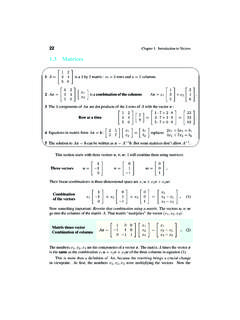
math.mit.edu1.3 Matrices 1 A = ... Linear Equations One more change in viewpoint is crucial. Up to now, the numbers x 1,x 2,x 3 were known. The right hand side b was not known. We found that vector of differences by multiplying A times x. Now we think of b as known and we look for x.
Eigenvalues and Eigenvectors
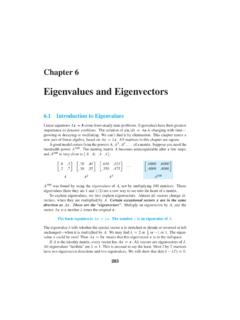
math.mit.eduSpecial properties of a matrix lead to special eigenvalues and eigenvectors. That is a major theme of this chapter (it is captured in a table at the very end). 286 Chapter 6.
Eigenvalues and Eigenvectors - MIT Mathematics
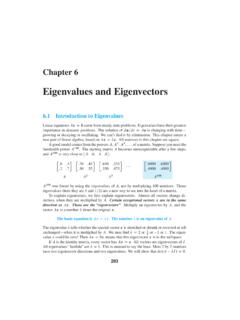
math.mit.edu6.1. Introduction to Eigenvalues 287 Eigenvalues The number is an eigenvalue of Aif and only if I is singular: det.A I/ D 0: (3) This “characteristic equation” det.A I/ D 0 involves only , not x. When A is n by n,
4 Cauchy’s integral formula - MIT Mathematics
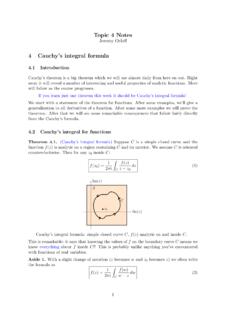
math.mit.edu4 Cauchy’s integral formula 4.1 Introduction ... 4 CAUCHY’S INTEGRAL FORMULA 4 4.3.1 Another approach to some basic examples Suppose Cis a simple closed curve around 0. We have seen that Z C 1 z ... Since an integral is basically a sum, this translates to the triangle inequality for integrals.
A FRIENDLY INTRODUCTION TO GROUP THEORY
math.mit.eduA FRIENDLY INTRODUCTION TO GROUP THEORY 3 A good way to check your understanding of the above de nitions is to make sure you understand why the following equation is correct: jhgij= o(g): (1) De nition 5: A group Gis called abelian (or commutative) if gh = hg for all g;h2G. A group is called cyclic if it is generated by a single element, that is,
4.3 Least Squares Approximations
math.mit.edu4.3. Least Squares Approximations 221 Figure 4.7: The projection p DAbx is closest to b,sobxminimizes E Dkb Axk2. In this section the situation is just the opposite. There are no solutions to Ax Db. Instead of splitting up x we are splitting up b. Figure 4.3 shows the big picture for least squares. Instead of Ax Db we solve Abx Dp.

Linear programming 1 Basics - MIT Mathematics
math.mit.edu2 subject to: 5x 1 + 7x 2 8 4x 1 + 2x 2 15 2x 1 + x 2 3 x 1 0;x 2 0: Some more terminology. A solution x= (x 1;x 2) is said to be feasible with respect to the above linear program if it satis es all the above constraints. The set of feasible solutions is called the feasible space or feasible region. A feasible solution is optimal if its ...
Square Roots via Newton’s Method
math.mit.eduSquare Roots via Newton’s Method S. G. Johnson, MIT Course 18.335 February 4, 2015 1 Overview ...
V7. Laplace’s Equation and Harmonic Functions
math.mit.eduA. Existence. Does there exist a φ(x,y) harmonic in some region containing Cand its interior R, and taking on the prescribed boundary values? B. Uniqueness. If it exists, is there only one such φ(x,y)? C. Solving. If there is a unique φ(x,y), determine it by some explicit formula, or approximate it by some numerical method.
The Limit of a Sequence - MIT Mathematics
math.mit.edu“obvious” using the definition of limit we started with in Chapter 1, but we are committed now and for the rest of the book to using the newer Definition 3.1 of limit, and therefore the theorem requires proof. Theorem 3.2B {an} increasing, L = liman ⇒ an ≤ L for all n; {an} decreasing, L = liman ⇒ an ≥ L for all n. Proof.
Related documents

Matrix Algebra and Applications - UTEP
math.utep.edu176 Chapter 3 Matrix Algebra and Applications quick Examples Matrix Addition and Subtraction Two matrices can be added (or subtracted) if and only if they have the same dimensions. To add (or subtract) two matrices of the same dimensions, we add (or subtract) the cor-responding entries. More formally, if A and B are m ×n matrices, then A + B and

Introduction to Matrix Analysis and Applications
math.bme.hufamous majorizations for matrices which have strong applications to matrix norm inequalities in symmetric norms. The last chapter contains topics related to quantum applications. Positive matrices with trace 1 are the states in quantum theories and they are also called density matrices. The relative entropy appeared in 1962 and the ma-

Linear Algebra, Theory And Applications
math.byu.eduPreface This is a book on linear algebra and matrix theory. While it is self contained, it will work best for those who have already had some exposure to linear algebra.
Lecture 28: Similar matrices and Jordan form
ocw.mit.eduSimilar matrices have the same eigenvalues! In fact, the matrices similar to A are all the 2 by 2 matrices with eigenvalues 3 7 1 7 3 and 1. Some other members of this family are 0 1 and 0 3 . To prove that similar matrices have the same eigenvalues, suppose Ax = λx. We modify this equation to include B = M−1 AM: AMM−1x = λx

Lecture 25: Symmetric matrices and positive definiteness
ocw.mit.eduk matrices in the upper left corner of A, where 1 ≤ k ≤ n), then A is positive definite. The subject of positive definite matrices brings together what we’ve learned about pivots, determinants and eigenvalues of square matrices. Soon we’ll have a chance to bring together what we’ve learned in this course and apply it

Linear Algebra and Its Applications
www.anandinstitute.orgmatrices. The eigenvalues of those matrices are special too. I think 2 by 2 matrices provide terrific examples of the information that eigenvalues l can give. Sections 5.1 and 5.2 are worth careful reading, to see how Ax = lx is useful. Here is a case in which small matrices allow tremendous insight.