<insert self-management goal> Quick Reference Guide
A1C ≤7.0% (or ≤6.5% to ˜ risk of CKD and retinopathy) If on insulin or insulin secretagogue, assess for hypoglycemia and ensure driving safety BB PŒtargets BP <130/80 mmHg If on treatment, assess for risk of falls C CholesterolŒtargets LDL-C <2.0 mmol/L (or >50 % reduction from baseline) DD rugs for CVDŒ risk reduction
Download <insert self-management goal> Quick Reference Guide

Information
Domain:
Source:
Link to this page:
Documents from same domain
Canadian Journal of Diabetes
guidelines.diabetes.caindependence is lost and/or life expectancy shortens, the benefit of lower glycemic targets is diminished and the risk of hypoglyce-mia increases (40–42).

DiabetesCanadaClinicalPracticeGuidelinesExpertCommittee ...
guidelines.diabetes.caType2DiabetesinChildrenandAdolescents,p.S247 DiabetesandPregnancy,p.S255 Relevant Appendices Appendix 5. Self-Monitoring of Blood Glucose (SMBG) RecommendationToolforHealth-CareProviders

ÉTAPE 1 - guidelines.diabetes.ca
guidelines.diabetes.caSuggestions pour l’amorçage et le titrage de l’insuline dans les cas de diabète de type 2 Les personnes qui commencent à prendre de l’insuline doivent être renseignées sur la prévention, la reconnaissance et le traitement de l’hypoglycémie.
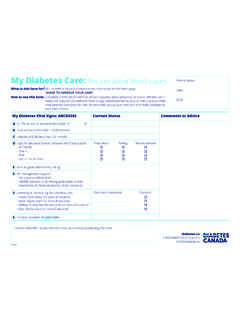
My Diabetes Care: Patient Name
guidelines.diabetes.caA1C The A1C is a blood test that will help you know whether your blood sugar has been at target over the past 3 months. A lower A1C will reduce your risk A lower A1C will reduce your risk of heart disease, stroke, kidney disease, eye problems, nerve damage, and foot problems.

High blood pressure and diabetes - guidelines.diabetes.ca
guidelines.diabetes.caWhy is controlling blood pressure important for people with diabetes? When blood pressure is high, it puts stress on the body. This can cause damage to the heart, brain, kidneys,
<insert self-management goal> Quick Reference Guide
guidelines.diabetes.caA1C <1.5% above target A1C ≥1.5% above target Symptomatic hyperglycemia and/or metabolic decompensation* Add additional antihyperglycemic agent best suited to the individual based on the following: Clinical Considerations Choice of Agent Avoidance of hypoglycemia and/or weight gain with adequate glycemic effi cacy

Pharmacologic Glycemic Management of Type 2 Diabetes in ...
guidelines.diabetes.ca2018 (1). New evidence has been published since the 2018 guide-lines, prompting this update to our recommendations for Chapter 13, “Pharmacologic Glycemic Management of Type 2 Diabetes in Adults” (1). What’s New in 2020 First, additional agents approved for use in Canada have been shown to have cardiovascular (CV) benefits in patients ...

Glycemic Index Food Guide - Diabetes Canada
guidelines.diabetes.caTry these meal planning ideas to lower meal GI: &RRN\RXUSDVWDDOGHQWH 4UP &KHFN\RXU pasta package instructions for cooking time. Make fruits and milk part of your meal plate (Figure 1). These foods often have a low GI and make a healthy dessert. Try lower GI grains, such as barley and bulgur. Pulses can be grains and starches or meat and
Glycemic Index Food Guide - Diabetes Canada
guidelines.diabetes.caThe glycemic index (GI) is a scale that ranks a carbohydrate-containing food or drink by how much it raises blood sugar levels after it is eaten or drank. Foods with a high GI increase blood sugar higher and faster than foods with a low GI. There are three GI categories:

Lows and highs: blood sugar levels - Diabetes Canada
guidelines.diabetes.caWhat is LOW blood sugar? When the amount of blood glucose (sugar in your blood) has dropped below your target range (less than 4 mmol/L), it is called low blood sugar or hypoglycemia. What are the signs of a LOW blood sugar level? You may feel: • Shaky, light-headed, nauseated • Nervous, irritable, anxious • Confused, unable to concentrate
Related documents
Updated 2017 ICO Guidelines for Diabetic Eye Care
www.icoph.orgdiabetic retinopathy, and the appropriate assessment and management of patients with diabetic retinopathy. The Guidelines also demonstrate the need for ophthalmologists to work with primary care providers and appropriate specialists such as endocrinologists.

Management of Type 2 Diabetes Mellitus
www.med.umich.eduJan 01, 2003 · Quality Department Guidelines for Clinical Care Ambulatory Diabetes Mellitus Guideline Team Team Leaders. ... (retinopathy, nephropathy, neuropathy) are recommended in the time frames below. ... diabetic changes, annually or …

Diabetes in Canada
www.diabetes.ca• Diabetic retinopathy is the leading cause of vision loss in people of working age (7). Vision loss is associated with increased falls, hip fractures, and a 4-fold increase in mortality (7). The prevalence of diabetic retinopathy is approximately 25.1% in Canada (8). • Foot ulceration affects an estimated 15%–

Diabetic Retinopathy Guidelines - RCOphth
www.rcophth.ac.ukDiabetic retinopathy is a chronic progressive, potentially sight-threatening disease of the retinal microvasculature associated with the prolonged hyperglycaemia and other conditions linked to diabetes mellitus such as hypertension. 1.2 CLASSIFICATION OF DIABETIC RETINOPATHY Diabetic retinopathy is a potentially blinding disease in which the ...

Eylea® (Aflibercept) – Medicare Advantage Policy Guideline
www.uhcprovider.comguidelines for coverage of drugs and biologicals. Frequency is considered excessive when services are performed more frequently than listed in the package insert or generally ... Drug or chemical induced diabetes mellitus with proliferative diabetic retinopathy with combined traction .
Complications of Diabetes
www.pbrc.edu• The longer a person has diabetes, the higher the risk for developing diabetic retinopathy. If left untreated, diabetic retinopathy can cause blindness. • There are two major types of retinopathy: nonproliferative and proliferative. 1.Nonproliferative is the early stage and there are usually no or mild symptoms.

Podiatry: Diagnosis Codes
www.uhcprovider.comOther Policies and Guidelines may apply. Coding Clarification: The following diagnosis code lists pertains to the following CPT/HCPCS Codes: 11055, 11056, and 11057 ... Diabetes mellitus due to underlying condition with proliferative diabetic retinopathy with combined traction retinal detachment and rhegmatogenous retinal detachment, left eye .