
MAKE HYDROGEN IN INDIA
in helping to bring down the costs of these technologies by deploying them at scale. From 2014 to 2018, a total of $42bn was invested in India’s renewables sector, helping to further drive down costs (IBEF, 2019). Whilst there are significant benefits of deploying renewables, not least reducing local air pollution and carbon dioxide emissions,
Download MAKE HYDROGEN IN INDIA

Information
Domain:
Source:
Link to this page:
Documents from same domain
Green Growth and Agriculture in Himachal Pradesh
www.teriin.orgGreen Growth and Agriculture in Himachal Pradesh 2 Table 1 Contribution of different sectors in the primary sector to the gross state domestic product Primary sector 2012-13 (in INR billions) Percentage increase/decrease over 2011-12
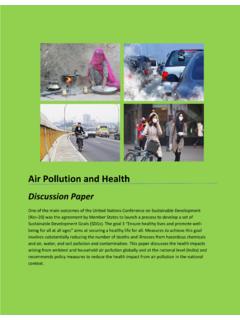
Air Pollution and Health - The Energy and …
www.teriin.orgAir Pollution and Health Discussion Paper One of the main outcomes of the United Nations Conference on Sustainable Development (Rio+20) was the agreement by Member States to launch a process to develop a set of
Green Growth and Sustainable Development in India
www.teriin.org1 Summary for Policymakers Green Growth and Sustainable Development in India Towards the 2030 Development Agenda The Energy and Resources Institute
Renewable Energy and Green Growth in India
www.teriin.orgRenewable Energy and Green Growth in India 3 Solar The Jawaharlal Nehru National Solar Mission (JNNSM) was launched in 2010 after which the Indian SPV market has seen significant growth.
Green Growth and Transport in India - The Energy …
www.teriin.org1 1. Background Good transport infrastructure is essential for socio-economic development of a country. India s transport network is vast and diverse comprising an extensive road network of
Green Growth Strategies for Oil and Natural Gas …
www.teriin.orgGreen Growth Strategies for Oil and Natural Gas Sector in India 3 1 Introduction Resource constraints, price volatility and the climate crisis necessitate a serious re-
Green Growth and Climate Change Mitigation in …
www.teriin.org1 1. Introduction Himachal Pradesh (HP) is a northern state in India situated in western Himalayas, which covers an area of 55,673 Km, with population of 68, 56, 509 persons as per the Census of
Green Growth and Renewable Energy in Himachal …
www.teriin.orgGreen Growth and Renewable Energy in Himachal Pradesh 3 2.1 Renewable Energy Policies of the State 2.1.1 Small Hydro Power Policy As a source of energy hydro power is economically viable, non-polluting and is
POLICY BRIEF TERI Policy Brief F - The Energy and ...
www.teriin.orgTERI Policy Brief CONTENTS www.teriin.org POLICY BRIEF The Energy and Resources Institute The Energy and Resources Institute Darbari Seth Block, IHC Complex,
Discussion Brief - teriin.org
www.teriin.orgSustainable Development Goals Discussion Brief One of the main outcomes of the United Nations Conference on Sustainable Development (Rio+20) was the
Related documents
Levelized Costs of New Generation Resources in the Annual ...
www.eia.govcosts, variable costs that include O&M and fuel costs, financing costs, and an assumed utilization rate for ... battery storage, capacity might be added in regions with higher renewables penetration, particularly solar, to capture any curtailments that would otherwise occur during the daytime, allowing for higher ...
Integrating Variable Renewable Energy: Challenges and ...
www.nrel.govand has cooled). A study by Xcel Energy found that for a 30-year-old 500-MW coal plant, costs ranged from $153,000 to $201,000 per cold start, whereas hot starts costs ranged from $82,000 to $110,000 (WGA 2012; Agan et al. 2008). Costs are specific to individual units, however, and
2022 renewable energy industry outlook
www2.deloitte.comthe decreasing costs of renewable energy—a critical input in the production process. In 2022, as renewable energy penetration on the grid increases, green hydrogen development is also expected to grow, owing to its potential to act as long-duration and seasonal storage of fuel available on demand to generate power.
IRP 2019 - Energy
www.energy.gov.za“Variable costs” refer to costs incurred as a result of the production of the generation plant. Integrated Resource Plan (IRP2019) Page 8 of 98 1. INTRODUCTION South Africa’s National Development Plan (NDP) 2030 offers a long-term plan for the country. It defines a desired destination where inequality and unemployment are

Integrating Variable Renewable Energy Into the Grid: Key ...
www.nrel.govand avoided generation costs) can also result “Greening the Grid” aims to modernize the power system so that it can accommodate large-scale integration of variable renewable energy resources. Photo from iStockPhoto 17755781 and illustration from iStockPhoto 8294603.
1 Renewable Energy and Climate Change
www.ipcc.chcosts and co-benefi ts, barriers to up-scaling and integration requirements, future scenarios and policy options. GHG emissions associated with the provision of energy services are a major cause of climate change. The IPCC Fourth Assessment Report (AR4) concluded that “Most of the observed increase in global average temperature
ELECTRICITY STORAGE AND RENEWABLES
www.irena.orggeneration from variable renewables (i.e. solar and wind). Strategies are also needed to decarbonise end uses, from transport and industry to the buildings in which we live and work. This brings the role of electricity storage, and in particular battery systems, to centre stage.