
Materials Soil classification - Learn Civil Engineering
testing of the soil, but it gives the engineer the general behavior of the soil. The Unified Soil Classification System (USCS) and the American Association of State Highway and Transportation Officials (AASHTO) system are the common classification system we use in civil engineering practice. Learning objectives: 1. Background of soil classification
Download Materials Soil classification - Learn Civil Engineering

Information
Domain:
Source:
Link to this page:
Documents from same domain
Excavation and Embankment (cut and fill) - Civil …
www.learncivilengineering.comEARTHWORK CONSTRUCTION AND LAYOUT TOPIC I 2 Earthwork Construction and Layout Introduction The earthwork section is the typical starting point anyone starting to prepare for the Construction

Mechanics of Materials- Flexure - Civil Engineering
www.learncivilengineering.comMechanics of Materials- Flexure Flexural members are those that experience primarily bending stresses, such as beams. A beam is a structural member that supports applied loads and its own weight primarily by internal moments and shears. A typical rectangular …

Mechanics of Materials-Deflection - Civil Engineering
www.learncivilengineering.comMechanics of Materials-Deflection Beam Deflections The deformation of a beam is usually expressed in terms of its deflection from its original unloaded position. Beams deflect (or sag) under load. Even the strongest, most substantial beam imaginable will deflect under its own weight. Under

Temporary structures **construction loads**
www.learncivilengineering.com3. Personnel and Equipment Loads on sloping Roofs R = 1.2 - .05F where: F = slope of the roof (in/ft) R = Reduction Factor ( .6 < R < 1.0 ) Restriction of Loads – As per ASCE 37-02 the following working surfaces shall have their use and access restricted by …
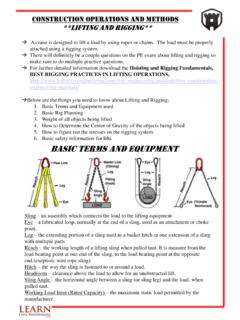
BEST RIGGING PRACTICES IN LIFTING OPERATIONS, …
www.learncivilengineering.comConstruction operations And methods **Lifting and rigging** A crane is designed to lift a load by using ropes or chains. The load must be properly attached using a rigging system. There will definitely be a couple questions on the PE exam about lifting and rigging so make sure to do multiple practice questions.

Excavation and embankment (cut and fill)
www.learncivilengineering.comExcavation and embankment (cut and fill) Excavation = the removal of soil or rock from its natural location. Embankment = the placement and compaction of layers of earth or rock to form a roadbed of the planned shape, density, and profile grade. Various sections of a roadway design will require bringing in earth.

QUANTITY TAKE-OFF - Learn Civil Engineering
www.learncivilengineering.comQUANTITY TAKE-OFF ROOFING Roof material quantity take-off are pretty easy trig problems, but I will go over it quick to make sure you get it, because most likely a question will be on the PE exam. Trick of the Trade #4: When thinking of roof problems you just need to worry about three things. 1.The angle of the roof, or the rise/run of the roof
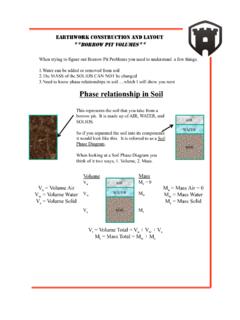
Phase relationship in Soil - Learn Civil Engineering
www.learncivilengineering.comPhase relationship in Soil This represents the soil that you take from a borrow pit. It is made up of AIR, WATER, and SOLIDS. So if you separated the soil into its components it would look like this. It is referred to as a Soil Phase Diagram. When looking at a Soil Phase Diagram you think of it two ways, 1. Volume, 2. Mass. AIR WATER SOIL AIR ...
QUANTITY TAKE-OFF
www.learncivilengineering.comQUANTITY TAKE OFF – MASONRY PRACTICE PROBLEM #2 Find the quantity of standard size bricks(8inx3.75inx2.25in) you should have delivered to your project if the following conditions are given: -Wall is 8 ft high, 14 ft wide - two opening, one 48in x 72in, one 32in x 48in - Mortar joints are .5in thick - 2 rows are required
Related documents

IS 1498 (1970): Classification and identification of soils ...
law.resource.orgsoil classification. 0.3 Soils seldom exist in nature separately as sand, gravel or any other single component but are usually found as mixture with varying propor tions of particles of different sizes. This revision is essentially based on the Unified Soil Classification System with the modification that the fine grained soils have been ...

Soil Properties and the Unified Soil Classification System ...
pdhonline.com2. Unified Soil Classification System (USCS). In 1952, the Bureau of Reclamation (Reclamation) and the U.S. Army Corps of Engineers, with Professor Arthur Casagrande of Harvard University, reached agreement on modifications to his "Airfield Classification System" and named it: Unified Soil Classification System (USCS).
SPECIFICATIONS FOR RAILWAY FORMATION
rdso.indianrailways.gov.inThe Geotechnical Engineers/Agencies had evolved many soil classification systems, over the world. The soil classification system developed by Casegrande was subsequently modified and named as 'Unified Classification’ system. In 1959, Bureau of Indian Standards adopted, the Unified classification system as a standard, which was revised in 1970.
Unified Soil Classification System
www.environment.nsw.gov.auUNIFIED SOIL CLASSIFICATION . SYSTEM: FIELD METHOD . ABBREVIATED NAME. USCS: TEST NUMBER: P13: TEST METHOD TYPE: B: VERSION NUMBER: 2: SCOPE: This test method describes the engineering properties of a soil based on the size of the particles, the amounts of the various sizes and the characteristics of the very fine grains. It can
Chapter 3 Soil Classification - Geoengineer.org
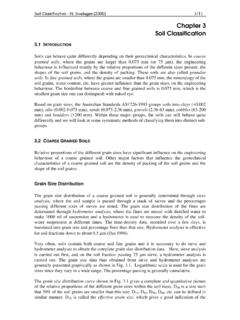
www.geoengineer.orgSoil Classification - N. Sivakugan (2000) 3/11 When there are smaller and larger grains, but none in an intermediate size range, the soil is known as a gap-graded soil. Typical grain size distribution curves of well graded (soil A), gap graded (soil B) and uniform (soil C) soils are shown in Fig. 3.2. 0 20 40 60 80 100 0.001 0.01 0.1 1 10 100

Appendix B The Unified Soil Classification System
www.globalsecurity.orgB-6 Unified Soil Classification System FM 5-472/NAVFAC MO 330/AFJMAN 32-1221(I) NOTES: 1. Values in columns 7 and 11 are for guidance only. Design should be …