
Materials Soil classification - Learn Civil Engineering
A-1 to A-3 are sands and gravels, A-4 to A-7 are silts and clays. There is a A-8 which is reserved for unusable peat. The following is the chart to use to find the designated soil group. www.learncivilengineering.com 10 Subsurface exploration and sampling Soil classification - …
Download Materials Soil classification - Learn Civil Engineering

Information
Domain:
Source:
Link to this page:
Documents from same domain

Excavation and Embankment (cut and fill) - Civil …
www.learncivilengineering.comEARTHWORK CONSTRUCTION AND LAYOUT TOPIC I 2 Earthwork Construction and Layout Introduction The earthwork section is the typical starting point anyone starting to prepare for the Construction

Mechanics of Materials- Flexure - Civil Engineering
www.learncivilengineering.comMechanics of Materials- Flexure Flexural members are those that experience primarily bending stresses, such as beams. A beam is a structural member that supports applied loads and its own weight primarily by internal moments and shears. A typical rectangular …

Mechanics of Materials-Deflection - Civil Engineering
www.learncivilengineering.comMechanics of Materials-Deflection Beam Deflections The deformation of a beam is usually expressed in terms of its deflection from its original unloaded position. Beams deflect (or sag) under load. Even the strongest, most substantial beam imaginable will deflect under its own weight. Under

Temporary structures **construction loads**
www.learncivilengineering.com3. Personnel and Equipment Loads on sloping Roofs R = 1.2 - .05F where: F = slope of the roof (in/ft) R = Reduction Factor ( .6 < R < 1.0 ) Restriction of Loads – As per ASCE 37-02 the following working surfaces shall have their use and access restricted by …

BEST RIGGING PRACTICES IN LIFTING OPERATIONS, …
www.learncivilengineering.comConstruction operations And methods **Lifting and rigging** A crane is designed to lift a load by using ropes or chains. The load must be properly attached using a rigging system. There will definitely be a couple questions on the PE exam about lifting and rigging so make sure to do multiple practice questions.

Excavation and embankment (cut and fill)
www.learncivilengineering.comExcavation and embankment (cut and fill) Excavation = the removal of soil or rock from its natural location. Embankment = the placement and compaction of layers of earth or rock to form a roadbed of the planned shape, density, and profile grade. Various sections of a roadway design will require bringing in earth.

QUANTITY TAKE-OFF - Learn Civil Engineering
www.learncivilengineering.comQUANTITY TAKE-OFF ROOFING Roof material quantity take-off are pretty easy trig problems, but I will go over it quick to make sure you get it, because most likely a question will be on the PE exam. Trick of the Trade #4: When thinking of roof problems you just need to worry about three things. 1.The angle of the roof, or the rise/run of the roof
Phase relationship in Soil - Learn Civil Engineering
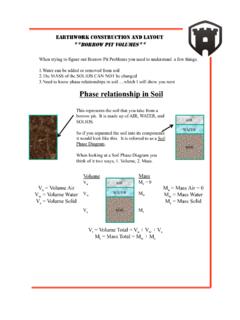
www.learncivilengineering.comPhase relationship in Soil This represents the soil that you take from a borrow pit. It is made up of AIR, WATER, and SOLIDS. So if you separated the soil into its components it would look like this. It is referred to as a Soil Phase Diagram. When looking at a Soil Phase Diagram you think of it two ways, 1. Volume, 2. Mass. AIR WATER SOIL AIR ...
QUANTITY TAKE-OFF
www.learncivilengineering.comQUANTITY TAKE OFF – MASONRY PRACTICE PROBLEM #2 Find the quantity of standard size bricks(8inx3.75inx2.25in) you should have delivered to your project if the following conditions are given: -Wall is 8 ft high, 14 ft wide - two opening, one 48in x 72in, one 32in x 48in - Mortar joints are .5in thick - 2 rows are required
Related documents

Fluvial Landforms & Processes - City University of New York
www.geo.hunter.cuny.edusands, gravel, silts, and clay deposits, that form arcuate, meander-scroll ridges. Natural levees are depositional landforms formed from the vertical accumulation of sediments deposited during flood events. Natural levees form topographically higher surfaces adjacent to the

DH071 & DR071 Typical Installation Instructions ... - E/One
eone.comcompactable clays and silts are not suitable backfill for this or any underground structure such as inlet or discharge lines. If you are unsure of the consistency of the native soil, it is recommended that a geotechnical evaluation of the material be obtained before specifying backfill. Another option is the use of a flowable fill (i.e., low slump

Introduction to Soil Mechanics and Shear Strength
westernforestry.org•Silts are very fine bulky particles like sands – they are rock and mineral fragments – they are reasonably inert. •Clays are minerals that are the product of chemical weathering of feldspar, ferromagnesian, and mica minerals. •Clay particles are very small and are chemically active. •Silts and Clays exhibit different engineering ...
Unified Soil Classification System - Office of Environment ...
www.environment.nsw.gov.auInorganic silts, such as a typical rock flour, show a moderately quick reaction. Dry Strength (Crushing characteristics) After removing particles >0.4 mm (No 40 sieve size) mould a pat of soil to the consistency of putty, adding water if necessary. Allow the pat to dry completely by oven, sun or air drying,

7 Subgrade Construction - Indiana
www.in.govSilts, silty loams, or loessial type soils are required to be within -3 percent of the optimum. Soils composed primarily of sand or sand and gravel may normally be compacted to the specified density at a moisture content several percentage points …

Soil Compaction Handbook - Multiquip Inc
www.multiquip.comML Inorganic silts and very fine sands, rock flour, silty or clay-like fine sands with slight plasticity CL Inorganic clays of low to medium plasticity, gravelly clays, sandy clays, silty clays, lean clays OL Organic silts and organic silt-clays of low plasticity MN Organic silts, micaceous or diatomaceous fine sandy or silty

Chapter 7 Slope Stability Analysis
www.wsdot.wa.goverodable silts and sands. If groundwater varies seasonally, long-term monitoring of the groundwater levels in the soil should be conducted. If groundwater levels tend to be responsive to significant rainfall events, the long-term groundwater monitoring should be continuous, and on-site rainfall data collection should also be considered.