
Mechanical Engineering Subject :Industrial Engineering BE ...
B. F. Gilbreth C. Robert Owen D. F. W. Taylor Answer: D 4.The production cost per unit can be reduced by A. Producing more with increased inputs B. Producing more with the same inputs C. Eliminating idle time D. Minimizing resource waste Answer: B 5. Travel charts are used to A. analyse material handling
Download Mechanical Engineering Subject :Industrial Engineering BE ...

Information
Domain:
Source:
Link to this page:
Documents from same domain
Bachelor of Commerce - Shivaji University
www.unishivaji.ac.inSHIVAJI UNIVERSITY, KOLHAPUR B. Com. Part – II Sem-III & Sem-IV Sr. No. Semester III Sr. No. Semester IV 1 English for Business Communication - Paper –III
( B.E. Mechanical Engineering Sem –VII & VIII )
www.unishivaji.ac.inSHIVAJI UNIVERSITY KOLHAPUR Page 4 10 Air Distribution System: 04 Re-circulated air, Ventilation air, Duct work, Use of friction loss & rectangular equivalent of

SHIVAJI UNIVERSITY, KOLHAPUR ELECTRICAL …
www.unishivaji.ac.in1 SHIVAJI UNIVERSITY, KOLHAPUR ELECTRICAL ENGINEERING REVISED SYLLABUS S.E. ( Electrical )-Part-I ( SEM- III ) Sr. Teaching Scheme Examination Scheme No. Name of Subject
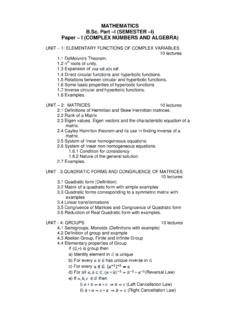
B.Sc. Part I Semester I and II Mathematics Syllabus
www.unishivaji.ac.inmathematics b.sc. part –i (semester –i) paper – i (complex numbers and algebra) unit – 1: elementary functions of complex variables 10 lectures
SHIVAJI UNIVERSITY DEPARTMENT OF …
www.unishivaji.ac.inM.Sc. (Stat) Acad Flexib. Pg No. Shivaji University, Kolhapur 1 SHIVAJI UNIVERSITY DEPARTMENT OF STATISTICS KOLHAPUR M.Sc. (Statistics) syllabus (Revised) to be effective from the Academic Year 2006-2007.

Syllabus For B.Com. Part-I Sem-I & Sem-II - Shivaji …
www.unishivaji.ac.inB (2009) Accredited By AAC Syllabus For B.Com. Part-I Sem-I & Sem-II Introduced from June 2013 and Onwards (Subject to the modifications will be made from time to time)
Post Graduate Diploma in Economics - Shivaji …
www.unishivaji.ac.in1 SHIVAJI UNIVERSITY, KOLHAPUR Department of Economics Revised Syllabus of Post Graduate Diploma in Economics to be Introduced from June 2015

www.unishivaji.ac.in
www.unishivaji.ac.inShivaji University, Kolhapur Regulations for M.Phil./ Ph.D. Programme Grants (Minimum Standards and for of M.Phil_,' Ph.D Degreesl Regulations, 2016 : dated May 2016)

STUDENTS FACILITATION CENTRE - Shivaji University
www.unishivaji.ac.in3 | Page 3. Duplicate Mark Sheet • Download the application form from www.unishivaji.ac.in → Examinations → Download Forms or obtain it from the Shivaji University Consumers Store.

M.A. I ECONOMICS Syllabus - Shivaji University
www.unishivaji.ac.in2 Shivaji University, Kolhapur. M.A. Part-I Economics Revised syllabus (from June 2010) Group- C. Compulsory Paper-I MICRO ECONOMIC ANALYSIS PREAMBLE:
Related documents

MULTIPLE CHOICE QUESTIONS AND ANSWERS
iotmumbai.bharatividyapeeth.educ. Gilbreth d. Peter Drucker 64. Authority hierarchy, rules and procedures and division of roles and responsibilities to manage work are all features of : a. Taylor’s principles of management b. Fayol’s principles of management c. General administrative theory

04 Medicion de Puestros de Trabajo - MDP
nulan.mdp.edu.arGilbreth introdujo el estudio de los movimientos que combinado con su medición dio origen al sistema más difundido de análisis del trabajo. Dijo también “con el estudio de los movimientos, la capacidad de ganar dinero del obrero se puede más que doblar. Dondequiera que se ha aplicado el estudio de los movimientos, la producción

Management - Amy E. Hissom-Daugherty
www.amyhissom.comOct 26, 2009 · Frank and Lillian Gilbreth refined time-and-motion study in the early twentieth century. "The Gilbreths' preferred "motion study" to Taylor's "time study," however the term "Time and Motion" has tended to stick in popular terminology. The Gilbreths studied the actions taken by
Motion and Time Study - University of Washington
courses.washington.edu• Frank and Lillian Gilbreth used motion picture to study worker motions – developed 17 motions called “therbligs” that describe all possible work. •GET G •PUT P • GET WEIGHT GW • PUT WEIGHT PW •REGRASP R • APPLY PRESSURE A • EYE ACTION E • FOOT ACTION F • STEP S • BEND & ARISE B
Human resource management and human resource …
files.eric.ed.govtheorists such as Fredrick Taylor and Frank and Lillian Gilbreth emerged with a goal to increase productivity through process management of the organization’s human resources. Taylor and the Gilbreths introduced concepts of efficient workflow and optimal conditions (Darmody, 2007; Liebhold, 1995; Nadworny, 1957).

Today’s Concept of Organizational Management
samples.jblearning.comFrank Gilbreth (1868–1924) and Lillian Gilbreth (1878–1972) developed a class of fundamental motions, starting with the therblig (Gilbreth spelled back-wards but with the t and h transposed) as the most basic elemental motion. Lillian Gilbreth may be of particular interest to occupational therapists, since much of her

INGENIERÍA DE MÉTODOS movimientos y tiempos
www.ecoeediciones.comRecordemos aquí, como ilustración, el trabajo de Frank Gilbreth en el mejora-miento de los métodos y movimientos para la construcción de edificios. Desde que se inició en el oficio, Frank notó que cada albañil tenía su propio método de trabajo y que no había dos que hicieran el trabajo exactamente de igual forma.

Management Theorists: Thinkers for the 21st century
www.ucipfg.comGilbreth, for example, founded a highly successful business in the 1890s to 1910s based on time and motion studies, the elimination of waste and the reduction of time spent on work activities. However, their analysis of work at a micro level began to develop a movement away from an obsession with control and tasks towards an interest