
ModularFunctionsandModularForms - James Milne
MODULAR FUNCTIONS AND MODULAR FORMS iii. AbstractHeckeoperators 65 Lemmason2 × 2matrices 67 HeckeoperatorsforΓ(1) 68 TheZ-structureonthespaceofmodularformsforΓ(1) 72
Download ModularFunctionsandModularForms - James Milne

Information
Domain:
Source:
Link to this page:
Documents from same domain

Algebraic Geometry - James Milne
www.jmilne.orgIntroduction There is almost nothing left to discover in geometry. Descartes, March 26, 1619 Just as the starting point of linear algebra is the study of the solutions of systems of

J.S. Milne
www.jmilne.orgauthor={Milne, James S.}, title={Group Theory (v3.13)}, year={2013}, ... GAP is an open source computer algebra program, emphasizing computational group theory.

J.S. Milne
www.jmilne.orgGroup Theory J.S. Milne S3 r D 1 2 3 2 3 1 f D 1 2 3 1 3 2 Version 3.10 September 24, 2010. A more recent version of these notes is available at www.jmilne.org/math/

Algebraic Number Theory - James Milne
www.jmilne.orgAn algebraic number field is a finite extension of Q; an algebraic number is an element of an algebraic number field. Algebraic number theory studies the arithmetic of algebraic

Shimura Varieties and Moduli - James Milne
www.jmilne.orgShimura Varieties and Moduli J.S. Milne April 30, 2011, v2.00 Abstract Connected Shimura varieties are the quotients of hermitian symmetric domains

Motives — Grothendieck's Dream
www.jmilne.orgMotives — Grothendieck’s Dream James S. Milne April 24, 2012; v2.04 Abstract Grothendieck introduced the notion of a “motif” in a letter to Serre in 1964.

Algebraic Groups - James Milne
www.jmilne.orgbut the most serious students. By considering only schemes algebraic over a field, we avoid many of the technicalities that plague the general theory.

J.S. Milne: Elliptic Curves
www.jmilne.orgPreface In early 1996, I taught a course on elliptic curves. Since this was not long after Wiles hadprovedFermat’sLast TheoremandI promisedto explainsome ofthe

The tikz package
www.jmilne.orgThe tikz package This is a general purpose graphics package. To load it for this document, I used: \usepackage{tikz} \usetikzlibrary{matrix,arrows,decorations.pathmorphing}
Modular functions and modular forms - James Milne
www.jmilne.orgPREREQUISITES The algebra and complex analysis usually covered in advanced undergraduate or first-year graduate courses. REFERENCES A reference monnnnn is to question nnnnn on mathoverflow.net.
Related documents
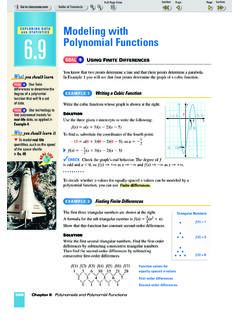
EXPLORING DATA AND STATISTICS Modeling with Polynomial ...
www.classzone.comPage 1 of 2 6.9 Modeling with Polynomial Functions 381 In Example 2 notice that the function has degree two and that the second-order differences are constant. This illustrates the first property of finite differences.
HP 33s scientific calculator user’s manual
www.hp.comContents 5 File name 33s-English-Manual-040130-Publication(Edition 2).doc Page : 388 Printed Date : 2004/1/30 Size : 13.7 x 21.2 cm

ADVANCED FUNCTIONS HANDBOOK - hp.com
www.hp.comSection 1: Using _ Effectively 13 This function equals zero at no more than n real values of x, called zeros of the polynomial.n real values of x, called zeros of the polynomial. A limit to the number of positive = − = − = [(: = + + + + Where
SECTION 2.5: FINDING ZEROS OF POLYNOMIAL FUNCTIONS
www.kkuniyuk.com2.46 SECTION 2.5: FINDING ZEROS OF POLYNOMIAL FUNCTIONS Assume fx() is a nonconstant polynomial with real coefficients written in standard form. PART A: TECHNIQUES WE HAVE ALREADY SEEN Refer to: Notes 1.31 to 1.35 Section A.5 in the book

2 Complex Functions and the Cauchy-Riemann Equations
www.math.columbia.edu2 Complex Functions and the Cauchy-Riemann Equations 2.1 Complex functions In one-variable calculus, we study functions f(x) of a real variable x.
Polynomial functions - Mathematics resources
www.mathcentre.ac.uk3. Graphs of polynomial functions We have met some of the basic polynomials already. For example, f(x) = 2is a constant function and f(x) = 2x+1 is a linear function.

Functions - Exponential Functions
www.wallace.ccfaculty.org10.4 Functions - Exponential Functions Objective: Solve exponential equations by finding a common base. As our study of algebra gets more advanced we begin to study more involved