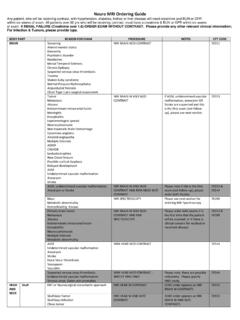
MRI Ordering Guide
within six weeks of exam. All patients over 60 yrs who will be receiving contrast, must have a cr eatinine & BUN or GFR within six weeks of exam. If RENAL FAILURE (Creatinine over 1.8)-ORDER EXAM WITHOUT CONTRAST. Please provide any other relevant clinical information; For Infection & Tumors, please provide type.
Download MRI Ordering Guide

Information
Domain:
Source:
Link to this page:
Documents from same domain

CONFIDENTIALITY GUIDELINES FOR PARTICIPANTS …
elpaso.ttuhsc.eduIN NURSING PEER REVIEW ... written agreement by all ... good faith in nursing peer review. Violating confidentiality could result in loss ...
Pediatric History and Physical Examination
elpaso.ttuhsc.eduPRENATAL HISTORY Age of the mother Health of the mother during this pregnancy: any infections (GBS, GC/chlamydia, hepatitis, syphilis, HIV, rubella, herpes) other illnesses, vaginal bleeding, toxemia, or care of animals, such as cats or other animal -borne diseases, substance abuse Number of previous pregnancies and their results
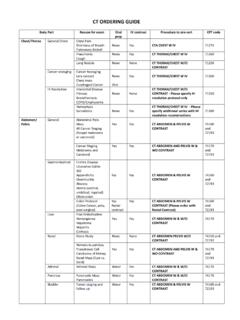
CT ORDERING GUIDE
elpaso.ttuhsc.eduTransitional Cell Carcinoma of Kidney Renal Mass (Cyst vs. Solid) Yes Yes CT ABDOMEN AND PELVIS W & WO CONTRAST 74170 and 72193 Adrenal Adrenal Mass Water Yes CT ABDOMEN W & W/O CONTRAST 74170 Pancreas Pancreatic Mass Pancreatitis Water Yes CT ABDOMEN W & W/O CONTRAST 74170 Bladder Tumor staging and follow up

Peripheral I.V. Infiltrations
elpaso.ttuhsc.eduManagement Stop the infusion Disconnect the iv tubing, attach a syringe and aspirate any residual drug from the site Determine if infusate is a vesicant or irritant Remove the iv if it is not a vesicant Leave the iv in situ if it is a vesicant Describe the site using the INS classification scale Elevate the affected extremity ...
Effects of Positive and Negative Feedback on Student’s ...
elpaso.ttuhsc.eduJan 20, 2017 · motivation and negative performance feedback diminishes it • Extrinsic rewards can undermine intrinsic motivation • But, feedback focused on perceived competence, autonomy, and locus of control can negate the negative effects and increase motivation
Basic Principles of Internal Control
elpaso.ttuhsc.eduAdequate documents and records include adequate supporting documentation and timely preparation of documents. Physical control over assets and records helps protect TTUHSCEP’s assets. These control activities may include electronic or mechanical controls (such as a …
CBCs and Peripheral Blood Smears
elpaso.ttuhsc.eduApr 03, 2019 · on blood smears when thrombocytopenia is detected by automated counting. This blood smear from a term newborn shows a high number of erythrocytes and many reticulocytes, which is physiologic for this age. A leukocytosis with left shift
Related documents
Stanford Hospital DISCHARGE CRITERIA FOR ORAM D 4.05 …
ether.stanford.edu3. Patients who received a femoral, popliteal, sciatic, or ankle block will be given crutches and be instructed to be non-weight bearing until full sensory and motor control have returned. 4. Patients discharged home directly from Phase I must meet criteria defined in Discharge of Patients by Criteria, a standardized procedure. C.
RADIOLOGY ORDERING GUIDE
abingtonradiology.comBODY PART REASON FOR EXAM IV CONTRAST ORAL CONTRAST PROCEDURE TO PRE CERT CPT CODE To schedule an appointment: call 215-481-EXAM (3926) Direct line for questions: call 267-818-0618 CT General –Chest BODY PART REASON FOR EXAM IV CONTRAST ORAL CONTRAST PROCEDURE TO PRE CERT CPT CODE 8

Contrast Media Guidelines UPDATED 18Jun2014
radres.ucsd.educomplete the information regarding type and volume of contrast and reactions, then sign questionnaire, post injection B. For patients receiving iodinated or gadolinium contrast media, pre-treatment to prevent or lessen reactions should be given under the following guidelines: 1. Patients with history of
HIGHLIGHTS OF PRESCRIBING INFORMATION GADAVIST. …
labeling.bayerhealthcare.comSee full prescribing information for complete boxed warning . Gadolinium-based contrast agents (GBCAs) increase the risk for NSF among patients with impaired elimination of the drugs. Avoid use of GBCAs in these patients unless the diagnostic information is essential and not available with non -contrasted MRI or other modalities. •

The Post-Hospital Follow-Up Visit - California Health Care ...
www.chcf.orgThe Post-Hospital Follow-Up Visit: A Physician Checklist to Reduce Readmissions | 3 more likely to be readmitted if they did not attend a post-hospital follow-up visit. In contrast, a multi-center trial found that patients who received more intensive post-hospital primary care had significantly higher rates of readmission.15

European Medicines Agency post-authorisation procedural ...
www.ema.europa.euEuropean Medicines Agency post-authorisation procedural advice for users of the centralised procedure Important information regarding ending of Irish language derogation As of 1st January 2022, a derogation expires concerning the status of Irish as …
NCCN Guidelines for Patients Primary Central Nervous ...
www.nccn.orgfor Patients 9 Present information from the NCCN Guidelines in an easy-to-learn format 9 ... People with a post-transplant lymphoproliferative disorder (PTLD) are at increased risk of PCNSL. PTLDs are ... a contrast agent or simply “contrast.” If a brain MRI (or CT) suggests PCNSL, the next step is a biopsy.
Urinary contrast study techniques - Vet Times
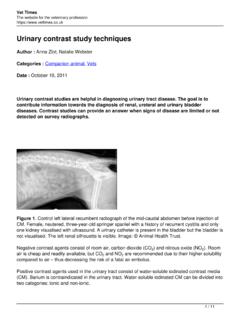
www.vettimes.co.ukUrinary contrast studies are helpful in diagnosing urinary tract disease. The goal is to contribute information towards the diagnosis of renal, ureteral and urinary bladder diseases. Contrast studies can provide an answer when signs of disease are limited or not detected on survey radiographs. Figure 1.