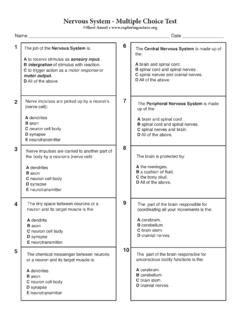
Nervous System - Multiple Choice Test - Exploring Nature
C spinal nerves and cranial nerves. D All of the above. The Peripheral Nervous System is made up of the: A brain and spinal cord. B spinal cord and spinal nerves. C spinal nerves and brain. D All of the above. The part of the brain responsible for unconscious bodily functions is the: A cerebrum. B cerebellum. C brain stem. D crainial nerves.
Download Nervous System - Multiple Choice Test - Exploring Nature

Information
Domain:
Source:
Link to this page:
Documents from same domain

Cellular Respiration - Exploring Nature Science …
www.exploringnature.org1) photosynthesis creates glucose molecules (instead of eating) → 2) this fuels cellular respiration in the plant cells → 3) creates ATP → 4) fuels plant growth and reproduction → 5) provides carbohydrates to animals for
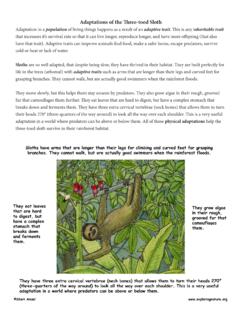
Adaptations of the Three-toed Sloth - The Exploring Nature ...
www.exploringnature.orgAdaptations of the Three-toed Sloth Adaptation in a population of living things happens as a result of an adaptive trait.This is any inheritable trait that increases it’s survival rate so that it can live longer, reproduce longer, and have more offspring (that also
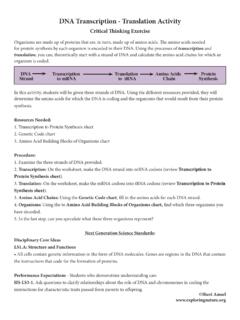
DNA Transcription - Translation Activity
www.exploringnature.orgGenes are regions in the DNA that contain the instructions that code for the formation of proteins. Performance Expectations - Students who demonstrate understanding can: HS-LS3-1. Ask questions to clarify relationships about the role of DNA and chromosomes in coding the
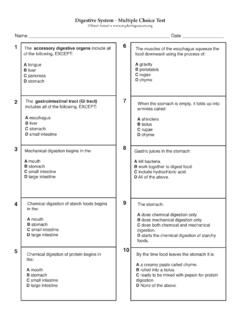
Digestive System - Multiple Choice Test - Exploring Nature
www.exploringnature.orgThe accessory digestive organs include all of the following, EXCEPT: A tongue B liver C pancreas D stomach The gastrointestinal tract (GI tract) includes all of the following, EXCEPT: A esophagus B liver C stomach D small intestine Mechanical digestion begins in the: A mouth B stomach C small intestine D large intestine
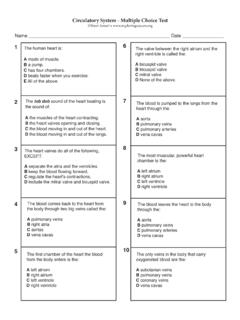
Circulatory System - Multiple Choice Test
www.exploringnature.orgB the heart valves opening and closing. C the blood moving in and out of the heart. D the blood moving in and out of the lungs. The heart valves do all of the following, EXCEPT: A separate the atria and the ventricles. B keep the blood flowing forward. C regulate the heart’s contractions. D include the mitral valve and bicuspid valve.
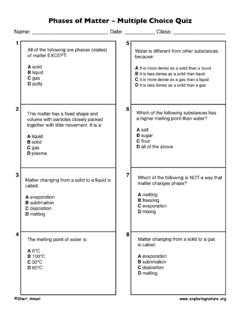
Matter Assessment and NGSS - Exploring Nature
www.exploringnature.orgScience and Engineering Practices: Developing and Using Models Modeling in 6–8 builds on K–5 and progresses to developing, using and revising models to describe, test, and predict more abstract phenomena and design systems. • Develop a model to predict and/or describe phenomena. (MS-PS1-1),(MS-PS1-4)
Bones and Features of the Skull - Cranium and Face
www.exploringnature.orgBones and Features of the Skull - Cranium and Face ©Sheri Amsel • www.exploringnature.org Bones of the Cranium The cranium is made up of 8 bones: 2 (paired) parietal bones • 2 (paired) temporal bones • frontal bone • occipital bone • sphenoid bone • ethmoid bone The frontal bone is located on the anterior cranium and includes the following features:

Phases of the Moon - Exploring Nature
www.exploringnature.org2. The moon takes the same amount of time to rotate once around on its axis as it does to revolve around the Earth - so the same side of the moon always faces the Earth. The moon looks different during its revolution around the Earth, because at each position its is getting a different amount of sunlight on its surface.
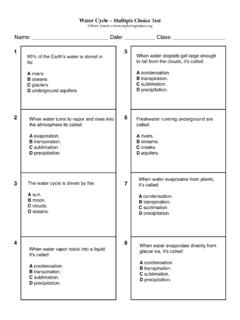
Water Cycle – Multiple Choice Test - Exploring Nature
www.exploringnature.orgC creeks. D aquifers. The water cycle is driven by the: A sun. B moon. C clouds. D oceans. When water turns to vapor and rises into the atmosphere its called: A evaporation. B transpiration. C sublimation. D precipitation. When water evaporates directly from glacial ice, it’s called: A condensation. B transpiration. C sublimation. D ...
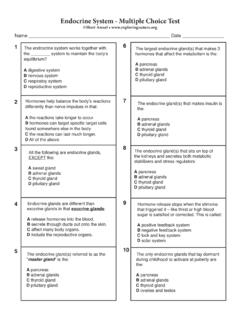
Endocrine System - Multiple Choice Test - Exploring Nature
www.exploringnature.orgEndocrine System - Multiple Choice Test KEY ... The endrocrine system works together with the _____ system to maintain the body’s equilibrium? A digestive system B nervous system C respiratoy system D reproductive system Hormones help balance the body’s reactions differently than nerve impulses in that:
Related documents
Sample APA Research Paper - The Write Source
www.thewritesource.com10 a.m. the next day. Participants from the control group were tested at 7:30 p.m. in a designated computer lab on the day the deprivation started. Those in the 12-hour group were tested at 10 p.m. on that same day. Those in the 24-hour group were tested at 10:40 a.m. on the following day. At their assigned time, participants arrived at a ...

DISSECTION OF THE SHEEP'S BRAIN - Hanover College
psych.hanover.educranial nerves, you should find the very large root of the trigeminal nerve. Pons Medulla Trigeminal Root 5. From the view below, find the IV ventricle and the cerebellum. ... Sheep Brain Dissection Guide 10. This is a more detailed view of the mid-saggital section. Here you can find the

Questions to accompany Anatomy and Physiology
www.lanternpublishing.com8. How many pairs of cranial nerves originate within the brain? D. twelve 9. Impulses (action potentials) pass from one neuron to another at a microscopic gap, called a synapse, where they trigger release of chemical signal molecules, called: A. neurotransmitters 10. Which of the following chemical substances is NOT an example of a ...
Orthotic Devices and Shoes - Cigna
static.cigna.comCranial Orthotic Devices for Positional or Deformational Plagiocephaly Upper Limb ... peripheral nerve injury [e.g., median, ulnar or radial nerves], sprain, strain) ... least 10 degrees (i.e., a non-fixed contracture) when ALL of the following criteria are met: ...

FUNCTIONS OF THE NERVOUS SYSTEM - Phoenix College
www.pc.maricopa.eduC. Nerves are bundles of axons that connect the CNS to sensory receptors, muscles, and glands. Nerves are divided into two groups. 1) Cranial nerves. Twelve pairs arise from the brain and exit through foramina in the skull. 2) Spinal nerves. Thirty one pairs arise from the spinal cord and exit through the intervertebral or sacral foramina. D.
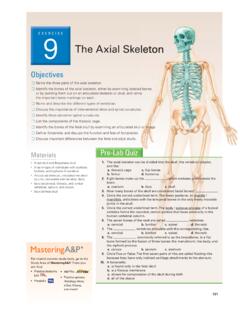
EXERCISE 9 The Axial Skeleton - Pearson
www.pearson.comthe cranial vault, or calvaria, forming the superior, lateral, and posterior walls of the skull; and the cranial base, forming (Text continues on page 128.) (Table continues on page 126.) Table 9.1A The Axial Skeleton: Cranial Bones and Important Bone Markings Cranial bone Important markings Description Frontal (1) Figures 9.1, 9.3, 9.7,
ALBERTA HEALTH CARE INSURANCE PLAN
open.alberta.ca26.9 Other operations on iris, ciliary body, sclera, and anterior chamber . 124
Chapter 1: Introduction to Human Anatomy and Physiology
resources.saylor.orgA. Dorsal Cavity ---Cranial Cavity - Brain, Spinal Cavity - Spinal Cord B. Ventral Cavity 1. Thoracic Cavity - right and left compartment separated by mediastinum. Heart , lungs, esophagus, trachea 2. Abdominopelvic Cavity ---Abdominal cavity - …
NERVOUS SYSTEM WORKSHEET
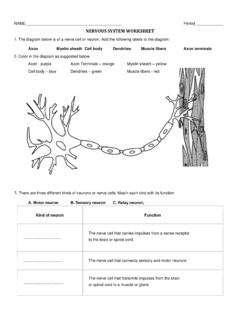
sfponline.org10. The sense organ or cells that receive stimuli from within and outside the body. ..... 11. The reaction to a stimulus by a muscle or gland. ..... 12.The part of the nerve cell containing the nucleus. 4. Indicate whether the following parts of the nervous 5. …