NIDCD Fact Sheet Cochlear Implants
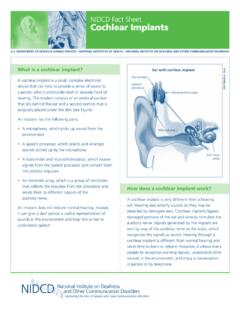
What is a cochlear implant? A cochlear implant is a small, complex electronic device that can help to provide a sense of sound to a person who is profoundly deaf or severely hard-of-hearing. The implant consists of an external portion that sits behind the ear and a second portion that is surgically placed under the skin (see figure).
Download NIDCD Fact Sheet Cochlear Implants

Information
Domain:
Source:
Link to this page:
Documents from same domain

Sound Advice on Hearing Protection for Young Ears
www.nidcd.nih.govDifferent hearing protectors offer different levels of protection, as shown by their Noise Reduction Rating, or NRR. The higher the NRR, the greater the protection
Speech and Language Developmental Milestones
www.nidcd.nih.govDevelopmental Milestones . The irst 3 years of life, when the brain is developing and maturing, is the most intensive period for acquiring speech and language skills. These skills develop best in a world that is rich with sounds, sights, and consistent …
Communication Problems in Children with Autism Spectrum ...
www.nidcd.nih.govCenters for Disease Control and Prevention (CDC) estimates that about 1 out of every 88 children will be identified with ASD. How does ASD affect communication? The word “autism” has its origin in the Greek word “autos,” which means “self.” Children with ASD often are self-absorbed and seem to exist in a private world
Specific Language Impairment - NIDCD
www.nidcd.nih.govTitle: Specific Language Impairment Author: National Institute on Deafness and Other Communication Disorders Subject: A fact sheet describing what is Specific Language Impairment \(SLI\), what causes it, how it is diagnosed and treated, and what research is …

Ménière’s Disease - NIDCD
www.nidcd.nih.govMénière’s disease, but no definite answers are available. Some researchers think that Ménière’s disease is the result of constrictions in blood vessels similar to those that cause migraine headaches. Others think Ménière’s disease could be a consequence of viral infections, allergies, or autoimmune reactions.
La enfermedad de Ménière - NIDCD
www.nidcd.nih.govTitle: La enfermedad de Ménière Author: Instituto Nacional de la Sordera y otros Trastornos de la Comunicación Subject: Una hoja de información que describe qué es la enfermedad de Ménière, sus síntomas, cómo se diagnostica y se trata, y qué …
Presbycusis - NIDCD
www.nidcd.nih.gova sensorineural hearing disorder. It is most commonly caused by gradual changes in the inner ear. The cumulative effects of repeated exposure to daily traffic sounds or construction work, noisy offices, equip-ment that produces noise, and loud music can cause sensorineural hearing loss. Sensorineural hearing
Autism Spectrum Disorder: Communication Problems ... - …
www.nidcd.nih.govusing eye contact, gestures, body movements, imitation, and babbling and other vocalizations to help them communicate. Children who lack these skills may be evaluated and treated by a speech-language pathologist to prevent further developmental delays. For slightly older children with ASD, communication
Apraxia of Speech - NIDCD
www.nidcd.nih.govthe presence of several of a group of symptoms, including those described earlier. Ruling out other conditions, such as muscle weakness or language production problems (e.g., aphasia), can help with the diagnostic process. People with either form of AOS may have a
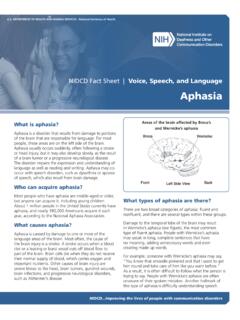
Aphasia - NIDCD
www.nidcd.nih.govThe use of speech-generating applications on mobile . 3 ... retrieval, grammar, prosody (tone), and other aspects of speech. Some of these new methods involve improving cognitive ... understand the parts of the brain that played a role in language and recovery after a stroke. Recently, scientists ...
Related documents
Medical Policy Medical Records Documentation Guidelines
www.bcbstx.comBreast Implant, Removal and/or Insertion – SUR716.009 Breast Surgery for Prophylaxis or Cancer Prevention – SUR716.015 Chemical Peels – SUR716.018 Cochlear Implant – SUR714.004 Cosmetic and Reconstructive Procedures – SUR716.001 Cryosurgical Ablation of Miscellaneous Solid Tumors Other Than Renal, Liver,

Habilitative Services and Outpatient Rehabilitation Therapy
www.uhcprovider.comCochlear implant monitoring (remapping and reprogramming of implant) and rehabilitation following the cochlear implant surgery is usually billed as aural rehabilitation; this is not covered as a speech therapy benefit. The member specific benefit plan document must be referenced for any applicable limits that may apply to aural rehabilitation.

Screening Checklist for Contraindications to Vaccines for ...
www.immunize.orga cochlear implant, or a spinal fluid leak? Is he/she on long-term aspirin therapy? 5. If the child to be vaccinated is 2 through 4 years of age, has a healthcare provider told you that the child had wheezing or asthma in the past 12 months?

CLINICAL PRACTICE GUIDELINE: COCHLEAR IMPLANTS
www.audiology.orgmake individualized decisions for each patient. In addition, the guideline can help inform physicians, reimbursement agencies, government agencies, the hearing health-care industry, patients, families, and caregivers about what research evidence demonstrates as the current best practices related to cochlear implant care.
Considerations for Use of PCV15 and PCV20 in U.S. Adults
www.cdc.govFeb 25, 2021 · • Simplifying existing pneumococcal vaccine recommendations could help improve vaccine coverage among adults • Disparities in pneumococcal disease burden and vaccine coverage should ... High-risk: those who were immunocompromised or had a cochlear implant *Pfizer funded study. In adults aged 19–49 years, 52% of pneumococcal pneumonia cases
Technology for Deaf People - University of Washington
courses.cs.washington.eduExamples: hearing aids, cochlear implants • Assistive technology › Popular in rehabilitation literature. Emphasis on the need for assistance. • Access technology › Allows an activity that would be difficult to impossible to achieve without it. Emphasis not on restoring function, but on achieving an end goal by whatever means possible.

Factsheet - Definitions - Derbyshire County Council elections
www.derbyshire.gov.ukcochlear implant to help them hear well. Many can use the telephone with people they know well (and often it will not be realised that partially hearing people can’t hear everything). Many people do not even realise that the partially hearing person can’t hear everything.

DEAF & HARD OF HEARING - Pennsylvania Department of …
www.dli.pa.govCOCHLEAR IMPLANT • A surgically implanted device that provides direct electrical stimulation to the auditory nerve in the inner ear. Cochlear implants are an option for individuals who do not benefit from hearing aids, and they are usually covered by insurance. Telephones and Relay Services ODHH understands the impact hearing loss has on