NIH Hazard Communication Program
INTRODUCTION . The National Institutes of Health (NIH) is committed to providing a safe and healthy work environment. The purpose of the NIH Hazard Communication Program (NIH HCP) is to increase employee awareness of hazardous chemicals used in the workplace so that they can
Download NIH Hazard Communication Program

Information
Domain:
Source:
Link to this page:
Documents from same domain
HVAC Duct Cleaning - National Institutes of Health
ors.od.nih.govDivision of Occupational Health and Safety . The dirty filter/vent above indicate a cleaning is needed and should be performed by a professional . DOHS Fact Sheet on . HVAC Duct Cleaning . National Institutes of Health • Office of Research Services (ORS) • Division of Occupational Health and Safety (DOHS) • Technical Assistance Branch (TAB)
Contractor Health and Safety Requirements
ors.od.nih.gova. Contractor Safety Program Assessment: The NIH is committed to providing a safe environment for its employees, guests, and patients. Safety, as demonstrated during previous contracts, may be used in the past performance evaluation of a Contractor. Contractors are required to enroll in the Contractor Safety Assessment Program (CSAP).
Guidance for the Selection of Laboratory Coats
ors.od.nih.govThis reference document provides a general overview for selection of laboratory coats. It does not alter or determine compliance responsibilities in OSHA standards or NIH’s Manual Chapter 1340. Because interpretations and policy may change over time, you should your consult with your Institute's Safety and Health Specialist.
Protocol for Use and Maintenance of Oxygen Monitoring …
ors.od.nih.govdisplacement of oxygen. At a minimum, the following factors should be used in determining if a device should be installed: manufacturer (e.g., magnet) guidance, volume of gas used, location of gas, and air changes/hour in the room/area. The 2008 NIH DRM notes that both ‘carbon dioxide manifold rooms…
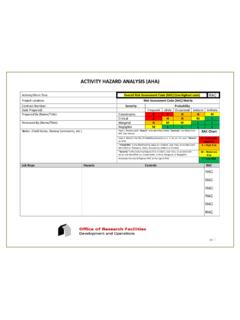
ACTIVITY HAZARD ANALYSIS (AHA)
ors.od.nih.govACTIVITY HAZARD ANALYSIS (AHA) Activity/Work Task: Overall Risk Assessment Code (RAC) (Use highest code) Project Location: Risk Assessment Code (RAC) Matrix . ... " is the likelihood to cause an incident, near miss, or accident and identified as: Frequent, Likely, Occasional, Seldom or Unlikely . H = High Risk "
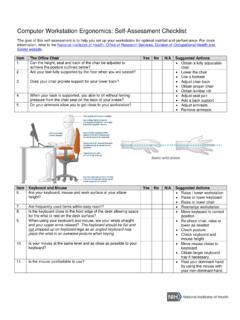
Computer Workstation Ergonomics: Self-Assessment Checklist
ors.od.nih.govSelf Assessment Computer Workstation Ergonomics: Self-Assessment Checklist . The goal of this self-assessment is to help you set up your workstation for optimal comfort and performance. For more information, refer to the . National Institutes of Health, Office of Research Services, Division of Occupational Health and Safety website.
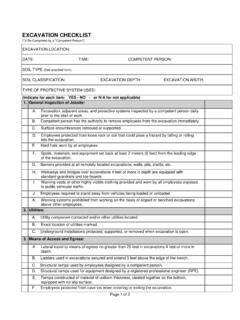
EXCAVATION CHK LST
ors.od.nih.govinto the excavation. rolling E. Hard hats worn by all employees. F. Spoils, materials, and equipment set back at least of the excavation. 2 meters (6 feet) from the leading edge G. Barriers provided at all remotely located excavations, wells, pits, shafts, etc. H. Walkways and bridges over excavations 4 feet or more in depth are equipped
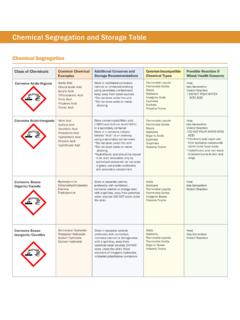
Chemical Segregation Table
ors.od.nih.govChemical Segregation. Common Chemical Additional Concerns and Common Incompatible Possible Reaction if Examples Storage Recommendations Chemicals Types Mixed/Health Concerns . Class of Chemicals . Flammable Liquids . Ethanol, Ethyl Acetate, Methanol, Acetone, Benzene, Xylene, Toluene Diethyl Ether Tetrahydrofuran Acetonitrile Glacial Acetic Acid
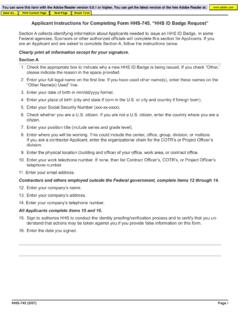
Applicant Instructions for Completing Form HHS-745, “HHS ...
ors.od.nih.govApplicant Instructions for Completing Form HHS-745, “HHS ID Badge Request” Section A collects identifying information about Applicants needed to issue an HHS ID Badge. In some Federal agencies, Sponsors or other authorized offi cials will complete this section for Applicants. If …
NIH Chemical Hygiene Plan
ors.od.nih.govBSC Biological Safety Cabinets CFH Chemical Fume Hood CFR Code of Federal Regulations CHO Chemical Hygiene Officer ... eyes, or mucus membranes. Physical hazards include, but are not limited to, chemicals which are explosive, flammable, or corrosive. (Definition listed in . Appendix F “Glossary of Terms.”) III.
Related documents

Introduction To Media
www.sjsu.eduIntroduction To Media Tim Hendrick . Media Overview and Planning/buying Page 1 AJEEP Media Overview Planning/Buying The Internet ... Media Across IMC (Integrated Marketing Communications) 6 7 New Media New/Interactive Media Planning Supplemental Article (Power of Multiple Media) Key Terms Internet Television Radio Media Medium Vehicle

Sample Introduction Letter for an Online Course
www.uah.eduSample Introduction Letter for an Online Course This sample letter is provided courtesy of Instructor Rita Treutel, UAB Department of English. Dear Students: Welcome to EH102. This course is a distance learning equivalent to the EH102 sections offered in traditional classrooms. This means that we will never meet face-to-face.

Introduction to Networking Protocols and Architecture
www.cse.wustl.eduThe Ohio State University Raj Jain 2- 9 Layering Protocols of a layer perform a similar set of functions All alternatives for a row have the same interfaces Choice of protocols at a layer is independent of those of at other layers. E.g., IP over Ethernet or token ring Need one component of each layer ⇒ Null components Same Interfaces Trans Control Prot
Introduction to Wireless Communications
www.cse.iitd.ac.inWireless Communications Introduction to Wireless Communications Ranjan Bose Department of Electrical Engineering Indian Institute of Technology, Delhi