
NIH Stroke Scale
patient with brainstem stroke who has bilateral loss of sensation is scored 2. If the patient does not respond and is quadriplegic, score 2. Patients in a coma (item 1a=3) are automati-cally given a 2 on this item. Scale Definition Sensory 0 Normal; no sensory loss. 1 Mild-to-moderate sensory loss; patient feels pinprick is less sharp
Download NIH Stroke Scale

Information
Domain:
Source:
Link to this page:
Documents from same domain
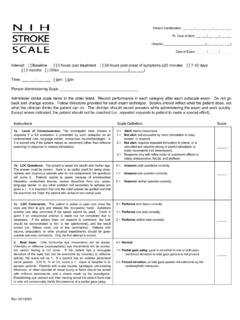
Instructions Scale Definition Score
www.ninds.nih.govOct 01, 2003 · Instructions Scale Definition Score 1a. Level of Consciousness: The investigator must choose a ... moving fingers appropriately, this can be scored as normal. If there is unilateral blindness or enucleation, visual fields in the remaining eye are scored. Score 1 …
Complex Regional Pain Syndrome fact sheet
www.ninds.nih.govWhat is complex regional pain syndrome? C omplex regional pain syndrome (CRPS) is ... pain condition that most often affects one limb (arm, leg, hand, or foot) usually after an injury. CRPS is believed to be caused by damage to, or malfunction of, the peripheral and central nervous ... Emerging treatments for CRPS include: • Intravenous ...
NIH Stroke Scale
www.ninds.nih.govAdminister stroke scale items in the order listed. Record performance in each category after each subscale exam. Do not go back and change scores. Follow directions provided for each exam technique. Scores should reflect what the patient does, not what the clinician thinks the patient can do. The clinician should record answers while

Traumatic Brain Injury - National Institute of ...
www.ninds.nih.govA traumatic brain injury (TBI) can be caused by a . forceful bump, blow, or jolt to the head or body, or from an object that pierces the skull and enters the brain. Not all blows or jolts to the head result in a TBI. Some types of TBI can cause temporary or short-term problems with normal brain function, including
Low Back Pain fact sheet - National Institute of ...
www.ninds.nih.govtests can help determine the cause of pain and appropriate treatment. Imaging tests are not needed in most cases but may be ordered to rule out specific causes of pain, including tumors and spinal stenosis. Occasionally the cause of chronic lower back pain is difficult to determine even after a thorough examination.
Related documents

Case Study 01 - DelmarLearning.com
www.delmarlearning.comNeurological Disorders and Stroke (NINDS), “The term hydrocephalus is derived from the Greek words hydro meaning water and cephalus meaning head. As its name implies, it is a condition in which the primary character-istic is excessive accumulation of fluid in the brain. Although hydrocephalus
Post-Acute COVID-19 Syndrome (PACS)
acd.od.nih.gov• Stroke- large & small vessel occlusion, micro-bleeds • Confusion and depressed level of consciousness • Loss of smell • Muscle/Nerve pain and weakness • Meningitis/encephalitis • Seizures • Asymptomatic hypoxia. Rare Post-viral syndromes • Delayed injury to brain and spinal cord (multiple sclerosis- like).

Guidelines for Management of Stroke
extranet.who.intThe goal of stroke care is to minimize brain injury and maximize patient recovery. The community-oriented “Stroke Chain of Survival” that links actions to be taken by patients, family members, and healthcare providers to maximize stroke recovery are the following: - Rapid recognition and reaction to stroke warning signs;

NIH STROKE SCALE (NIHSS)
lern.la.govApr 10, 2017 · LERN’s ongoing development of Louisiana’s statewide stroke care system is guided by the ... Target: Stroke. N Engl J Med 1995;333;1581-7 . NINDS TPA Stroke Trial. 16 v.20140811 *From American Heart Association, Target: Stroke. Lansberg et al, Stroke 2009 Number of Patients Who Benefit and Are Harmed
Acute stroke treatments - NHS England
www.england.nhs.ukThrombolysis in acute ischaemic stroke NINDS trials (1995), ECASS I (1995), ECASS II (1998), ATLANTIS A (1999) and ATLANTIS B (1999): confirmed benefit within 3 hours of onset ECASS III (2008): benefit in giving up to 4.5 hours of onset IST-3 (2012): confirmed benefits of prior trials for up to 4.5 hours of onset; advised thrombolysis aged over 80 years old

Numbness and Tingling After COVID-19: Care Instructions
www.med.umich.edustroke, tumor, multiple sclerosis - to name a few. Also, nerve entrapment disorders, where a nerve gets compressed or restricted by nearby tissues can cause paresthesia accompanied by pain. (Carpel Tunnel Syndrome is an example of a nerve entrapment disorder). COVID-19 can also cause numbness and tingling in some people.
NIH Stroke Scale - National Institute of Neurological ...
www.ninds.nih.govOct 01, 2003 · Only sensory loss attributed to stroke is scored as abnormal and the examiner should test as many body areas (arms [not hands], legs, trunk, face) as needed to accurately check for hemisensory loss. A score of 2, “severe or total sensory loss,” should only be given when a severe or total loss of sensation can be clearly demonstrated.

NATIONAL INSTITUTES OF HEALTH STROKE SCALE (NIHSS)
www.uab.eduThe NIH Stroke Scale (NIHSS) is a standardized neurological examination intended to describe the neurological deficits found in large groups of stroke patients participating in treatment trials. Administer stroke scale items in the order listed. Record performance in each category after each subscale exam. Do . not go back and change scores.