
node2vec: Scalable Feature Learning for Networks
knowledge. Even if one discounts the tedious effort required for feature engineering, such features are usually designed for specific tasks and do not generalize across different prediction tasks. An alternative approach is to learn feature representations by solving an optimization problem [4]. The challenge in feature learn-
Download node2vec: Scalable Feature Learning for Networks

Information
Domain:
Source:
Link to this page:
Documents from same domain
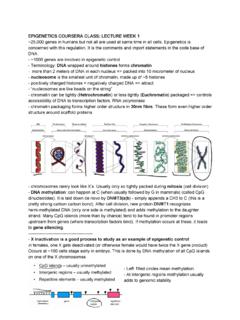
EPIGENETICS COURSERA CLASS: LECTURE WEEK 1
cs.stanford.eduepigenetics coursera class: lecture week 2 Acetylation or Methylation (among other things) can happen at Nterminal tails of histones. Various molecules can bind to histones, some suggest there is a “histone code”, as these all

KAREL THE ROBOT - Stanford Computer Science
cs.stanford.eduthe word Karel in a Karel program represents the entire class of robots that know how to respond to the move() , turnLeft() , pickBeeper() , and putBeeper() commands. Whenever you have an actual robot in the world, that robot is an object that represents a
Designing Fast Absorbing Markov Chains - Stanford University
cs.stanford.eduMarkov Chains and Absorption Times A discrete Markov chain (Grinstead and Snell 1997) Mis a stochastic process defined on a finite set Xof states.
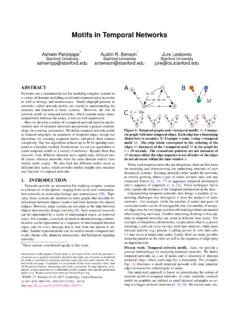
Motifs in Temporal Networks - Stanford University
cs.stanford.edumotifs defined by a constant number of temporal edges between 2 nodes, this general algorithm is optimal up to constant factors—it runs in O(m) time, where mis the number of temporal edges.
Statement of Purpose - Stanford University
cs.stanford.eduStatement of Purpose Jacob Steinhardt December 31, 2011 1 Career Goals The advent of the computer, together with Turing’s theory of universal computation, has revo-

Deep Visual-Semantic Alignments for Generating Image ...
cs.stanford.eduFigure 2. Overview of our approach. A dataset of images and their sentence descriptions is the input to our model (left). Our model first infers the correspondences (middle, Section3.1) and then learns to generate novel descriptions (right, Section3.2).
Distributed Representations of Sentences and Documents
cs.stanford.eduunique vector, represented by a column in matrix W. The paragraph vector and word vectors are averaged or concate-nated to predict the next word in a context. In the experi-ments, we use concatenation as the method to combine the vectors. More formally, the only change in this model compared to the word vector framework is in equation 1, where h is
Proof Techniques - Stanford Computer Science
cs.stanford.edu32 = 9, while disproving the statement would require showing that none of the odd numbers have squares that are odd.) 1.0.1 Proving something is true for all members of a group If we want to prove something is true for all odd numbers (for example, that the square of any odd number is odd), we can pick an arbitrary odd number x, and try to ...
Twitter Sentiment Classification using Distant Supervision
cs.stanford.edu1.2 Characteristics of Tweets Twitter messages have many unique attributes, which dif-ferentiates our research from previous research: Length The maximum length of a Twitter message is 140 characters. From our training set, we calculate that the average length of a tweet is 14 words or 78 characters. This

Guide to the MSCS Program Sheet
cs.stanford.edustatistics can usually be satisfied by any course in probability taught from a rigorous mathematical perspective. Courses in statistics designed for social scientists generally do not have the necessary sophistication. A useful rule of thumb is that courses satisfying this requirement must have a calculus prerequisite. 3.
Related documents

A Guide to the Project Management Body of Knowledge
www.cs.bilkent.edu.trA Guide to the Project Management Body of Knowledge (PMBOK® Guide) 2000 Edition ©2000 Project Management Institute, Four Campus Boulevard, Newtown Square, PA 19073-3299 USA vii List of Figures Figure 1–1. Overview of Project Management Knowledge Areas and Project Management Processes – …

Discussion paper Strategy-related auditing
global.theiia.orgment and added value are mostly acknowledged when providing information to stakeholders about the quality of strategy implementation through audits. In addition, CAEs are often acknowledged as a valuable sparring partner for management due to their knowledge of the internal organization and its culture.

The expansion of Robo-Advisory in Wealth Management
www2.deloitte.comEncouraging self-manage - ment of financials, Robo-Advisors provide ... ment strategy and moreover provides the depot and brokerage, the “Robo-Advisor 3.0” services go beyond that approach. ... limited financial background knowledge, time, or intention to deal with the selec-

INDONESIA ECONOMIC PROSPECTS
openknowledge.worldbank.orgment ROA Return on Assets EM Emerging Market ROE Return on Equity EMDE Emerging Market And Development Economy SA Social Assistance EME Emerging Market Economies SAM Social Accounting Matrix F&B Food and Beverage SME Small Medium Enterprises FDI Foreign Direct Investment STEM Science, Technology, Engineering, and Math- ... Manage …

A Guide to the Project MAnAGeMent Body of KnowledGe
repository.dinus.ac.idISBN: 978-1-935589-67-9 Published by: Project Management Institute, Inc. 14 Campus Boulevard Newtown Square, Pennsylvania 19073-3299 USA Phone: +610-356-4600

Assessment Benefits and Barriers - ed
files.eric.ed.govment benefi ts and barriers. To facilitate this discussion, teachers were assigned to one ... rubrics, organize and manage assessments, and use student self- and peer-assessments in their classes. The workshop also included practical application using rubrics in dance ... such as knowledge, homework, teamwork, and affective ...

AESD’s Quality and Communications Commitment The Army ...
dev.eis.army.milArmy Knowledge Online AESD Background AESD On-Boarding Process AESD on-boarding Process based on ITIL Service Manage-ment Model: Service Transition and Service Operations. tinuous Service Improvement processes. Proven common process framework utilized in the on-boarding of custom-ers. Phone: 1-866-335-2769 -mail: help@us.army.mil