
node2vec: Scalable Feature Learning for Networks
mize a reasonable objective required for scalable unsupervised fea-ture learning in networks. Classic approaches based on linear and non-linear dimensionality reduction techniques such as Principal Component Analysis, Multi-Dimensional Scaling and their exten-sions [3, 27, 30, 35] optimize an objective that transforms a repre-
Download node2vec: Scalable Feature Learning for Networks

Information
Domain:
Source:
Link to this page:
Documents from same domain

EPIGENETICS COURSERA CLASS: LECTURE WEEK 1
cs.stanford.eduepigenetics coursera class: lecture week 2 Acetylation or Methylation (among other things) can happen at Nterminal tails of histones. Various molecules can bind to histones, some suggest there is a “histone code”, as these all

KAREL THE ROBOT - Stanford Computer Science
cs.stanford.eduthe word Karel in a Karel program represents the entire class of robots that know how to respond to the move() , turnLeft() , pickBeeper() , and putBeeper() commands. Whenever you have an actual robot in the world, that robot is an object that represents a
Designing Fast Absorbing Markov Chains - Stanford University
cs.stanford.eduMarkov Chains and Absorption Times A discrete Markov chain (Grinstead and Snell 1997) Mis a stochastic process defined on a finite set Xof states.
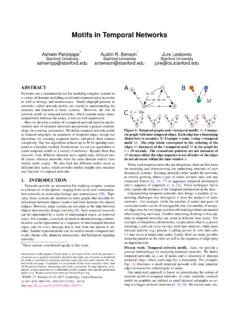
Motifs in Temporal Networks - Stanford University
cs.stanford.edumotifs defined by a constant number of temporal edges between 2 nodes, this general algorithm is optimal up to constant factors—it runs in O(m) time, where mis the number of temporal edges.

Statement of Purpose - Stanford University
cs.stanford.eduStatement of Purpose Jacob Steinhardt December 31, 2011 1 Career Goals The advent of the computer, together with Turing’s theory of universal computation, has revo-

Deep Visual-Semantic Alignments for Generating Image ...
cs.stanford.eduFigure 2. Overview of our approach. A dataset of images and their sentence descriptions is the input to our model (left). Our model first infers the correspondences (middle, Section3.1) and then learns to generate novel descriptions (right, Section3.2).
Distributed Representations of Sentences and Documents
cs.stanford.eduunique vector, represented by a column in matrix W. The paragraph vector and word vectors are averaged or concate-nated to predict the next word in a context. In the experi-ments, we use concatenation as the method to combine the vectors. More formally, the only change in this model compared to the word vector framework is in equation 1, where h is

Proof Techniques - Stanford Computer Science
cs.stanford.edu32 = 9, while disproving the statement would require showing that none of the odd numbers have squares that are odd.) 1.0.1 Proving something is true for all members of a group If we want to prove something is true for all odd numbers (for example, that the square of any odd number is odd), we can pick an arbitrary odd number x, and try to ...
Twitter Sentiment Classification using Distant Supervision
cs.stanford.edu1.2 Characteristics of Tweets Twitter messages have many unique attributes, which dif-ferentiates our research from previous research: Length The maximum length of a Twitter message is 140 characters. From our training set, we calculate that the average length of a tweet is 14 words or 78 characters. This

Guide to the MSCS Program Sheet
cs.stanford.edustatistics can usually be satisfied by any course in probability taught from a rigorous mathematical perspective. Courses in statistics designed for social scientists generally do not have the necessary sophistication. A useful rule of thumb is that courses satisfying this requirement must have a calculus prerequisite. 3.
Related documents
Chapter 2 Thermal Expansion - Rice University
www.owlnet.rice.eduFinite-element analysis (FEA) software such as NASTRAN (MSC Software) requires that α be input, not α−. Heating or cooling affects all the dimensions of a body of material, with a resultant change in volume. Volume changes may be determined from: ∆V/V 0 = α V∆T where ∆V and V 0 are the volume change and original volume, respectively ...
A Fast and Accurate Dependency Parser using Neural Networks
nlp.stanford.eduThe fea-ture generation of indicator features is gen-erally expensive — we have to concatenate some words, POS tags, or arc labels for gen-erating feature strings, and look them up in a huge table containing several millions of fea-tures. In our experiments, more than 95% of
Least Squares Optimization with L1-Norm Regularization
www.cs.ubc.cature selection method, and thus can give low variance fea-ture selection, compared to the high variance performance of typical subset selection techniques [1]. Furthermore, this does not come with a large disadvantage over subset selec-tion methods, since it …

D riving licence No Date of i ssue: Photograph Va lid Till ...
parivahan.gov.inSigna ture of the Issuing Authority ..... Identifi ca tion of Issuing Authority ..... Note. --The provision for s ec urity featu res like the ghost im age and/or the hologram would be ... The conc erned Sta te Go vernments will provide the following fea tures in the lice nce, in M ac hine R ea dable Zone: --
![arXiv:2108.10257v1 [eess.IV] 23 Aug 2021](/cache/preview/3/d/d/7/6/1/e/7/thumb-3dd761e7890ab5469fdc51e58d1e6b71.jpg)
arXiv:2108.10257v1 [eess.IV] 23 Aug 2021
arxiv.orgture designs such as residual learning [43,51] and dense connections [97,81]. Although the performance is sig-nificantly improved compared with traditional model-based *Corresponding author. 0.2 0.4 0.6 0.8 1.0 1.2 Number of Parameters 1e8 32.45 32.50 32.55 32.60 32.65 32.70 PSNR (dB) EDSR (CVPR2017) RNAN (ICLR2019) OISR (CVPR2019) RDN ...
DeepFM: A Factorization-Machine based Neural Network …
www.ijcai.orgSpecifically, the raw fea-ture input vector for CTR prediction is usually highly sparse3, super high-dimensional4, categorical-continuous-mixed, and grouped in fields (e.g., gender, location, age). This suggests an embedding layer to compress the input vector to a low-

LTE-M DEPL OYMENT GUIDE T O BASIC FEA TURE SET …
www.gsma.comFEA TURE SET REQUIREMENT S JUNE 2019. ltE-m dEploymEnt GuidE to BaSic fEaturE SEt rEQuirEmEntS 1 ExEcutivE Summary 4 2 introduction 5 2.1 Overview 5 2.2 Scope 5 2.3 Definitions 6 2.4 Abbreviations 6 2.5 References 9 3 GSma minimum BaSElinE for ltE-m intEropEraBility - proBlEm StatEmEnt 10
![arXiv:1904.11492v1 [cs.CV] 25 Apr 2019](/cache/preview/0/f/c/9/2/3/5/6/thumb-0fc923567ef27fd201c8d49b0825181d.jpg)
arXiv:1904.11492v1 [cs.CV] 25 Apr 2019
arxiv.org=1 as the fea-ture map of one input instance (e.g., an image or video), where Np is the number of positions in the feature map (e.g., Np=HW for image, Np=HWT for video). x and z denote the input and output of the non-local block, respectively, which have the same dimensions. The non-local block can then be expressed as