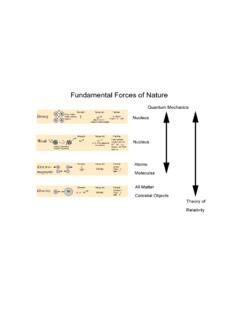
Nuclear Physics
Isotope A Z N Atomic Mass (u) Abundance 12 6 C 12 6 6 12.000000 98.90% 13 6 C 13 6 7 13.003355 1.10%
Download Nuclear Physics

Information
Domain:
Source:
Link to this page:
Documents from same domain
Measuring blackbody radiaiton using infrared …
physics.ucf.eduMeasuringBlackbody!Radiation!usingInfrared!Detectors!! Theory!! ... Objective!3:!Measurement!of!spectralradianceforablackbodycurve !!
Physics for Scientists and Engineers I
physics.ucf.eduPhysics for Scientists and Engineers I Dr. Beatriz Roldán Cuenya University of Central Florida, Physics Department, Orlando, FL PHY 2048H. Chapter 1 - Introduction I. General II. International System of Units III. Conversion of units IV. Dimensional Analysis V. Problem Solving Strategies.
Chapter 7 – Kinetic energy, potential energy, work
physics.ucf.eduI. Kinetic energy Energy associated with the state of motion of an object. (7.1) 2 K 1 mv2 Units: 1 Joule = 1J = 1 kgm2/s2 = N m II. Work Energy transferred “to” or “from” an object by means of a force acting on the object. To +W From -W - Constant force: F x ma x d v v v v axd ax 2 2 2 0 2 2 0 2 Work done by the force = Energy
Chapter 5 – Force and Motion I
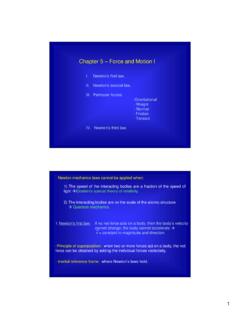
physics.ucf.eduChapter 5 – Force and Motion I I. Newton’s first law: If no net force acts on a body, then the body’s velocity cannot change; the body cannot accelerate v = constant in magnitude and direction. - Principle of superposition: when two or more forces act on a body, the net force can be obtained by adding the individual forces vectorially.
Chapter 5 – Force and Motion I - Physics
physics.ucf.eduN mg (5.5) - Normal force: perpendicular force on a body from a surface against which the body presses. - Frictional force: force on a body when the body attempts to slide along a surface. It is parallel ... Chapter 5 – Force and Motion II - Opposes the relative motion of a body in a fluid.
Chapter 29 – Electromagnetic Induction
physics.ucf.eduFaraday’s Law of Induction: - The induced emf in a closed loop equals the negative of the time rate of change of the magnetic flux through the loop. dt ε= − dΦB - Increasing flux ε< 0 ; Decreasing flux ε> 0 - Direction: curl fingers of right hand around A, if ε> 0 is in same direction of fingers (counter-clockwise), if ε< 0
Chapter 27 – Magnetic Field and Magnetic Forces
physics.ucf.edua magnet near a conducting loop can induce a current. - The magnetic forces between two bodies are due to the interaction between moving electrons in the atoms. - Inside a magnetized body (permanent magnet) there is a coordinated motion …
Chapter 24 – Capacitance and Dielectrics
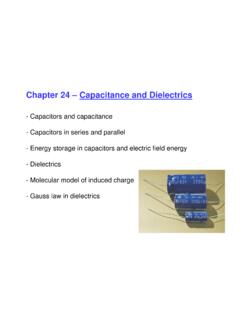
physics.ucf.edu- Capacitance is a measurement of the ability of capacitor to store energy (V = U / q). Capacitors in Vacuum - Parallel Plate Capacitor: uniform electric field between the plates, charge uniformly distributed over opposite surfaces A Q E εo εo σ = = d A V Q C ab = =ε0 A Qd V E d o ab ε 1 = ⋅ = ε0 = 8.85 x 10⁻¹² F/m
Black Body Radiation - Physics
physics.ucf.eduBlackbody Radiation 1/10/13 1:12 PM http://www.egglescliffe.org.uk/physics/astronomy/blackbody/bbody.html Page 1 of 7 Black Body Radiation Astronomy Main
Chapter 6 – Force and Motion II
physics.ucf.eduA centripetal force accelerates a body by changing the direction of the body’s velocity without changing its speed. v, a = ctes, but direction changes during motion.-Centripetal force: a, F are directed toward the center of curvature of the particle’s path. 3 III. Non-Uniform circular motion
Related documents
Moles Lab Activities
www.doe.virginia.govThe answer to question #19 is C-12, the reference isotope for atomic masses. Moles Lab Activity 2: Elements Time: Students will need about 5–10 minutes at each lab station to do initial calculations and measurements. They will need a total of 15–20 minutes to complete all questions, some of which could be completed at home.

Gas Chromatography-Mass Spectroscopy
cires1.colorado.eduThe fragments are charged ions with a certain mass. The mass of the fragment divided by the charge is called the mass to charge ratio (m/z). Since fragments produced by EI have a charge of +1, the m/z represents the molecular weight of the fragment. Ions created in the EI source are focused into the ion trap. The trap consists of two hyperbolic ...
Module 4 - Radiography Testing
www.rajagiritech.ac.inin the nucleus is the atoms mass number, and each isotope of a given element has a different mass number. •For example, carbon-12, carbon-13 and carbon-14 are three isotopes of the element carbon with mass numbers 12, 13 and 14 respectively. •Half life •Half-life is the amount of time required for a quantity

Nuclear Chemistry - University of Pennsylvania
www.sas.upenn.eduMass of 2 protons 2(1.00728 amu) Mass of 2 neutrons 2(1.00867 amu) Total = 4.03190 amu The mass of a Helium-4 nucleus is 4.00150 causing a mass defect of 0.0304 amu. The origin of this mass defect is some of the mass is converted to binding energy which binds the nucleons together in the nucleus. Energy then needs to be
Inductively Coupled Plasma Mass Spectrometry (ICP-MS)
www.iitk.ac.inMost abundant isotope of Ar is at mass 40 which dramatically interferes with the most abundant isotope Of Ca at mass 40. Combination of argon and oxygen in an aqueous sample generates the 40Ar16O+ interference, which has a significant impact on the major isotope of Fe at mass 56.
Radiological and Chemical Properties of Uranium
www.nrc.govNatural Uranium • There are three naturally occurring isotopes of uranium: U-234 U-235 U-238 • All th l li d l hAll three are long lived alpha-emitters. • U-238 is the head of the uranium decay series of which U-234 is a member. • U-235 is the head of the actinium decay series. • These decay series include alpha, beta and gamma emitters. 4
Method 533: Determination of Per- and Polyfluoroalkyl ...
www.epa.govsorbent bed volume. The ratio of sorbent mass to aqueous sample volume may not be decreased. If a laboratory uses 100 mL aqueous samples, the sorbent mass must be at least 200 mg. Changes may not be made to sample preservation, the quality control (QC) requirements, or the extraction procedure.
Mass spectrometry practice questions
www.sandsci.weebly.com(c)€€€€ The table below gives the percentage abundance of each isotope in the mass spectrum of a sample of titanium. € Define the term relative atomic mass of an element. Use the above data to calculate the value of the relative atomic mass of titanium in this sample. Give your answer to two decimal places. (4) (Total 18 marks) € €