
Nutrients Plants Require for Growth
There are 17 essential plant nutrients required for plant growth. 2. Sulfur is widely deficient in soils in the Pacific Northwest (table 3). Low levels of soil organic mat-ter or excessive watering can produce deficiencies. Calcium—A typical plant contains 0.5 percent Ca
Download Nutrients Plants Require for Growth

Information
Domain:
Source:
Link to this page:
Documents from same domain

4-H Poultry Showmanship Questions
www.extension.uidaho.edu2 2 How can one tell if baby chicks under a brooder light have the proper temperature? They are spread evenly under the brooder light, not all bunched up under the heat source or all far away from it.

Anaerobic Digestion Basics - uidaho.edu
www.extension.uidaho.educonverted into other products such as potting soil mixes. Digested liquid, which contains fewer pathogens and weed seeds and is rich in crop nutrients, can be used as ... (VS) (organic compounds of plant or animal origin that are lost on ignition of the dry solids at 550 ˚C [1022˚F]), particle size, pH, biodegradability,

BUL 870 Methods for Conducting an Educational Needs …
www.extension.uidaho.eduHowever, direct research requires considerably more resources to design and also requires institutional approval to conduct. Direct assessment should be conducted periodically for major program efforts. An indirect assessment can be conducted at any time when an advisory committee is meeting and does not require the same level of investment in ...

The Composting Process - uidaho.edu
www.extension.uidaho.edubut regulating and optimizing conditions ensures a faster process and the generation of a quality end product. ... (sugar and starches). In contrast, leaves, stems, nutshells, bark, and trees ... N ratios of 25 to 35:1 • Moisture contents of 50 to 60% by weight

A letter of last instruction: Everybody needs one
www.extension.uidaho.eduA letter of last instruction: Everybody needs one A letter of last instruction is an organized way for you to give your family all the facts about your finances—and have a basic tool for your own money management. A letter isn’t a will or a substitute for one. A will is a legal document telling an executor how to dis-
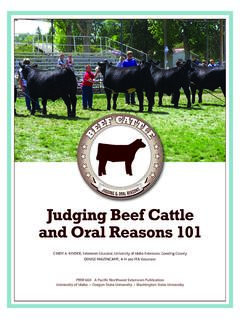
Judging Beef Cattle and Oral Reasons 101 - uidaho.edu
www.extension.uidaho.edubeef cattle: (1) growth and frame or skeletal size, (2) muscling, (3) volume, performance, (4) condition, trimness, and (5) structure, soundness, balance. Growth and frame or skeletal size the beef industry has ideal final live weights of 1250–1400 pounds and carcass weights of 700–900 pounds. Market-ready animals that are too
Related documents

Your Cat's Nutritional Needs - National Academies Press
www.nap.eduDetermining Grams of Essential Nutrients from Petfood Labels Petfood labels do not generally list amounts of essential nutrients in grams. However, all pet food labels must state guarantees for the minimum percentages of crude* protein and crude fat, and the maximum percentages of crude fiber and moisture.

Module 1: Overview of soil fertility, plant nutrition, and ...
www.agronext.iastate.eduo potential mobility of nutrients that might affect water quality . Understanding the principles of soil fertility is vital to efficient nutrient management, crop production, as well as environmental protection. There are seventeen chemical elements known to be essential for plant growth, and fourteen of these elements co\ me from the soil.

MACRONUTRIENTS, MICRONUTRIENTS AND WATER
acewebcontent.azureedge.netits essential amino-acid composition, digestibility and bioavailability, or the degree to which the amino acids can be used by the body. Generally, animal products contain all of the essential amino acids (called complete proteins), while plant foods do not. One notable exception is soy, which is a plant-based complete protein.

SOIL NUTRIENTS, SOURCES AND UPTAKE
www.agronomy.k-state.edumacro nutrients. Secondary nutrients are macronutrients but are less frequently deficient in soils. Micronutrients, also known as trace or minor elements, are required in very small amounts and are less frequently deficient. Even though nutrients are used in different amounts, each of the essential nutrients is equally important for plant growth.

How do plants get their nutrients? - Purdue University
www.asec.purdue.eduelements found in soil and water. Plant sci-entists focus on essential elements — those needed for growth and completion of the plant life cycle. Some essential elements are needed in large quantities (macronutrients) and others in much smaller quantities (micro-nutrients). • Plant macronutrients: calcium, carbon,
2. Fat-Soluble Vitamins and Nutrients
www.cdc.govantioxidant nutrients, principally from a variety of plant-derived foods such as fruits, vegetables, whole grains, and vegetable oils. Intake Recommendations. The National Academy of Sciences has established dietary-requirement intake values for vitamins A and E by determining the Adequate Intake (AI) for infants and the
Essential Nutrients for Plant Growth: Nutrient Functions ...
www.ctahr.hawaii.eduEssential Nutrients for Plant Growth: Nutrient Functions and Deficiency Symptoms R. Uchida From: Plant Nutrient Management in Hawaii’s Soils, Approaches for Tropical and Subtropical Agriculture J. A. Silva and R. Uchida, eds. College of Tropical Agriculture and Human Resources, University of Hawaii at Manoa, ©2000

37491 Dog P01 16 07/24/06 4:47 PM Page 1 YOUR DOG’S ...
www.nap.eduDetermining Grams of Essential Nutrients from Petfood Labels Petfood labels do not generally list amounts of essential nutrients in grams. However, all pet food labels must state guarantees for the minimum percentages of crude* protein and crude fat, and the maximum percentages of crude fiber and moisture. To convert these percentages