
Overall learning objectives Overall learning outcomes - STEM
Ask pupils to compare images of different skeletons and identify similarities. Draw out that even though the shape and size varies, a common feature is the backbone. This is why scientists use the presence (or absence) of a backbone as an important way of grouping animals. Animals with backbones are vertebrates.
Download Overall learning objectives Overall learning outcomes - STEM

Information
Domain:
Source:
Link to this page:
Documents from same domain
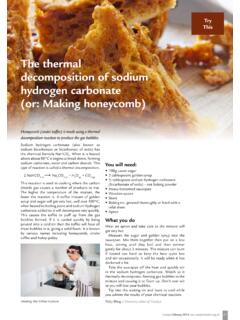
The thermal decomposition of sodium hydrogen …
www.stem.org.ukCatalyst February 2014 www.catalyststudent.org.uk21 Honeycomb (cinder toffee) is made using a thermal decomposition reaction to produce the gas bubbles.

A ci d s a n d A l ka l i s f o r K S 3 S ci e n ce - STEM
www.stem.org.ukAntacid for indigestion lime for acidic soils 4. Alkalis are special types of bases, which property do alkalis have? Alkali are bases that dissolve in water ... acid + metal carbonate → salt + water + carbon dioxide A ci d s a n d A l ka l i s f o r K S 3 S ci e n ce . 8. Complete the table - …
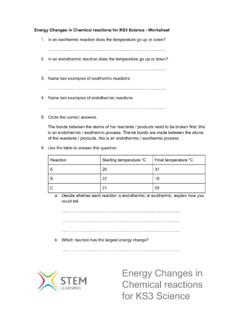
Energy Changes in Chemical reactions for KS3 Science
www.stem.org.ukIn an endothermic reaction, is enthalpy change positive or negative? positive 9. When hydrochloric acid reacts with ammonium hydroxide in a beaker, the temperature goes up. HCl + NH 4 O H → NH 4 C l + H 2 O ΔH = –53.4kJ/mol Complete the energy profile diagram and state whether the reaction is endothermic ...

States of Matter for KS3 - STEM
www.stem.org.ukStates of matter for KS3 Worksheet - Answers 1. Name the three states of matter and draw a particle diagram for each. 2. Complete the diagram below 3. Tick or Cross to show which states have which properties Property Solid Liquid Gas Fixed Shape x x Fixed Volume x Easily compressed x x States of Matter for KS3

Teacher questioning in science classrooms: Approaches that ...
www.stem.org.ukpotential in translating research insights into practical advice for teachers regarding tactical moves in ... Winne, 1979) were conducted using a process-product paradigm to study the relationship between teacher questioning and student achievement. However, these have produced mixed findings. ... students to the canonical knowledge that was ...

Questions to provoke thinking and discussion
www.stem.org.ukThese resources provoke thinking and discussion in science lessons to consolidate and extend core curriculum knowledge and understanding. The topics link to

50+ STEM activities for any primary classroom
www.stem.org.uk4 -5 5 -11 7 -9 7 -11 9 -11 9 -14 Choose age range: View 2 activities View 9 activities View 5 activities View 9 activities View 8 activities View 17

OUR SOLAR SYSTEM
www.stem.org.ukshare ideas In this activity, pupils will work in groups to research the different objects (the eight planets, comets and asteroids) in our Solar System. Each group will research one object and produce a fact sheet. At the end of the activity, the different groups present their findings to the class and combine the fact

50+ STEM activities for any secondary classroom
www.stem.org.ukChoose age range: View 43 activities View 2 activities View 5 activities View 17 activities This collection is for teachers, technicians, STEM Club leaders and families. It consists of easy to run, short and practical STEM activities which are ideal for any setting; classroom, outside and home.
Approaches Diagnostic questions - STEM
www.stem.org.ukDistributed under a Creative Commons Attribution-NonCommercial (CC BY-NC) license. Best Evidence Science Teaching Approaches Diagnostic questions There is, as Black and Wiliam noted in Inside the Black Box, a body of firm evidence that effective use of formative assessment can have a powerful effect on student learning. But what makes
Related documents
Basic Elasticity and viscoelasticity - Princeton University
assets.press.princeton.eduarthropod skeletons (chapter 5). All these materials have a well-ordered and tightly bonded structure and so broadly fall into the same class of material as metals and glasses. What happens when such materials are loaded, as when a muscle pulls on a bone, or when a shark crunches its way through its victim’s leg?
GLYCOLYSIS REVIEW & OVERVIEW - Department of …
mcb.berkeley.eduMammals can use some amino acid carbon skeletons to make glucose. We call these amino acids glucogenic. They are metabolized and enter into the citric acid cycle (TCA cycle) to make oxaloacetic acid, leading to the production of PEP. But acetate (a break down product of fatty acid metabolism and greasy amino acids) cannot be used.
PENTOSE PHOSPHATE PATHWAY - Department of …
mcb.berkeley.eduThe recycling of 5-carbon skeletons as expected for the stoichiometry below is complex: 6 Pentose 5 Hexose Metabolism Lecture 5 — PENTOSE PHOSPHATE PATHWAY — Restricted for students enrolled in MCB102, UC Berkeley, Spring 2008 ONLY
Activity: Is the Skeleton Male or Female?
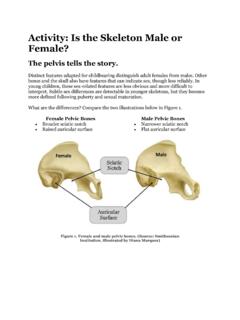
naturalhistory.si.eduinterpret. Subtle sex differences are detectable in younger skeletons, but they become more defined following puberty and sexual maturation. What are the differences? Compare the two illustrations below in Figure 1. Female Pelvic Bones Broader sciatic notch Raised auricular surface Male Pelvic Bones Narrower sciatic notch
Vertebrate and Invertebrate Animal Structure Notes
bvamsci7.weebly.comThey have skeletons. 10) An animal has bilateral symmetry if __. A. no lines can be drawn to divide the animal into halves that are mirror images. B. many lines can be drawn to divide the animal into halves that are mirror images. C. one line can be drawn to divide the animal into halves that are mirror images. ...
Answer: B - Forest Hills School District
www.fhrangers.orgC) They can have very long carbon skeletons. D) They have a lot of electrons associated with hydrogen. E) They are easily reduced. Answer: D Topic: Concept 9.1 Skill: Knowledge/Comprehension Refer to Figure 9.1 to answer the following questions. Figure 9.1 illustrates some of the steps (reactions) of glycolysis in their proper sequence.
Chapter 9 - The Family Afterward - (pp. 122-135)
www.aa.orgskeletons in the closet. Everyone knows about the others’ alcoholic troubles. This is a condition which, in ordinary life, would produce untold grief; there might be scandalous gossip, laughter at the expense of other people, and a tendency to take advantage of in timate information. Among us, these are rare occur rences.

Evidence of Evolution2008 - WPMU DEV
cpb-us-e1.wpmucdn.com1. Carefully examine the drawings of forelimb skeletons shown in Figure 1 on the next page. Look for similarities in the bones amongst the various animals. 2. Color in the human arm first. Color the bones of the arm (the humerus, ulna, and radius) blue. Color the bones of the hand (the carpal, metacarpals, and phalanges) yellow. 3.
The Structure and Function of Large Biological ... - Pearson
www.pearson.comgroups (orange), the length of their carbon skeletons, and the way their parts are arranged spatially around asymmetric carbons (compare, for example, the purple portions of glucose and galactose). MAKE CONNECTIONS In the 1970s, a process was developed that converts the glucose in corn syrup to its sweeter-tasting isomer, fructose.