
PANDAS Fact Sheet
1. Children with PANDAS are initially diagnosed with Obsessive Compulsive disorder or a tic disorder. OCD and tic symptoms in PANDAS are similar to those in the classic forms of childhood OCD and tic disorders (Murphy, Kurlan, & Leckman, 2010). 2. PANDAS first appears in childhood from age 3 to puberty. In addition to OCD or tics, these children
Download PANDAS Fact Sheet

Information
Domain:
Source:
Link to this page:
Documents from same domain

Obsessive Compulsive Personality Disorder (OCPD)
iocdf.orgA person does not need to have all of these symptoms to have the personality disorder. What is the difference between OCPD and OCD? • People with OCD have insight, meaning they are aware that their unwanted thoughts are unreasonable. People with OCPD think their way is the “right and best way” and usually feel comfortable with …
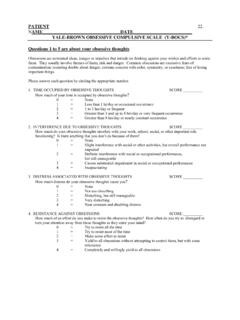
PATIENT 22. AME DATE YALE-BROWN OBSESSIVE …
iocdf.orgPATIENT 22. NAME_____DATE_____ YALE-BROWN OBSESSIVE COMPULSIVE SCALE (Y-BOCS)* Questions 1 to 5 are about your obsessive thoughts Obsessions are unwanted ideas, images or impulses that intrude on thinking against your wishes and efforts to resist
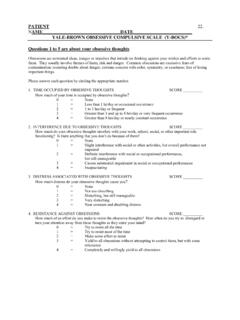
PATIENT AME DATE YALE-BROWN OBSESSIVE COMPULSIVE …
iocdf.orgPATIENT 22. NAME_____DATE_____ YALE-BROWN OBSESSIVE COMPULSIVE SCALE (Y-BOCS)* Questions 1 to 5 are about your obsessive thoughts Obsessions are unwanted ideas, images or impulses that intrude on thinking against your wishes and efforts to resist

International OCD Foundation
iocdf.org6 oCd: Frequently asked Questions How common is OCD? Our best estimates are that about 1 in 100 adults – or between 2 to 3 million adults in the United States – currently have OCD.1,2 This is roughly the same number of people living in the city of Houston, Texas.

SCRUPULOSITY What is Scrupulosity? What are the …
iocdf.orgCognitive behavior therapy featuring a procedure called “exposure and response prevention” is the primary psychological treatment for scrupulosity. A certain kind of
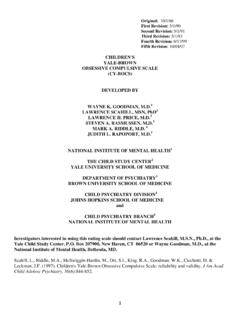
CHILDREN'S YALE-BROWN OBSESSIVE COMPULSIVE SCALE …
iocdf.orgobsessive compulsive scale (cy-bocs) developed by wayne k. goodman, m.d.1 lawrence scahill, msn, phd2 lawrence h. price, m.d.3 steven a. rasmussen, m.d.3 mark a. riddle, m.d. 4 judith l. rapoport, m.d.5 national institute of mental health1 the child study center2 yale university school of medicine department of psychiatry3
What is compulsive hoarding?
iocdf.orgAre hoarding and obsessive compulsive disorder (OCD) related? Compulsive hoarding was commonly considered to be a type of OCD. Some estimate that as many as 1 in 4 people with OCD also have compulsive hoarding. Recent research suggests that nearly 1 in 5 compulsive hoarders have non-hoarding OCD symptoms.
“JUST RIGHT” OCD SYMPTOMS
iocdf.orgThose with “just right” symptoms are also more likely to have other (“co-morbid”) conditions like tic disorders or skin picking that can make treatment more difficult. ... whereas a person with tics would tend to show less voluntary control over his/her actions.

Scrupulosity Fact Sheet - International OCD Foundation
iocdf.orgScrupulosity responds to the same treatments as those used with other forms of OCD. Cognitive behavior therapy featuring a procedure called “exposure and response prevention” is the primary psychological treatment for scrupulosity. A certain kind of medicines called Selective Serotonin Reuptake Inhibitors (SSRIs) is the primary drug
Related documents

DSM-5 SUMMARY PAGES
mrvolkmarpchs.weebly.comNeurodevelopmental Disorders: ADHD, Autism Spectrum, Intellectual Development, Tics Specialty Areas I: Trauma, Dissociative, Eating & Elimination Disorders ... - Multiple motor tics + 1 vocal tic - Persistent for 1 year - Marked distress or impairment - Onset before 18 years old
“JUST RIGHT” OCD SYMPTOMS
iocdf.orgThose with “just right” symptoms are also more likely to have other (“co-morbid”) conditions like tic disorders or skin picking that can make treatment more difficult. ... whereas a person with tics would tend to show less voluntary control over his/her actions.

OVERVIEW - BACB
www.bacb.comchronic pain, disruptive behavior, impulsivity, inattention, tic disorders, and sleep disturbance, among others. Interventions involve understanding clients’ thoughts, feelings, and actions—all of which are viewed as behavior that must be understood in context—thereby necessitating
The clinical approach to movement disorders
www.movementdisorders.orgmovement disorders, such as Parkinson disease (PD), tremor, tics and dystonia, are common conditions. the overall prevalence of PD, for example, is 1% in people

PE2224 Tics and Tic Disorders - Seattle Children's
www.seattlechildrens.orgTics and Tic Disorders 1 of 4 To Learn More • Neurology 206-987-2078 • • Ask your child’s healthcare provider • seattlechildrens.org Free Interpreter Services • In the hospital, ask your nurse. From outside the hospital, call the toll-free Family Interpreting Line, 1-866-583-1527. Tell the interpreter the name or extension you need.

MANAGING TOURETTE & TIC DISORDERS
www.tourette.orgPREVALENCE OF TS AND TIC DISORDERS • Tics are common and occur in as many as 1 in 5 school-aged children. • TS and Chronic Tic Disorders occur in an estimated 10 cases per 1,000 (1% or 1:100), suggesting that more than 500,000 children have a Tic Disorder in the United States. • TS occurs in 6 cases per 1,000 (0.6% or 1:160) children, meaning

Tic attacks and how to cope with them
www.tourettes-action.org.ukand tic disorders to help tolerate the urge to tic, reduce stress and manage tics. Guided relaxation on www.tourettes-action.org.uk Tics, stress and mental health: A video by clinical psychologist Dr Tara Murphy with top tips on reducing stress levels to help manage tics and overall well-being. Watch on YouTube

Overview of DSM 5 Neurodevelopmental Disorders
www.unm.edu• The neurodevelopmental motor disorders include developmental coordination disorder, stereotypic movement disorder, and tic disorders. • Developmental coordination disorder is characterized by deficits in the acquisition and execution of coordinated motor skills and is manifested by clumsiness and