
PART III. FUNCTIONS: LIMITS AND CONTINUITY
PART III. FUNCTIONS: LIMITS AND CONTINUITY III.1. LIMITS OF FUNCTIONS This chapter is concerned with functions f: D → R where D is a nonempty subset of R. That is, we will be considering real-valued functions of a real variable. The set D is called the domain of f. Definition 1. Let f: D → R and let c be an accumulation point of D. A number L
Download PART III. FUNCTIONS: LIMITS AND CONTINUITY

Information
Domain:
Source:
Link to this page:
Documents from same domain

Lecture notes Math 4377/6308 { Advanced Linear …
www.math.uh.eduLecture notes Math 4377/6308 { Advanced Linear Algebra I Vaughn Climenhaga October 7, 2013

Lecture notes Math 4377/6308 { Advanced Linear …
www.math.uh.eduLecture notes Math 4377/6308 { Advanced Linear Algebra I Vaughn Climenhaga December 3, 2013

Section 3.2 Solving Systems of Linear Equations Using Matrices
www.math.uh.eduSection 3.2 – Solving Systems of Linear Equations Using Matrices 1. Section 3.2 Solving Systems of Linear Equations Using Matrices . In Section 1.3 we solved 2X2 systems of linear equations using either the substitution or

Test 2 Review - UH
www.math.uh.eduJiwen He, University of Houston Math 1431 – Section 24076, Test 2 Review October 28, 2008 32 / 69 Section 4.7 Vertical Aymptotes: Rational Function The line x = 4 is a vertical asymptote for

1 Definition and Properties of the Exp Function - UH
www.math.uh.edu1 Definition and Properties of the Exp Function 1.1 Definition of the Exp Function Number e Definition 1. The number e is defined by ... ∀x > 0, E L = elnx = x. • ∀x > 0, y = lnx ⇔ ey = x. • graph(ex) is the reflection of graph(lnx) by line y = x. ... eudu = eu +C = eg(x) +C.

Jiwen He 1.1 Geometric Series and Variations
www.math.uh.eduVariations on the Geometric Series (II) Closed forms for many power series can be found by relating the series to the geometric series Examples 2.
Chapter 3 Second Order Linear Differential Equations
www.math.uh.edusecond order linear differential equation: a second or- der, linear differential equation is an equation which can be written in the form y 00 + p ( x ) y 0 + q ( x ) y = f ( x ) (1)
Second Order Linear Differential Equations - UH
www.math.uh.eduSecond Order Linear Differential Equations ... This chapter is concerned with special yet very important second order equations, namely linear equations. Recall that a first order linear differential equation is an equation which can be written in the form y0 + p(x)y= q(x)

Introduction to Real Analysis Fall 2014 Lecture Notes
www.math.uh.eduChapter 1 Metric Spaces These notes accompany the Fall 2011 Introduction to Real Analysis course 1.1 De nition and Examples De nition 1.1. Given a set X a metric on X is a function d: X X!R

Introduction to Real Analysis Spring 2014 Lecture Notes
www.math.uh.eduChapter 1 Sequences and Series of Functions In this chapter we introduce di erent notions of convergence for sequence and series of functions and then examine how integrals and derivatives be-
Related documents

18.03SCF11 text: Delta Functions: Unit Impulse
ocw.mit.eduDelta Functions: Unit Impulse OCW 18.03SC t 1=2 2 q(t) =) t 1=2 1 Q(t) t 1=8 8 q(t) =) t 1=8 1 Q(t) Figure 1: two possible graphs of q(t) and Q(t), both with total input = 1. It is easy to see that each of the boxes on the left side of Figure 1 has total area equal to 1. Thus, the graphs for Q(t) rise linearly to 1 and then stay equal to 1 ...

Rational Functions - University of Utah
www.math.utah.eduRational Functions In this chapter, you’ll learn what a rational function is, and you’ll learn how to sketch the graph of a rational function. Rational functions A rational function is a fraction of polynomials. That is, if p(x)andq(x) are polynomials, then p(x) q(x) is a rational function. The numerator is p(x)andthedenominator is q(x ...
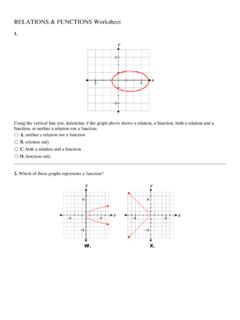
RELATIONS & FUNCTIONS Worksheet
8theastviewmath.weebly.comThe only mapping that does not map a domain element to two or more range elements is Z. 16. A relation is a set of one or more ordered pairs. A function is a relation in which each element of the domain is paired with EXACTLY one element of the range. In the table below, there are two y-coordinates for the x-coordinate -10. Therefore, it is a ...

Worksheet 2.6A, Rational functions - Sam Houston State ...
www.shsu.eduHere is a graph of the curve, along with the two vertical asymptotes: 2. b(x) = x x 1 has domain all real numbers except 1 so, in interval notation, the domain is (1 ;1) [(1;1): The rational function intersects the axes at the origin. It has a vertical asymptote x = …

Exponential Functions - University of Utah
www.math.utah.eduGraphs of exponential functions It’s really important that you know the general shape of the graph of an exponential function. There are two options: either the base is greater than 1, or the base is less than 1 (but still positive). Base greater than 1. If a is greater than 1, then the graph of f(x)=ax grows taller as it moves to the right.

Chapter 2: Linear Functions - Mt. Hood Community College
www.mhcc.eduLinear Function A linear function is a function whose graph produces a line. Linear functions can always be written in the form f (x) =b +mx or f (x) =mx +b; they’re equivalent where b is the initial or starting value of the function (when input, x = 0), and m is the constant rate of change of the function Many people like to write linear functions in the form