
PART III. FUNCTIONS: LIMITS AND CONTINUITY
PART III. FUNCTIONS: LIMITS AND CONTINUITY III.1. LIMITS OF FUNCTIONS This chapter is concerned with functions f: D → R where D is a nonempty subset of R. That is, we will be considering real-valued functions of a real variable. The set D is called the domain of f. Definition 1. Let f: D → R and let c be an accumulation point of D. A number L
Download PART III. FUNCTIONS: LIMITS AND CONTINUITY

Information
Domain:
Source:
Link to this page:
Documents from same domain

Lecture notes Math 4377/6308 { Advanced Linear …
www.math.uh.eduLecture notes Math 4377/6308 { Advanced Linear Algebra I Vaughn Climenhaga October 7, 2013

Lecture notes Math 4377/6308 { Advanced Linear …
www.math.uh.eduLecture notes Math 4377/6308 { Advanced Linear Algebra I Vaughn Climenhaga December 3, 2013

Section 3.2 Solving Systems of Linear Equations Using Matrices
www.math.uh.eduSection 3.2 – Solving Systems of Linear Equations Using Matrices 1. Section 3.2 Solving Systems of Linear Equations Using Matrices . In Section 1.3 we solved 2X2 systems of linear equations using either the substitution or

Test 2 Review - UH
www.math.uh.eduJiwen He, University of Houston Math 1431 – Section 24076, Test 2 Review October 28, 2008 32 / 69 Section 4.7 Vertical Aymptotes: Rational Function The line x = 4 is a vertical asymptote for

1 Definition and Properties of the Exp Function - UH
www.math.uh.edu1 Definition and Properties of the Exp Function 1.1 Definition of the Exp Function Number e Definition 1. The number e is defined by ... ∀x > 0, E L = elnx = x. • ∀x > 0, y = lnx ⇔ ey = x. • graph(ex) is the reflection of graph(lnx) by line y = x. ... eudu = eu +C = eg(x) +C.

Jiwen He 1.1 Geometric Series and Variations
www.math.uh.eduVariations on the Geometric Series (II) Closed forms for many power series can be found by relating the series to the geometric series Examples 2.
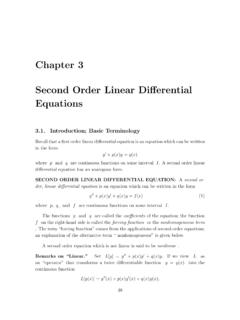
Chapter 3 Second Order Linear Differential Equations
www.math.uh.edusecond order linear differential equation: a second or- der, linear differential equation is an equation which can be written in the form y 00 + p ( x ) y 0 + q ( x ) y = f ( x ) (1)
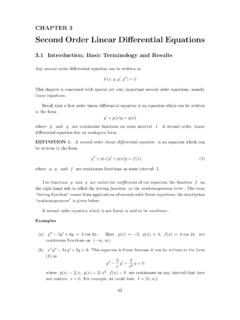
Second Order Linear Differential Equations - UH
www.math.uh.eduSecond Order Linear Differential Equations ... This chapter is concerned with special yet very important second order equations, namely linear equations. Recall that a first order linear differential equation is an equation which can be written in the form y0 + p(x)y= q(x)

Introduction to Real Analysis Fall 2014 Lecture Notes
www.math.uh.eduChapter 1 Metric Spaces These notes accompany the Fall 2011 Introduction to Real Analysis course 1.1 De nition and Examples De nition 1.1. Given a set X a metric on X is a function d: X X!R

Introduction to Real Analysis Spring 2014 Lecture Notes
www.math.uh.eduChapter 1 Sequences and Series of Functions In this chapter we introduce di erent notions of convergence for sequence and series of functions and then examine how integrals and derivatives be-
Related documents

Transformations of Exponential Functions - MRS. POWER
mrsspower.weebly.comTransformations of Exponential Functions To graph an exponential function of the form y a c k ()b x h() , apply transformations to the base function, yc x, where c > 0. Each of the parameters, a, b, h, and k, is associated with a particular transformation. Example 1: Translations of Exponential Functions Consider the exponential function

3 Graphing Quadratic Functions Worksheet
openlab.citytech.cuny.edu3 Graphing Quadratic Functions Worksheet Author: rpostman Created Date: 2/7/2011 12:50:42 PM ...

Inverse Trig Functions - Cornell University
twiki.math.cornell.eduDefinitions of the Inverse Functions When the trig functions are restricted to the domains above they become one-to-one func-tions, so we can define the inverse functions. For the sine function we use the notation sin−1(x) or arcsin(x). Both are read “arc sine” . Look carefully at where we have placed the -1.
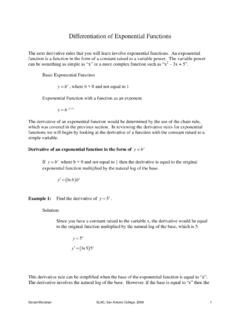
Differentiation of Exponential Functions
www.alamo.eduDifferentiation of Exponential Functions . The next derivative rules that you will learn involve exponential functions. An exponential function is a function in the form of a constant raised to a variable power. The variable power can be something as simple as “x” or a more complex function such as “x2 – 3x + 5”. Basic Exponential ...

The Algebra of Functions - Alamo Colleges District
www.alamo.eduThe Algebra of Functions . Like terms, functions may be combined by addition, subtraction, multiplication or division. Example 1. Given f ( x ) = 2x + 1 and g ( x ) = x2 + 2x – 1 find ( f + g ) ( x ) and ( f + g ) ( 2 )
Unit 3 Chapter 6 Polynomials and Polynomial Functions
www.scasd.orgLT 2. I can use polynomial functions to model real life situations and make predictions LT 3. I can identify the characteristics of a polynomial function, such as the intervals of increase/decrease, intercepts, domain/range, relative minimum/maximum, and end behavior. WS # 3 Practice 6-1 Polynomial Functions Find a cubic model for each function.