PARTIAL DIFFERENTIAL EQUATIONS
These lecture notes arose from the course \Partial Di erential Equations" { Math 124A taught by the author in the Department of Mathematics at UCSB in the fall quarters of 2009 and 2010. The selection of topics and the order in which they are introduced is based on [Str]. Most of the problems appearing in this text are also borrowed from Strauss.
Download PARTIAL DIFFERENTIAL EQUATIONS

Information
Domain:
Source:
Link to this page:
Documents from same domain

Real Analysis qual study guide - UC Santa Barbara
web.math.ucsb.eduReal Analysis qual study guide James C. Hateley 1. Measure Theory Exercise1.1. If AˆR and >0 show 9open sets OˆR such that m(O) m(A) + . Proof: Let fI
PARTIAL DIFFERENTIAL EQUATIONS - UC Santa Barbara
web.math.ucsb.eduPARTIAL DIFFERENTIAL EQUATIONS Math 124A { Fall 2010 « Viktor Grigoryan ... 5 Classi cation of second order linear PDEs 21 ... There are a number of properties by which PDEs can be separated into families of similar equations. The two main properties are order and linearity.
1 Magic Squares - UC Santa Barbara
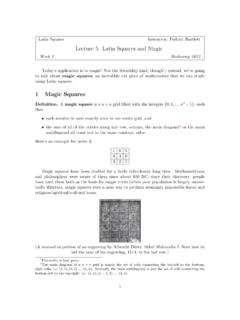
web.math.ucsb.edu1 Magic Squares De nition. A magic square is a n n grid lled with the integers f0;1;:::n2 1g, such that each number is used exactly once in our entire grid, and the sum of all of the entries along any row, column, the main diagonal2 or the main antidiagonal all come out to the same constant value. Here’s an example for order 3:

Finding All the Roots: Sturm’s Theorem
web.math.ucsb.eduSo this process generates a Sturm chain, as claimed. 1.2 Stating and Proving Sturm’s Theorem Sturm chains are pretty odd things; from their construction, it’s not immediately obvious
INTERNATIONAL SERIES IN PURE AND APPLIED …
web.math.ucsb.eduAND APPLIED MATHEMATICS William Ted Martin, E. H. Spanier, G. Springer and P. J. ... Numerical Methods for Scientists and Engineers HILDEBRAND: Introduction to Numerical Analysis ... Applied Mathematics for Engineers and Physicists RALSTON: A First Course in Numerical Analysis
Factoring Cubic Polynomials - UC Santa Barbara
web.math.ucsb.eduFactoring Cubic Polynomials March 3, 2016 A cubic polynomial is of the form p(x) = a 3x3 + a 2x2 + a 1x+ a 0: The Fundamental Theorem of Algebra guarantees that if a 0;a 1;a 2;a 3 are all real numbers, then we can factor my polynomial into the form

Practice Problems: Integration by Parts (Solutions)
web.math.ucsb.eduThis is the same as Problem #1, so Z ewsinwdw= 1 2 (ewsinw ewcosw) + C Plug back in w: Z sin(lnx)dx= 1 2 (xsin(lnx) xcos(lnx)) + C 13. R x3 p 1 + x2dx You can do this problem a couple di erent ways. I will show you two solutions. Solution I: You can actually do this problem without using integration by parts. Use the substitution w= 1 + x2 ...

Practice Problems: Trig Substitution
web.math.ucsb.eduR x p 1 x4dx Solution: Z x p 1 x4dx= x 1 (x2)2dx Let u= x2, then du= 2xdx: Z x p 1 (x2)2dx= 1 2 Z 1 u2du Now let u= sin , then du= cos d : 1 2 Z p 1 u2du= 1 2 Z 1 sin2 cos d = 1 2 Z cos2 d = 1 4 Z (1+cos2 )d = 1 4 + 1 2 sin2 +C= 1 4 ( +sin cos )+C Plug back in u. Since u= sin , the opposite side will be u, the hypotenuse will be 1, and the
Related documents
Laplace Transform solved problems - cuni.cz
matematika.cuni.czLaplace transform for both sides of the given equation. For particular functions we use tables of the Laplace transforms and obtain s(sY(s) y(0)) D(y)(0) = 1 s 1 s2 From this equation we solve Y(s) s3 y(0) + D(y)(0)s2 + s 1 s4 and invert it using the inverse Laplace transform and the same tables again and

Lecture Notes for Laplace Transform
www.personal.psu.eduLecture Notes for Laplace Transform Wen Shen April 2009 NB! These notes are used by myself. They are provided to students as a supplement to the textbook. They can not substitute the textbook. |Laplace Transform is used to handle piecewise continuous or impulsive force. 6.1: Deflnition of the Laplace transform (1) Topics: † Deflnition of ...
Solution of ODEs using Laplace Transforms
chemeng.queensu.caSolution is obtained by a getting the inverse Laplace transform from a table Alternatively we can use partial fraction expansion to compute the solution using simple inverse transforms. 14 Solution of Linear ODEs ... CHEE319_notes_2011_lecture3.ppt Author: Martin Guay

ECE 431 Digital Signal Processing Lecture Notes
cobb.ece.wisc.eduLT: Laplace Transform DFT: Discrete Fourier Transform ZT: z-Transform An fiIflpreceding an acronym indicates fiInverseflas in IDTFT and IDFT. All of these concepts should be familiar to the student, except the DFT and ZT, which we will de–ne and study in detail. 2 Review of the DT Fourier Transform 2.1 De–nition and Properties

Course Notes - College of Engineering
engineering.purdue.eduAcknowledgments These notes very closely follow the book: Signals and Systems, 2nd edition, by Alan V. Oppenheim, Alan S. Willsky with S. Hamid Nawab.
ORDINARY DIFFERENTIAL EQUATIONS FOR ENGINEERS | …
people.bath.ac.uk4. LAPLACE TRANSFORMS 75 1 Introduction 75 2 Laplace Transform 77 2.1 Definition 77 2.1.1 Piecewise Continuous Function 77 2.1.2 Laplace Transform 77 2.2 Existence of Laplace Transform 77 3 Basic Properties and Formulas of Laplace Transform 78 3.1 Linearity of Laplace Transform 78 3.2 Laplace Transforms for f(t) = eat 78

The Inverse Laplace Transform
www.math.unl.edu3. Example: Suppose you want to find the inverse Laplace transform x(t) of X(s) = 1 (s +1)4 + s − 3 (s − 3)2 +6. Just use the shift property (paragraph 11 from the previous set of notes): x(t) = L−1 ˆ 1 (s +1)4 ˙ + L−1 ˆ s − 3 (s − 3)2 +6 ˙ = e−t t3 6 + e3t cos √ 6t. 4. Example: Let y(t) be the inverse Laplace transform of ...