PARTIAL DIFFERENTIAL EQUATIONS
The linear equation (1.9) is called homogeneous linear PDE, while the equation Lu= g(x;y) (1.11) is called inhomogeneous linear equation. Notice that if uh is a solution to the homogeneous equation (1.9), and upis a particular solution to the inhomogeneous equation (1.11), then uh+upis also a solution to the inhomogeneous equation (1.11). Indeed
Download PARTIAL DIFFERENTIAL EQUATIONS

Information
Domain:
Source:
Link to this page:
Documents from same domain

Real Analysis qual study guide - UC Santa Barbara
web.math.ucsb.eduReal Analysis qual study guide James C. Hateley 1. Measure Theory Exercise1.1. If AˆR and >0 show 9open sets OˆR such that m(O) m(A) + . Proof: Let fI
PARTIAL DIFFERENTIAL EQUATIONS - UC Santa Barbara
web.math.ucsb.eduPARTIAL DIFFERENTIAL EQUATIONS Math 124A { Fall 2010 « Viktor Grigoryan ... 5 Classi cation of second order linear PDEs 21 ... There are a number of properties by which PDEs can be separated into families of similar equations. The two main properties are order and linearity.
1 Magic Squares - UC Santa Barbara
web.math.ucsb.edu1 Magic Squares De nition. A magic square is a n n grid lled with the integers f0;1;:::n2 1g, such that each number is used exactly once in our entire grid, and the sum of all of the entries along any row, column, the main diagonal2 or the main antidiagonal all come out to the same constant value. Here’s an example for order 3:

Finding All the Roots: Sturm’s Theorem
web.math.ucsb.eduSo this process generates a Sturm chain, as claimed. 1.2 Stating and Proving Sturm’s Theorem Sturm chains are pretty odd things; from their construction, it’s not immediately obvious
INTERNATIONAL SERIES IN PURE AND APPLIED …
web.math.ucsb.eduAND APPLIED MATHEMATICS William Ted Martin, E. H. Spanier, G. Springer and P. J. ... Numerical Methods for Scientists and Engineers HILDEBRAND: Introduction to Numerical Analysis ... Applied Mathematics for Engineers and Physicists RALSTON: A First Course in Numerical Analysis
Factoring Cubic Polynomials - UC Santa Barbara
web.math.ucsb.eduFactoring Cubic Polynomials March 3, 2016 A cubic polynomial is of the form p(x) = a 3x3 + a 2x2 + a 1x+ a 0: The Fundamental Theorem of Algebra guarantees that if a 0;a 1;a 2;a 3 are all real numbers, then we can factor my polynomial into the form

Practice Problems: Integration by Parts (Solutions)
web.math.ucsb.eduThis is the same as Problem #1, so Z ewsinwdw= 1 2 (ewsinw ewcosw) + C Plug back in w: Z sin(lnx)dx= 1 2 (xsin(lnx) xcos(lnx)) + C 13. R x3 p 1 + x2dx You can do this problem a couple di erent ways. I will show you two solutions. Solution I: You can actually do this problem without using integration by parts. Use the substitution w= 1 + x2 ...

Practice Problems: Trig Substitution
web.math.ucsb.eduR x p 1 x4dx Solution: Z x p 1 x4dx= x 1 (x2)2dx Let u= x2, then du= 2xdx: Z x p 1 (x2)2dx= 1 2 Z 1 u2du Now let u= sin , then du= cos d : 1 2 Z p 1 u2du= 1 2 Z 1 sin2 cos d = 1 2 Z cos2 d = 1 4 Z (1+cos2 )d = 1 4 + 1 2 sin2 +C= 1 4 ( +sin cos )+C Plug back in u. Since u= sin , the opposite side will be u, the hypotenuse will be 1, and the
Related documents
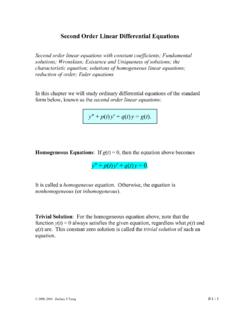
Second Order Linear Differential Equations
www.personal.psu.edureduction of order; Euler equations In this chapter we will study ordinary differential equations of the standard form below, known as the second order linear equations: y″ + p(t) y′ + q(t) y = g(t). Homogeneous Equations: If g(t) = 0, then the equation above becomes y″ + p(t) y′ + q(t) y = 0. It is called a homogeneous equation ...
Lecture 5: Homogeneous Equations and Properties of Matrices
dkatz.ku.eduA system of linear equations is said to be homogeneous if the right hand side of each equation is zero, i.e., each equation in the system has the form a 1x 1 + a 2x 2 + + a nx n = 0: Note that x 1 = x 2 = = x n = 0 is always a solution to a homogeneous system of equations, called the trivial solution. Any other solution is a non-trivial solution.

6.4.9 Solutions to homogeneous systems of linear equations
ece.uwaterloo.ca• If you were to solve the corresponding homogeneous system of linear equations, the constant vector in the solution is zero: Solutions to homogeneous systems of linear equations 11 6 3.9 §· ¨¸ ¨¸ ¨¸©¹ 2 22 1.4 01 0 x xx · ¸ ¸ ¸¹ x 0 0 0 §· ¨¸ ¨¸ ¨¸ ©¹ 2 22 1.4 1 00 x xx · ¸ ¸ ¸ ¹ x Example
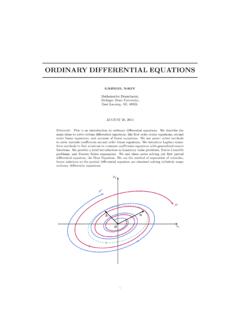
ORDINARY DIFFERENTIAL EQUATIONS
users.math.msu.edulinear equations, separable equations, Euler homogeneous equations, and exact equations. Soon this way of studying di erential equations reached a dead end. Most of the di erential equations cannot be solved by any of the techniques presented in the rst sections of this chapter. People then tried something di erent.

Chapter 2 Ordinary Differential Equations
www.et.byu.edu2.2.4 Homogeneous Equations Homogeneous function Homogeneous equation Reduction to separable equation – substitution Homogeneous functions in Rn 2.2.5 Linear 1st order ODE General solution Solution of IVP 2.2.6 Special Equations Bernoulli Equation Ricatti equation Clairaut equation Lagrange equation Equations solvable for y
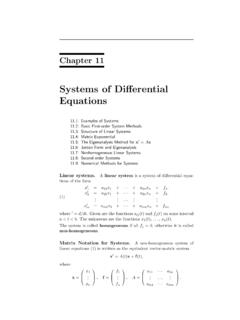
Systems of Differential Equations - University of Utah
www.math.utah.eduThe system is called homogeneous if all fj = 0, otherwise it is called non-homogeneous. Matrix Notation for Systems. A non-homogeneous system of ... 526 Systems of Differential Equations corresponding homogeneous system has an equilibrium solution x1(t) = x2(t) = x3(t) = 120. This constant solution is the limit at infinity of

Chapter 7 First-order Differential Equations
www.sjsu.eduLearn to solve typical first order ordinary differential equations of both homogeneous and non‐homogeneous types with or without specified conditions. Learn the definitions of essential physical quantities in fluid mechanics analyses. Learn the Bernoulli’s equation relating the driving pressure and the velocities of ...

Higher Order Linear Differential Equations
www2.math.upenn.eduHomogeneous equations The general solution If we have a homogeneous linear di erential equation Ly = 0; its solution set will coincide with Ker(L). In particular, the kernel of a linear transformation is a subspace of its domain. Theorem The set of solutions to a linear di erential equation of order n is a subspace of Cn(I). It is called the ...