
Pattern Block Lessons - The Math Learning Center
level bands, K–2 and 3–5. The lessons are excerpts from the Bridges in Math - ematics curriculum, published by The Math Learning Center. We hope you’ll find the free resources useful and engaging for your students. The Common Core State Standards (2010) define what students should un-derstand and be able to do in their study of mathematics.
Download Pattern Block Lessons - The Math Learning Center

Information
Domain:
Source:
Link to this page:
Documents from same domain

SECOND EDITION TEACHERS GUIDE 2 - The Math …
www.mathlearningcenter.orgNumber Corner Grade 2 Teachers Guide The Math Learning Center ... 12 – 6, 14 – 7) 3 1 Introducing Doubles & Doubles Plus or Minus One Facts

Bridges in Mathematics Grade 5 Unit 4 Module 1
www.mathlearningcenter.org• Divide a 3 or 4-digit whole number by a 2-digit whole number using strategies based on place value, the properties of operations, or the relationship between multiplication and division (5 NBT 6)

Bridges Grade 4 Assessment Guide - Overview
www.mathlearningcenter.orgBridges Assessment Guide Introduction Although the role of assessment has become a complex and sometimes charged topic, the daily reality of assessment in …

Martha Ruttle - The Math Learning Center
www.mathlearningcenter.orgMartha Ruttle. The pages in this Practice Book can be assigned in order to provide practice with key skills during each unit of the Bridges in Mathematics curriculum. The pages can also be used with other elementary math curricula. If you are using this Practice Book with

Family Unit Overview: Bridges Grade 4 Unit 2
www.mathlearningcenter.orgThe Math Learning Center 1018 2 www.mathlearningcenter.org Parents and teachers may reproduce this document or classroom and home use. Grade 4, Unit 2: Multi-Digit Multiplication & Early Division

Family Unit Overview: Bridges Grade 5 Unit 1
www.mathlearningcenter.orgThe Math Learning Center 1018 2 wwwmathlearningcenterorg Parents and teachers may reproduce this document for classroom and home use. Grade 5, Unit 1: xpressions, quations olume

Family Unit Overview: Bridges Grade 5 Unit 2
www.mathlearningcenter.orgUse a ratio table to multiply the numbers. 45 × 44 = _____ 1 2 4 40 44 45 90 180 1,800 1,980 Students continue to practice multiplying multi-digit numbers. In this example, they use a ratio table to use known facts to calculate first the partial products (45 × 4 and 45 × 40) and then the final product, which is the sum of those partial products
Bridges in Mathematics Grade 5 Unit 3 Module 2
www.mathlearningcenter.orgAfter a decimal subtraction problem string, students consider place value in decimal numbers and then use a new model to investigate thousandths and ten-thousandths Finally, the teacher introduces the Modeling Decimals Home Connection Skills & Concepts •emonstrate an understanding that in a multi-digit number, each digit represents ten D
A Resource for Teachers, A Tool for Young Children © 2010 ...
www.mathlearningcenter.orgA Resource for Teachers, A Tool for Young Children Authored by Jeffrey Frykholm, Ph.D. Overview: This book prepares teachers with the theoretical basis, practical knowledge, and expertise to use the number line as a vigorous model for mathematical learning in grades K–5. While the number line is a common artifact
Allyn Fisher - The Math Learning Center
www.mathlearningcenter.orgUnit Three: Addition, Subtraction & Probability Use anytime after Session 12 Facts to 8 37 Flowers & Oranges 38 Telling Time on Two Kinds of Clocks 39 Ladybug Story Problems 40 Facts to 9 41 Cookies & Apples 42 Number Patterns 43 Measuring Ladybug Paths 44 Facts to 10 45 Snacks 46 Addition & Subtraction Tables 47 Comparing Numbers to 100 48
Related documents
Common Core State StandardS
www.corestandards.org1 Make sense of problems and persevere in solving them. Mathematically proficient students start by explaining to themselves the meaning of a problem and looking for entry points to its solution. They analyze givens, constraints, relationships, and goals. They make conjectures about the form and

2020 SAT Understanding Scores - College Board
collegereadiness.collegeboard.org1. The . SAT. Suite . of Assessments. The SAT® Suite of Assessments is an integrated system of . tests that includes the SAT (for students in grades 11 and 12), the PSAT/NMSQT® and the PSAT™ 10 (for grades 10 and 11), and the PSAT™ 8/9 (for grades 8 and 9). The tests measure the same skills and knowledge in grade-appropriate ways.

THE ACT GAME ACT: ASSERTIVE COMMUNICATION …
chipts.ucla.eduStep 7: Explain the steps in problem-solving. Problem definition, goal clarification, alternative setting, evaluation of alternatives, implementation, and feedback are the problem-solving goals. Example: What do you do when you try to solve a problem? In good problem-solving, there are some steps that you take. I will write them on the board.

Supporting Mathematics Discourse with Sentence Starters ...
courses.maine.edc.orgproblem-solving. For example, sentence starters such as, “Can you explain how you…” and, “I wonder why you…” help students engage with their peers and extend their mathematics dialogue. When students use sentence starters and frames such as, “Can you tell me how you knew…?” and, “What does the _____ in your drawing represent
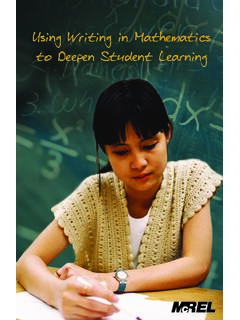
Using Writing in Mathematics to Deepen Student Learning
files.eric.ed.gov“Here’s the writing prompt: When I see this problem, my first reaction is. . . Here are your options: 1. I realize why I hate math. 2. I’m a little afraid, but I know that condense means to make something smaller. 3. I’m not exactly sure how to do this problem, but …

Can Do Descriptors - WIDA
wida.wisc.eduAug 01, 2016 · Organization of the WIDA Can Do Descriptors, Key Uses Edition, Grades K–12 The WIDA Can Do Descriptors, Key Uses Edition is organized by grade-level bands (K, 1, 2–3, 4–5, 6–8, and 9–12) that correspond to those in ACCESS for ELLs 2.0. Within each grade-level band, the descriptors are organized by Key Use (Recount, Explain, Argue and Discuss) and …
California Common Core State Standards
www.cde.ca.govknow and do mathematics by solving a range of problems and engaging in key mathematical practices. The development of the standards was informed by international benchmarking and began with research on what is known about how students’ mathematical knowledge, skills, and understanding develop over time. The progression from kindergarten
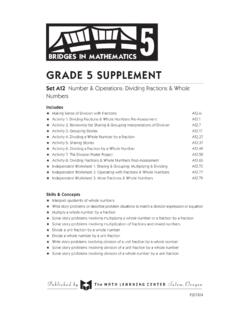
GRADE 5 SUPPLEMENT - The Math Learning Center
www.mathlearningcenter.orgThe models and instructional strategies you use during this supplement set will lead nicely into the work stu - dents do with multiplying and dividing fractions in Grades 6 and 7. Math educators Suzanne Chapin and Art Johnson caution us, however, that some of the division situations students will encounter in sixth and seventh
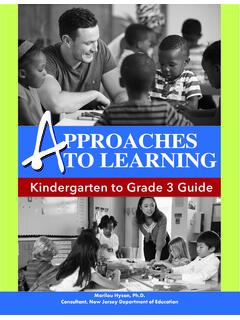
Approaches to Learning: Kindergarten to Grade 3 Guide
www.state.nj.uscompetencies are so important for K-3 children; gives you grade-by-grade examples of how children demonstrate these competencies; and lists many examples of ways that you can support children’s EPPIC skills: engagement in learning, their planning and problem-solving, and their initiative and creativity.