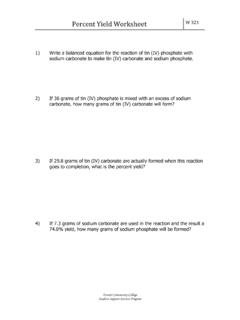
Percent Yield Worksheet
1) Write a balanced equation for the reaction of tin (IV) phosphate with sodium carbonate to make tin (IV) carbonate and sodium phosphate. 2) If 36 grams of tin (IV) phosphate is mixed with an excess of sodium carbonate, how many grams of tin (IV) carbonate will form? 3) If 29.8 grams of tin (IV) carbonate are actually formed when this reaction
Download Percent Yield Worksheet

Information
Domain:
Source:
Link to this page:
Documents from same domain
Medical Coding - Everett Community College
www.everettcc.educredit hour per week. Only students pursuing the Medical Coding or Medical Billing Specialist certificates should enroll in the coding classes.
Associate of Science - Transfer - Everett …
www.everettcc.eduHUMANITIES AND SOCIAL SCIENCES FOR THE ASSOCIATE OF SCIENCE DEGREE 15 credits in three different disciplines, selected from both (1) and (2) below.
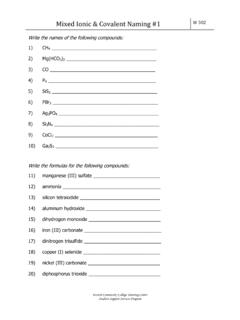
Mixed Ionic & Covalent Naming
www.everettcc.eduMixed Ionic & Covalent Naming W 302#1 Everett Community College Tutoring Center Student Support Services Program Write the names of the following compounds:
Mixed Naming Worksheet #2 - Everett Community College
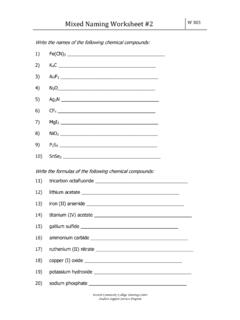
www.everettcc.eduMixed Naming Worksheet #2 W 303 Everett Community College Tutoring Center Student Support Services Program Write the names of the following chemical compounds:
Phlebotomy Technician Training - Everett Community College
www.everettcc.eduPhlebotomy is the act of drawing or removing blood from the circulatory system through a cut (incision) or puncture in order to obtain a sample for analysis and
Main Verbs and Helping Verbs - Everett Community College
www.everettcc.eduMain Verbs and Helping Verbs A verb may be more than one word. The main verb is the most important verb. The helping verb comes before it. Some Common Helping Verbs am was has is were have are will had The main verbs below are in bold print. Helping verbs are in italics.
Naming Ionic Compounds Worksheet 1
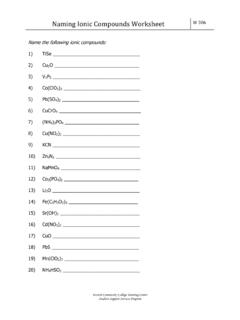
www.everettcc.eduNaming Ionic Compounds Worksheet W 306 Everett Community College Tutoring Center Student Support Services Program Name the following ionic compounds:
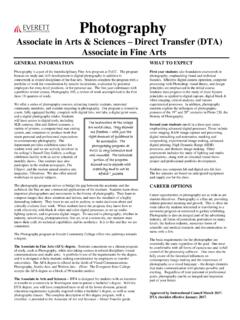
Photography - Everett Community College
www.everettcc.eduPhotography is a part of the interdisciplinary Fine Arts program at EvCC. The program focuses on study and skill development in digital photography in addition to coursework in related disciplines of the fine arts. Students complete the program with a

TRANSFER CREDIT EVALUATION REQUEST
www.everettcc.eduTransfer Credit Evaluation Request . ... We only accept Transfer Credit Evaluation Requests from students who have previously attended or are currently registered for classes at Everett C.C. ... You may choose to attach the official transcripts in sealed envelopes to this request form.
Instructor’s Resource Guide - Everett Community College
www.everettcc.eduInstructor’s Resource Guide (Version 2014-2015) ... cases an instructor is hired as an independent contractor and not considered an employee of EvCC. Instructor Contract (Employee): A contract is automatically generated once CCEC initiates compensation. Compensation is initiated
Related documents

Sodium – Potassium Pump
www.nosborne.com2. +Three +sodium ions (3 Na , shown as red balls) from the cytoplasm bind to “lock and key” sites on the Na -K+ pump. 3. The bound ATP is then split into ADP and inorganic phosphate (the ADP is released back into the cytoplasm, while the inorganic phosphate, P, remains bound to the pump). The breaking of this bond releases energy that powers a
SODIUM PHOSPHATE DIBASIC
nj.govSodium Phosphate Dibasic is an odorless, colorless, sand-like solid or white powder. It is used to make starch, as an emulsifier in foods, and in the production of enamels, ceramics and detergents. REASON FOR CITATION * Sodium Phosphate Dibasic is on the Hazardous
Sodium Hypochlorite ENVIRONMENT, SAFETY, HEALTH, AND ...
www-group.slac.stanford.eduproduce chlorine and chloramine gas. Decomposition of sodium hypochlorite takes place within a few seconds with the following salts: ammonium acetate, ammonium carbonate, ammonium nitrate, ammonium oxalate, and ammonium phosphate. Contact with metals may evolve flammable hydrogen gas. Containers may explode when heated. Releases chlorine gas when
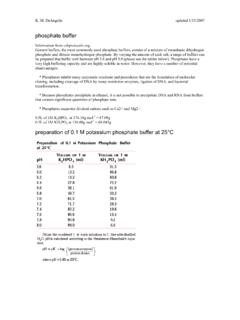
phosphate buffer - University of Nebraska–Lincoln
www.unl.eduphosphate buffer Information from cshprotocols.org: Gomori buffers, the most commonly used phosphate buffers, consist of a mixture of monobasic dihydrogen phosphate and dibasic monohydrogen phosphate. By varying the amount of each salt, a range of buffers can be prepared that buffer well between pH 5.8 and pH 8.0 (please see the tables below).
Chloride in Drinking-water - WHO
www.who.intSodium chloride 357 391 Potassium chloride 344 567 Calcium chloride 745 1590 Organoleptic properties The taste threshold of the chloride anion in water is dependent on the associated cation. Taste thresholds for sodium chloride and calcium chloride in water are in the range 200–300 mg/litre (2).