Plant Classification - Seneca High School
Plant Divisions Tracheophyta or Spermophyta – Seed Producing plants that bear flowers – Pterodophyta - a class of Tracheophyta that does not produce seeds (Ferns, reproducing with spores) Thallophyta – Fungi and bacteria
Download Plant Classification - Seneca High School

Information
Domain:
Source:
Link to this page:
Documents from same domain
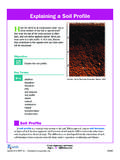
Explaining a Soil Profile
www.senecahs.orgA soil profile is usually studied to a depth of 3 to 5 feet. To see the soil profile, soil cores may be taken or holes dug to expose the pro-file.

Understanding Soil Texture and Structure
www.senecahs.orgSilt is the mid-size soil particle. Silt has good water-holding ability and good fertility char-acteristics. It feels like flour when dry and smooth like velvet when moist.
Plant Classification - Seneca High School
www.senecahs.orgCultivar Cultivars have distinguishing characteristics from the other plants in the species, but cultivars do not transfer those characteristics to offspring
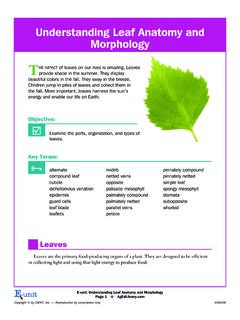
Understanding Leaf Anatomy and Morphology
www.senecahs.orgare responsible for most of the photosynthesis in the leaf and are called the palisade mesophyll. Located under the palisade mesophyll are loosely packed cells called the spongy mesophyll.

STHS Random Drug Testing Program Frequently Asked …
www.senecahs.orgFrequently Asked Questions Q: Why is this drug testing policy being put into place? A: Participation in extracurricular activities is a privilege, and participants need to be exemplars. The District also wants to foster health, safety, and the welfare of its students.
Explaining a Soil Profile - senecahs.org
www.senecahs.orgA soil profile is a vertical cross section of the soil. The differences are developed from the interaction of such soil-forming factors as parent material, slope, native vegetation, weathering, and climate. As a soil ages, horizontal layers develop and changes result. The causes of these

Understanding Horticulture
www.senecahs.orgapples, and pears. Small fruits include strawberries, raspberries, and blueberries. Almonds, pecans, and walnuts are popular nut crops. OLERICULTURE The area of horticulture that involves the production of vegetable food crops is olericulture. Olericulture includes the planting, harvesting, storing, processing, and marketing of vegeta-ble crops.
Understanding Soil Texture and Structure
www.senecahs.orgSoil Structure Sand, silt, clay, and organic-matter particles in a soil combine with one another to form larger particles of various shapes and sizes. These larger particles, or clusters, are often referred to as aggregates. The arrangement of the soil particles into aggregates of various sizes and shapes is soil structure.

SPANISH I CURRICULUM GUIDE
www.senecahs.orgCurriculum Guide: SPANISH I Course of Study : Spanish Core Standard: Connections And Communities Level: 1 Standards for 21st Century Enduring Understandings Essential Questions 3.1 3.2 5.1, 5.2 ISBE 30A and 30B The study of language applies to many different content areas. In what ways are the other subject areas in the curriculum affected by
Understanding Leaf Anatomy and Morphology
www.senecahs.orgAxillary bud Stipule Stem Petiole Blade FIGURE 1. The major parts of a leaf. Dicots have leaves with veins that connect and branch from each other. Veins in a branch-ing pattern are called netted veins. A leaf with netted veins sometimes has several smaller
Related documents
UNIT 2 STEAM POWER PLANT Steam Power Plant
www.ignou.ac.inPower Plant Engineering Objectives After studying this unit, you should be able to know steam generator, steam turbine, and describe cooling towers and condensers. 2.2 BASIC CONSIDERATION IN THE ANALYSIS OF POWER CYCLES Actual Cycle The cycles encountered in actual devices are difficult to analyze because of the
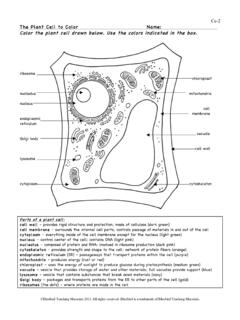
Ce-2 The Plant Cell to Color Name: Color the plant cell ...
cpb-us-e1.wpmucdn.comThe Plant Cell Worksheet Name: KEY Label the plant cell drawn below and then give the function of each cell part. cell wall 7. 1. mitochondria e ER 8. 2. cytoplasm nucleolus 9. 3. cell membrane 10. nucleus 10.

LEARNING ABOUT Grade 5 and up PLANT LESSON PARTS OF …
www.towergarden.coman animation from the Great Plant Escape website that shows a simplified 4-step fertilization sequence on slide 5. Lesson Objective: Learners will explain how fertilization occurs to form seeds and how the ovary develops into fruit containing seed(s) and will then label a diagram with flower terminology.
Plant Pathogens & Principles of Plant Pathology
www.agrimoon.comPlant pathology can also be defined as the study of the nature, cause and prevention of plant diseases. Plant pathology is related to most of the old and new sciences like biology, physics, chemistry, physiology, mathematics, genetics, soil science, biochemistry, biotechnology etc. Plant pathology has the following major objectives. 1.
Secondary Metabolites - Plant Phys
6e.plantphys.netmajor types of plant secondary metabolites, their biosyn-thesis, and what is known about their functions in the plant, particularly their defensive roles. Secondary metabolites are divided into three major groups Plant secondary metabolites can be divided into three chemically distinct groups: terpenes, phenolics, and nitro -
Wisconsin Dairy Plant Directory
datcp.wi.govThe 2020-2021 Wisconsin Dairy Plant Directory is designed to enable the user to locate and identify the business office and plant location of every licensed dairy plant and bulk milk tanker (BMT) wash facility in Wisconsin. In the first section, each plant is listed by county and is identified by trade name, plant

Plant Parts - UCANR
marinmg.ucanr.educarrot plant, grass plant, hand lens, ruler, and Plant Parts worksheet. Instruct students to lay their plants on the opened newspaper and gently spread the roots out. Have students use a colored marker and draw a circle around the roots of each plant. Invite students to use the hand lens to make close observations of the roots.
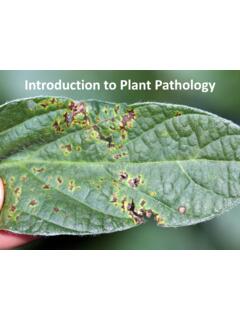
Introduction to Plant Pathology - Integrated Pest …
www.ipm.iastate.edu•Infectious plant diseases are caused by living organisms that attack and obtain their nutrition from the plant they infect. The parasitic organism that causes a disease is a pathogen. Numerous fungi, bacteria, viruses, and nematodes are pathogens of corn and soybean in Iowa. •The plant invaded by the pathogen and serving as its

PLANT POPULATIONS & PLANT SPACINGS
www.kzndard.gov.zaPlant spacing, on the other hand, refers to the ARRANGEMENT of plants on the area planted. Example: Widely varying plant spacings such as 1 000 mm x 10 mm, 500 mm x 20 mm and 100 mm x 100 mm, all give a plant population of 100 plants per square metre. Question: What is the optimum population or spacing for a specific vegetable crop?