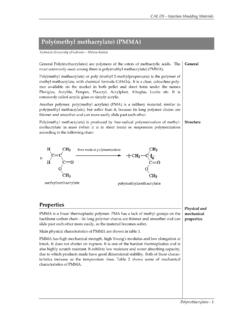
Poly(methyl methacrylate) (PMMA)
Tensile Creep Modulus, 1 h 1800 ‐ 2700 MPa Tensile Creep Modulus, 1000 h 1200 ‐ 1800 MPa The low water absorption capacity of PMMA makes it very suitable for electrical engineering purposes. Its dielectric properties are very good, but polystyrene and LDPE are superior to it.
Download Poly(methyl methacrylate) (PMMA)

Information
Domain:
Source:
Link to this page:
Documents from same domain

IS 2508 (1984): Low Density Polyethylene Films
alokrj.weebly.comIS:2506- 1964 Indian Standard SPECIFICATION FOR LOW DENSITY POLYETHYLENE FILMS ( Second Revision ) 0. FOREWORD 8.1 This Indian Standard ( Second Revision ) was adopted by the Indian
Melt Flow Index - Plastics World
alokrj.weebly.comCarbon blacks have the most pronounced effect, and unless very high flow polymers are used as carriers, resultant masterbatches have little or no flow when measured using a standard 2.16 kg weight. For this reason most data sheets quote values measured using higher weights (e.g. 21.6 kg). For example, a typical masterbatch

Analytic Geometry in Two and Three Dimensions
alokrj.weebly.comThe Ellipse is 616 ft long, 528 ft wide, and is in the shape of a conic section. Its shape can be modeled using the methods of this chapter. See page 652. 5144_Demana_Ch08pp631-698 1/13/06 6:49 AM Page 631

Blow molding troubleshooting guide - Plastics World
alokrj.weebly.comImproper mold closure. • Decrease extrusion pressure or rate. • Increase melt temperature. • Check mold alignment. • Center mandrel in die. • Increase container weight. • Decrease pre-blow air pressure or time. • Change tooling to smaller diameter set. • Consult your Dow representative about lower die swell resins. In the U.S., you
Related documents
Thermal insulation materials made of rigid polyurethane foam
highperformanceinsulation.eu2.1.2.3 Influence of temperature 2.1.2.4 Influence of water absorption after ... (compressive creep) 2.5 Tensile strength perpendicular to faces σ ... giving them structural and constructional design properties that offer a high level of security, both in the processing stages and in the finished building.
Standard Test Method for Tensile Properties of Plastics1
www.dept.aoe.vt.eduNOTE 4—For tensile properties of resin-matrix composites reinforced with oriented continuous or discontinuous high modulus >20-GPa (>3.0 × 10⁶-psi) fibers, tests shall be made in accordance with Test Method D3039/D3039M. 1.4 Test data obtained by this test method have been found to be useful in engineering design. However, it is important to
Engineering Properties of Polyethylene
www.awwa.orgneering properties established at the standard temperature of 73°F (23°C) and then employ industry established temperature compensating multipliers to provide for the service condition temperatures. Tensile Strength Tensile strength is a short-term property that provides a …

Kapton® Summary of Properties - DuPont
www.dupont.comproperties as tensile strength and modulus are inversely proportional to temperature, whereas elongation reaches a maximum value at about 300°C (570°F). Other factors, such as humidity, film thickness, and tensile elongation rates, were found to have only a negligible effect on the shape of the 23°C (73°F) curve. Figure 1.

Lecture notes on Structure and Properties of Engineering ...
www.wright.edu• Mechanical properties of polymers change dramatically with temperature, going from glass-like brittle behavior at low temperatures to a rubber-like behavior at high temperatures. • Polymers are also very sensitive to the rate of deformation (strain rate). Decreasing rate of deformation has the same effect as increasing temperature (T).
HIGH-TEMPERATURE CHARACTERISTICS OF STAINLESS STEELS
nickelinstitute.orgtemperature is related to time at temperature. Allowable Deformation Another factor to consider in designing for high-temperature service is the amount of deformation that can be permitted during the total service life. This factor determines which of two high-temperature strength properties should be given priority; creep or
Mylar Physical Properties - DuPont Teijin Films
usa.dupontteijinfilms.comTemperature affects the tensile properties of Mylar®; data on a typical sample are shown in Figure 2. When considering the use of Mylar® at high temperatures, reference should be made to the last five pages of this bulletin. Figure 2. Tensile Properties vs. Temperature Compressive Properties Compression tests provide information about the

HAYNES 230 alloy
www.haynesintl.comCreep and Rupture Properties HAYNES® 230® alloy is a solid-solution-strengthened material which combines excellent high-temperature strength with good fabricability at room temperature. It is particularly effective for very long-term applications at temperatures of 1200°F (650°C) or more, and is

alloy X-750
www.specialmetals.comFigure 2. High-temperature fatigue strength (108 cycles) of bar. Rotating-beam tests (3450 rpm). ess, ksi Stress, ksi Time, hr Temperature, °F The results of two series of tests of high-temperature tensile properties are shown in Tables 7 and 8. Relaxation data are in Figure 1. Fatigue strength of equalized plus precipitation-treated