Polynomial functions - mathcentre.ac.uk
3. Graphs of polynomial functions We have met some of the basic polynomials already. For example, f(x) = 2is a constant function and f(x) = 2x+1 is a linear function. f(x) x 1 2 f(x) = 2 f(x) = 2x + 1 It is important to notice that the graphs of constant functions and linear functions are always straight lines.
Download Polynomial functions - mathcentre.ac.uk

Information
Domain:
Source:
Link to this page:
Documents from same domain
sigma - mathcentre.ac.uk
www.mathcentre.ac.ukSigma notation Sigma notation is a method used to write out a long sum in a concise way. In this unit we look at ways of using sigma …
Ratios
www.mathcentre.ac.uk1. Introduction A ratio is a way of comparing two or more similar quantities. Ratios can be used to compare costs, weights, sizes and other quantities.
The geometry of a circle - mathcentre.ac.uk
www.mathcentre.ac.ukThe geometry of a circle mc-TY-circles-2009-1 In this unit we find the equation of a circle, when we are told its centre and its radius. There are
evaluation of mathematics support centres - …
www.mathcentre.ac.uk3 Section 1: Executive Summary Mathematics Support Centres (MSCs) have been established at universities in the UK and in a number of other countries
Partial fractions - mathcentre.ac.uk
www.mathcentre.ac.ukPartial fractions mc-TY-partialfractions-2009-1 An algebraic fraction such as 3x+5 2x2 − 5x− 3 can often be broken down into simpler parts called partial fractions.
Percentages
www.mathcentre.ac.ukKey Point Percentage means ‘out of 100’, which means ‘divide by 100’. To change a fraction to a percentage, divide the numerator by the denominator and multiply by
Polynomial functions - Mathematics resources
www.mathcentre.ac.uk3. Graphs of polynomial functions We have met some of the basic polynomials already. For example, f(x) = 2is a constant function and f(x) = 2x+1 is a linear function.
Solving inequalities - Mathematics resources
www.mathcentre.ac.ukSolving inequalities mc-TY-inequalities-2009-1 Inequalities are mathematical expressions involving the symbols >, <, ≥ and ≤. To ‘solve’ an
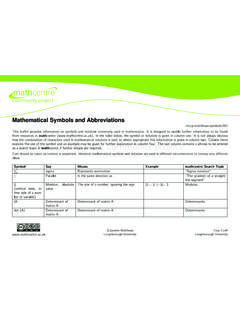
mathcentrecommunityproject - Mathematics …
www.mathcentre.ac.ukmathcentrecommunityproject encouraging academics to share maths support resources AllmccpresourcesarereleasedunderaCreativeCommonslicence community …
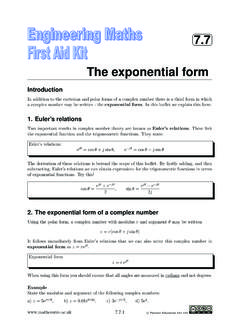
7.7 The exponential form - Mathematics resources
www.mathcentre.ac.uk7.7 The exponential form Introduction In addition to the cartesian and polar forms of a complex number there is a third form in which a complex number may be written - the exponential form.
Related documents
Schaum's Outline of Linear Algebra
www.astronomia.edu.uyLinear Combinations, Spanning Sets 4.5 Subspaces 4.6 Linear Spans, Row Space of a Matrix 4.7 Linear Dependence and Independence 4.8 Basis and Dimension 4.9 Application to Matrices, Rank of a Matrix 4.10 Sums and Direct Sums 4.11 Coordinates CHAPTER 5 Linear Mappings 164 5.1 Introduction 5.2 Mappings, Functions 5.3 Linear Mappings (Linear
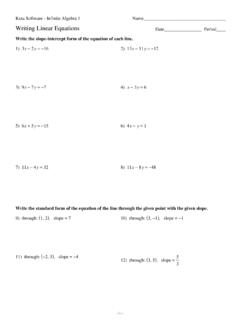
Writing Linear Equations
cdn.kutasoftware.comWriting Linear Equations Date_____ Period____ Write the slope-intercept form of the equation of each line. 1) 3 x − 2y = −16 2) 13 x − 11 y = −12 3) 9x − 7y = −7 4) x − 3y = 6 5) 6x + 5y = −15 6) 4x − y = 1 7) 11 x − 4y = 32 8) 11 x − 8y = −48
ELEMENTARY DIFFERENTIAL EQUATIONS WITH BOUNDARY …
ramanujan.math.trinity.eduFunctions 430 8.6 Convolution 440 8.7 Constant Cofficient Equationswith Impulses 452 8.8 A Brief Table of Laplace Transforms Chapter 9 Linear Higher Order Equations 9.1 Introduction to Linear Higher Order Equations 465 9.2 Higher Order Constant Coefficient Homogeneous Equations 475 9.3 Undetermined Coefficients for Higher Order Equations 487
Linear Algebra Review and Reference - Stanford University
cs229.stanford.eduJun 20, 2020 · Linear algebra provides a way of compactly representing and operating on sets of linear equations. For example, consider the following system of equations: 4x 1 5x 2 = 13 2x 1 + 3x 2 = 9: This is two equations and two variables, so as you know from high school algebra, you can nd a unique solution for x 1 and x 2 (unless the equations are ...
Linear Transformations - Stanford University
math.stanford.eduLinear Transformations The two basic vector operations are addition and scaling. From this perspec-tive, the nicest functions are those which \preserve" these operations: Def: A linear transformation is a function T: Rn!Rm which satis es: (1) T(x+ y) = T(x) + T(y) for all x;y 2Rn (2) T(cx) = cT(x) for all x 2Rn and c2R.
INTRODUCTION TO THE SPECIAL FUNCTIONS OF …
www.physics.wm.eduA simple first order linear differential equation 29 ... Modified Bessel functions of the second kind 190 ... The course begins with review of infinite series and complex analysis, then covers Gamma and Elliptic functions in some de-tail, before turning to the main theme of …

Review of Likelihood Theory - Princeton University
data.princeton.eduReview of Likelihood Theory This is a brief summary of some of the key results we need from likelihood theory. A.1 Maximum Likelihood Estimation Let Y 1,...,Y n be n independent random variables (r.v.’s) with probability density functions (pdf) f i(y i;θ) depending on a vector-valued parameter θ. A.1.1 The Log-likelihood Function
CHAPTER 6 Power Series Solutions to Second Order Linear …
math.wvu.eduLINEAR ORDINARY DIFFERENTIAL EQUATIONS (ODE"s) CHAPTER 6 Power Series Solutions to Second Order Linear ODE’s 1. Review of Linear Theory and Motivation for Using Power Series 2. Functions Defined by Power Series 3. The Interval of Convergence of a Power Series 4. Taylor and MaClaurin Series 5. Power Series Solution of Second Order Linear ODE’s
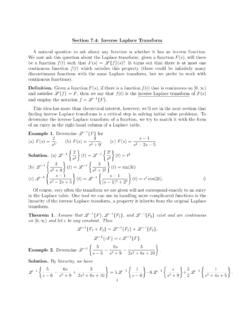
Section 7.4: Inverse Laplace Transform - University of Florida
people.clas.ufl.eduReview of Partial Fractions A rational function P(s)=Q(s), where P(s);Q(s) are polynomials with the degree of P less than the degree of Q, has a partial fraction expansion based on the factorization of Q. There are three main cases to consider, the easiest being that of nonrepeated linear factors. If Q(s) is a product of distinct linear factors,

LINEAR FIRST ORDER Ordinary Differential Equations
web.iit.edua review of the direct method to solve linear first-order differential equations, jump ahead to the direct method on slide 14. The Property ... the obtained functions will be solutions of the associated homogenous equation of the original differential equation; and