Practice Guideline - college-ece.ca
interactions is the goal. As co-learners, collaborators, keen observers and intentional communicators, registered early childhood educators (RECEs) support positive interactions with children rather than manage or direct behaviour. The College of Early Childhood Educators has developed this practice guideline to help
Download Practice Guideline - college-ece.ca

Information
Domain:
Source:
Link to this page:
Documents from same domain
Practice Guideline - college-ece.ca
www.college-ece.caPractice Guideline Introduction: Rethinking Behaviour Guidance Today, a reframing of the definition of behaviour guidance is required —one that views responsive

Change of Information Form - college-ece.ca
www.college-ece.caSection 6: Signed . Confirmation . By checking this box and typing or printing my name, I confirm that all the information in this Change of Information Form and related documents is true.

For registered early childhood educators in Ontario July 2017
www.college-ece.ca4 College of Early Childhood Educators | Code of Ethics and Standards of Practice | July 2017 RECEs work in diverse roles and settings, including but not limited to: • Licensed child care (e.g.centre-based, home-based child care) • Unlicensed child care (e.g.unlicensed home-based child care, nanny, childminding services)
Practice Guideline - college-ece.ca
www.college-ece.caPractice Guideline The Profession: Care and public contribute to ongoing, quality practice as well Relationship-Based Practice The purpose of the early childhood education profession, noted in the Early Childhood Educators Act, 2007, is to “promote the well-being and holistic development of children.” In order to meet this
Reflective Practice and Self-Directed Learning
www.college-ece.ca(CPL Portfolio Cycle Handbook, 2017). How do I benefit from self-directed learning? Engaging in self-directed learning provides you with full control and ownership over your own learning. It gives you the opportunity to choose learning activities that are relevant and meaningful to your professional practice needs and long-term goals.
Form General Application - college-ece.ca
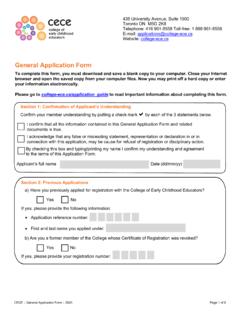
www.college-ece.caapplication_guide and then fill out the following: • Province or Territory ... If you answered "Yes” to question 11, answer the following: ... 10.Have you ever had a letter of permission to work in a full-day kindergarten program in the role of an ECE removed? Yes No.
PG - Pedagogical Practice
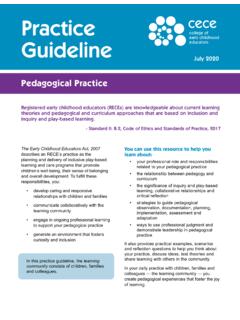
www.college-ece.caPedagogical Practice Registered early childhood educators (RECEs) are knowledgeable about current learning theories and pedagogical and curriculum approaches that are based on inclusion and inquiry and play-based learning. - Standard II: B.2, Code of Ethics and Standards of Practice, 2017 The Early Childhood Educators Act, 2007
CECE Code of Ethics and Standards of Practice for RECEs in ...
www.college-ece.ca8 College of Early Childhood Educators | Code of Ethics and Standards of Practice | July 2017 Standard I: Caring and Responsive Relationships A. Principle Registered early childhood educators (RECEs) understand that strong, positive relationships contribute to healthy child development and are necessary for children’s well-being and learning.
Honourable Stephen Lecce
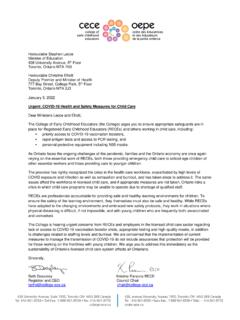
www.college-ece.caHonourable Stephen Lecce Minister of Education 438 University Avenue, 5th Floor Toronto, Ontario M7A 1N3 Honourable Christine Elliott Deputy Premier and Minister of Health 777 Bay Street, College Park, 5th Floor Toronto, Ontario M7A 2J3 January 5, 2022 Urgent: COVID-19 Health and Safety Measures for Child Care Dear Ministers Lecce and Elliott,
Practice Guideline: Diversity and Culture
www.college-ece.caDiversity and culture can be defined in many different ways in various documents by different cultural groups and organizations. For consistency, this resource will draw on the definitions found in the Code and Standards which states: Diversity is the difference and uniqueness that each person brings to the early-years setting.
Related documents
FORMATIVE ASSESSMENT: GUIDANCE FOR EARLY …
ceelo.orgdevelopment in order to help early childhood educators make informed instructional and programmatic decisions. A comprehensive assessment system includes, at a minimum, screening measures, formative assessments, measures of environmental quality, and measures of the quality of adult -child interactions.”

21st CENTURY LEARNING FOR EARLY CHILDHOOD GUIDE
static.battelleforkids.orgNeuroscientists, educators, and early childhood development experts agree that early experiences have a major impact on the development of the brain and learning as adults. The brain has the greatest plasticity, or is the most flexible, during infancy through age five to accommodate a wide range of experiences, interactions, and environments.

Healthy Gender Development and Young Children
depts.washington.eduHealthy Gender Development and Young Children: A Guide for Early Childhood Programs and Professionals. offers practical guidance for teachers, caregivers, parents and staff. It draws on decades of research on child and gender development, and experiences of early childhood educators, pediatricians, and mental health professionals.

Playing with Mathematics: Play in Early Childhood as a ...
files.eric.ed.govThe role of early childhood educators in using play to build on children’s existing ... A group of three-year-olds is having a conversation with an adult. One of the children ... The social interactions within play facilitate joint meaning making, as
RELATIONSHIPS WITH CHILDREN - ACECQA
www.acecqa.gov.auwhich educators build relationships with children. WHY RELATIONSHIPS ARE IMPORTANT Good relationships early in life help children to connect with others, build positive friendships and support children to self-regulate their emotions. Meaningful interactions For relationships to be meaningful, interactions need to be warm, caring and responsive.

A resource for Early Childhood Educators.
www.childaustralia.org.auHave reasonable expectations Intentionally teach turn taking in small groups (over two’s) and considerate behaviour Give toddlers concrete information e.g. “Biting hurts” Talk with parents about children’s development 5 When children bite A resource for Early Childhood Educators

CONTEXT OF EARLY CHILDHOOD EDUCATION AND CARE …
www.tusla.ieearly years providers and educators to help meet these requirements and expectations. The developments which impact on service provision for young children include: The development of Síolta: The National Quality Framework for Early Childhood Education (CECDE, 2006) and the Síolta Quality Assurance Programme (QAP).
Related search queries
FORMATIVE ASSESSMENT, FOR EARLY, Early childhood educators, Assessment, Formative, Adult, Interactions, For Early Childhood, Educators, Early childhood, Early, Gender, Mathematics: Play in Early Childhood, Relationships with children, Resource for Early Childhood Educators, Expectations, CONTEXT OF EARLY CHILDHOOD EDUCATION AND CARE