Practice Guidelines for Obstetric Anesthesia
related complications, and increase patient satisfaction. Focus These guidelines focus on the anesthetic management of pregnant patients during labor, nonoperative delivery, operative delivery, and selected aspects of postpartum care and analgesia (i.e., neuraxial opioids for postpartum anal-gesia after neuraxial anesthesia for cesarean delivery).
Download Practice Guidelines for Obstetric Anesthesia

Information
Domain:
Source:
Link to this page:
Documents from same domain
Practice Advisory for the Prevention, Diagnosis, and ...
www.asahq.orgsory for the prevention, diagnosis, and management of infectious complications associated with neuraxial techniques: A report by the American Society of Anesthesiologists Task Force on infectious complications associated with neuraxial techniques.
Practice Guidelines for Postanesthetic Care - asahq.org
www.asahq.orgReceived from American Society of Anesthesiologists, Park Ridge, Illinois. Submitted for publication October 18, 2012. Accepted for publication October 18, 2012. Supported by the American Society of Anesthesiologists and developed under the direction of the Committee on …

Practice Guidelines for Sedation and Analgesia by Non ...
www.asahq.orgPractice Guidelines for Sedation and Analgesia by ... pharmacology, physiology, and clinical management of pa-tients receiving sedation and analgesia. For this reason, they are frequently called on to participate in the development ... ment of insomnia, anxiety, or pain. The Guidelines also
STANDARDS FOR POSTANESTHESIA CARE - asahq.org
www.asahq.orgFROM: Committee on Standards and Practice Parameters 409-1.3 (PA) SUBJECT: Standards for Postanesthesia Care (Clean) Page 1 DATE: March 2, 2014
Practice Guidelines for Chronic Pain Management
www.asahq.orgThis document updates the “Practice Guidelines for Chronic Pain Management,” adopted by the ASA in 1996 and published in 1997.1 Methodology A. Definition of Chronic Pain For these Guidelines, chronic pain is defined as pain of any etiology not directly related to neoplastic involvement, asso-ciated with a chronic medical condition or ...
Standards for Postanesthesia Care 2019
www.asahq.orgcare (for example, a Surgical Intensive Care Unit) shall be available to receive patients after anesthesia care. All patients who receive anesthesia care shall be admitted to the PACU or its equivalent except by specific order of the anesthesiologist responsible for the patient’s care. 2.
Practice Guidelines for Preoperative Fasting and the Use ...
www.asahq.orgIn 2015, the ASA Committee on Standards and Practice Parameters requested that the updated guidelines published in 2011 be re-evaluated. This current update consists of a literature evaluation and an update of the evidence-based guideline nomenclature. A summary of recommendations is found in appendix 1 (table 1).

Practice Guidelines for Management of the Difficult Airway
www.asahq.orgAn Updated Report by the American Society of Anesthesiologists Task Force on Management of the Difficult Airway Updated by the Committee on Standards and Practice Param-eters: Jeffrey L. Apfelbaum, M.D. (Chair), Chicago, Illinois; Carin A. Hagberg, M.D., Houston, Texas; and selected members of the Task
ASA Physical Status Classification System
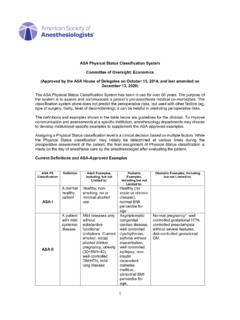
www.asahq.orgPediatric Examples, Including but not Limited to: ... lung disease Asymptomatic congenital cardiac disease, well controlled dysrhythmias, asthma without exacerbation, ... thrombophilic disease requiring anticoagulation. ASA IV . A patient with severe systemic disease Recent (<3
Practice Guidelines for Sedation and Analgesia by Non ...
www.asahq.orgNon-Anesthesiologists An Updated Report by the American Society of Anesthesiologists Task Force on Sedation and Analgesia by Non-Anesthesiologists ANESTHESIOLOGISTS possess specific expertise in the pharmacology, physiology, and clinical management of pa- ... Cardiovascular function is usually maintained.
Related documents
Guidelines for Patient Self-Administration of Medicines
hgs.uhb.nhs.ukGuidelines for Patient Self-Administration of Medicines Issue Date: 24/08/2017 Controlled Document Number: 578 Version No: 2.1 the medicinal product being administered. This is traditional nurse administration. However, if a patient is self- administering controlled drugs this is the only level
Improving Reassessment and Documentation of Pain …
heilbrunnfamily.rucares.orgexample, intravenous [IV] patient-controlled analgesia [PCA], epidural and intrathecal analgesia, moderate sedation, and a number of specific invasive treatments [such as nerve blocks] or drugs [such as dihydro-ergotamine (DHE) for migraine]), there is no predetermined standard of care that specifies exactly when
Guidelines for Use of Sedation and Anesthesia by Dentists
www.mouthhealthy.orgOct 15, 2014 · Guidelines for the Use of Sedation and General Anesthesia by Dentists ... analgesia – the diminution or elimination of pain. local anesthesia - the elimination of sensation, ... of the patient would lead to a significant increase in the threat to life or body part)

CPT: Surgery Coding Guidelines - AHIMA
campus.ahima.orgof Patient Controlled Analgesia) • Preoperative, intraoperative and postoperative documentation, including photographs, drawings, dictation, transcription as necessary to document the services provided. 11 Unbundling Two types of practices lead to unbundling. • The first is unintentional and results from a misunderstanding of coding.

PATIENT CONTROLLED ANALGESIA (PCA) SUBCUTANEOUS
www.seslhd.health.nsw.gov.auCLINICAL POLICIES, PROCEDURES & GUIDELINES Approved by Quality & Patient Care Committee July 2017 PATIENT CONTROLLED ANALGESIA (PCA) – INTRAVENOUS OR SUBCUTANEOUS cont’d Set up, programing and commencing the PCA Deliver all PCAs via a dedicated pain management pump. The pump must be contained in a lock box.
Guidelines on the Management of Postoperative Pain
rsds.orgKey words: Postoperative pain management, clinical practice guidelines, analgesia, education, multi-modal therapy, patient assessment, regional analgesia, neuraxial analgesia. M ore than 80% of patients who undergo surgical procedures experience acute postoperative painandapproximately75%ofthosewithpost-
Clinical Procedures and Guidelines
www.stjohn.org.nziv CLINICAL PROCEDURES AND GUIDELINES 2019-22 Contents 1: General treatment principles 1 1.1 Authority to practise and practice levels 1 1.2 General principles 4 1.3 Providing treatment that differs from that authorised in these CPGs 6 1.4 Analgesia11 1.5 Advance directives and advance care plans 21 1.6 Patient competency 23

Veterinary Anesthetic and Analgesic Formulary
www.colorado.eduprovide analgesia (1, 2). Analgesia: The absence of pain in response to stimulation that would normally be painful. An analgesic drug can provide analgesia by acting at the level of the central nervous system or at the site of inflammation to diminish or block pain signals (1, 2).
Guidelines for Syringe Driver Management in Palliative Care
www.health.qld.gov.auGuidelines Summary Section One: The patient experience ... provides enough analgesia to cover uncontrolled pain, and if other drugs are being infused, overdosing could occur of the other drug(s) ... of a syringe at an accurately controlled rate to deliver medications10. Their