
Practice Problems: Integration by Parts (Solutions)
vtkala@math.ucsb.edu November 25, 2014 The following are solutions to the Integration by Parts practice problems posted November 9. 1. R exsinxdx Solution: Let u= sinx, dv= exdx. Then du= cosxdxand v= ex. Then Z exsinxdx= exsinx Z excosxdx Now we need to use integration by parts on the second integral.
Download Practice Problems: Integration by Parts (Solutions)

Information
Domain:
Source:
Link to this page:
Documents from same domain

Real Analysis qual study guide - UC Santa Barbara
web.math.ucsb.eduReal Analysis qual study guide James C. Hateley 1. Measure Theory Exercise1.1. If AˆR and >0 show 9open sets OˆR such that m(O) m(A) + . Proof: Let fI
PARTIAL DIFFERENTIAL EQUATIONS - UC Santa Barbara
web.math.ucsb.eduPARTIAL DIFFERENTIAL EQUATIONS Math 124A { Fall 2010 « Viktor Grigoryan ... 5 Classi cation of second order linear PDEs 21 ... There are a number of properties by which PDEs can be separated into families of similar equations. The two main properties are order and linearity.
1 Magic Squares - UC Santa Barbara
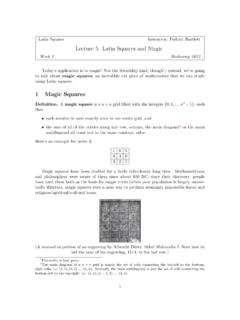
web.math.ucsb.edu1 Magic Squares De nition. A magic square is a n n grid lled with the integers f0;1;:::n2 1g, such that each number is used exactly once in our entire grid, and the sum of all of the entries along any row, column, the main diagonal2 or the main antidiagonal all come out to the same constant value. Here’s an example for order 3:

Finding All the Roots: Sturm’s Theorem
web.math.ucsb.eduSo this process generates a Sturm chain, as claimed. 1.2 Stating and Proving Sturm’s Theorem Sturm chains are pretty odd things; from their construction, it’s not immediately obvious
INTERNATIONAL SERIES IN PURE AND APPLIED …
web.math.ucsb.eduAND APPLIED MATHEMATICS William Ted Martin, E. H. Spanier, G. Springer and P. J. ... Numerical Methods for Scientists and Engineers HILDEBRAND: Introduction to Numerical Analysis ... Applied Mathematics for Engineers and Physicists RALSTON: A First Course in Numerical Analysis
PARTIAL DIFFERENTIAL EQUATIONS - UC Santa Barbara
web.math.ucsb.eduPARTIAL DIFFERENTIAL EQUATIONS Math 124A { Fall 2010 « Viktor Grigoryan grigoryan@math.ucsb.edu Department of Mathematics University of California, Santa Barbara These lecture notes arose from the course \Partial Di erential Equations" { Math 124A taught by the author in the Department of Mathematics at UCSB in the fall quarters of 2009 and 2010.
Factoring Cubic Polynomials - UC Santa Barbara
web.math.ucsb.eduFactoring Cubic Polynomials March 3, 2016 A cubic polynomial is of the form p(x) = a 3x3 + a 2x2 + a 1x+ a 0: The Fundamental Theorem of Algebra guarantees that if a 0;a 1;a 2;a 3 are all real numbers, then we can factor my polynomial into the form

Practice Problems: Trig Substitution
web.math.ucsb.eduR x p 1 x4dx Solution: Z x p 1 x4dx= x 1 (x2)2dx Let u= x2, then du= 2xdx: Z x p 1 (x2)2dx= 1 2 Z 1 u2du Now let u= sin , then du= cos d : 1 2 Z p 1 u2du= 1 2 Z 1 sin2 cos d = 1 2 Z cos2 d = 1 4 Z (1+cos2 )d = 1 4 + 1 2 sin2 +C= 1 4 ( +sin cos )+C Plug back in u. Since u= sin , the opposite side will be u, the hypotenuse will be 1, and the
Related documents

Grade 3 Multiplication Worksheet - Multiplication Tables ...
www.k5learning.comGrade 3 Multiplication Worksheet - Multiplication Tables - 2 & 3 math practice printable elementary school Created Date: 20151227235525Z ...

Grade 3 Multiplication Worksheet - Multiplication Tables ...
www.k5learning.comGrade 3 Multiplication Worksheet - Multiplication Tables - 4 & 6 Author: K5 Learning Subject: Grade 3 Multiplication Worksheet Keywords: Grade 3 Multiplication Worksheet - Multiplication Tables - 4 & 6 math practice printable elementary school Created Date: 20151228123250Z
Hardin Middle School Math Cheat Sheets
www.jwilliamsmath.weebly.com3 Table of Contents Pages Cheat Sheets 5 –42 Math Symbols 5 Multiplication Table 6 Types of Numbers 7 Divisibility Rules 8 Place Value 9 Rounding & Comparing 10 Measures of Central Tendency 11 Properties 12 Coordinate Graphing 13 Measurement Conversions 14 Metric Conversions 15 Order of Operations 16 – 17 Integers 18 – 19

Chapter 3 Quadratic Programming
www.math.uh.eduThe reduced KKT system (3.9) can be solved by a Cholesky factorization of the reduced Hessian ZTBZ 2 lR(n¡m)£(n¡m). Once w Y and wZ have been computed as the solutions of (3.8) and (3.9), x⁄ is obtained according to (3.7). Finally, the Lagrange multiplier turns out …

North Carolina Standard Course of Study North Carolina Math 3
files.nc.govNC Math 3 Standards 3 NC.M3.A-CED.2 Create and graph equations in two variables to represent absolute value, polynomial, exponential and rational relationships between quantities. NC.M3.A-CED.3 Create systems of equations and/or inequalities to model situations in context.
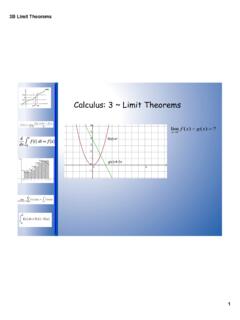
Calculus: 3 ~ Limit Theorems - Math - The University of Utah
www.math.utah.eduCalculus: 3 ~ Limit Theorems f(x)=x2 g(x)=4-2x. 3B Limit Theorems 2 Limit Theorems is a positive integer. is a real number have limits as x → c. 3B Limit Theorems 3 EX 1 EX 2 EX 3 If find. 3B Limit Theorems 4 Substitution Theorem If f(x) is a polynomial or a rational function, then assuming f(c) is defined. Ex 4

End-of-the-Year Test - Grade 3 - Math Mammoth
www.mathmammoth.comThe test does not cover every single concept that is covered in the Math Mammoth Grade 3 Complete Curriculum, but all the major concepts and ideas are tested here. This test is evaluating the child's ability in the following content areas: zmultiplication tables and basic division facts zmental addition and subtraction
Math 2331 { Linear Algebra
www.math.uh.edu5.3 Diagonalization DiagonalizationTheoremExamples Diagonalization: Example (cont.) Step 2. Find three linearly independent eigenvectors of A. By solving (A I)x = 0; for each value of , we obtain the following: Basis for = 1: v 1 = 2 4 0 1 1 3 5 Basis for = 2: v 2 = 2 4 0 1 0 3 5; v 3 = 2 4 1 0 1 3 5 Jiwen He, University of Houston Math 2331 ...

Math 55 Problem Set 3
people.math.harvard.eduMath 55 Problem Set 3 Neil Herriot with additions by Andrei Jorza 1. (i) d 1(f;f) = R 1 0 jf(x) f(x)jdx= R 1 0 0dx= 0. And, if f6= g, then F(x) = jf(x) g(x)jis not identically zero.