Prisoner Intake Systems: Assessing Needs and Classifying ...
behavior and sex offender needs) are examined only as needed. Information from the case file and/or a brief interview with the offender are automatically coded to generate a score for the 10 subscales of the Level of Services Index— Revised (LSI–R). Automating the LSI–R has allowed Colorado to integrate it
Download Prisoner Intake Systems: Assessing Needs and Classifying ...

Information
Domain:
Source:
Link to this page:
Documents from same domain

Office of Justice Programs National Institute of Justice
info.nicic.govThe National Institute of Justice is a component of the Office of Justice Programs, which also includes the Bureau of Justice Assistance, the Bureau of Justice Statistics, the Office of Juvenile Justice …
Thinking for a Change and Cognitive-Behavioral Programs
info.nicic.govThinking for a Change, a widely used cognitive behavioral curriculum for offenders. Furthermore, this evaluation provides a “real -world” test of T4C, because it was implemented by line staff in a community corrections agency as opposed to being a pilot

Thinking for a Change - NIC Micro-Sites
info.nicic.govThinking for a Change Training for Facilitators Overview of the Blended Training Model This packet serves as an introduction and resource to agencies preparing for ...

Civil Liabilities and Other Legal Issues for Probation ...
info.nicic.gov1. Title 42 of the U.S. Code, § 1983—Civil Action for Deprivation of Rights 2. Title 42 of the U.S. Code, § 1985—Conspiracy to Interfere With Civil Rights 3. Title 42 of the U.S. Code, § 1981—Equal Rights Under the Law B. Criminal Liabilities 1. Title 18 of the U.S. Code, § 242—Deprivation of Rights Under Color of Law 2.
COGNITIVE-BEHAVIORAL TREATMENT
info.nicic.govcluded that released prisoners need more assistance than in the past, yet available resources have decreased. The Need for Mental Health Services Mental health services were offered in significantly more correctional facilities in 2000 than in 1988; however, the relative percentage of facilities that offered mental health services decreased ...
inmate Behavior Management
info.nicic.govcontrolling inmate behavior that prevents acts like this from occurring in the irst place. Such a system has been developed by the National Institute of Corrections (NIC), which has identiied six elements of an inmate behavior management plan: i . Assessing Risks and Needs . Assigning Inmates to Housing . Meeting Inmates’ Basic Needs. Deining and
Evidence-Based Practices in the Criminal Justice System
info.nicic.govEvidence-based policy and practice is focused on reducing offender risk, ... individual differences in criminal conduct and recognizing the importance of personal, interpersonal, and community factors. What results is a truly int erdisciplinary general ... rehabilitation will succeed in reducing recidivism. What works, in our view, is the delivery

PRISON STAFFING ANALYSIS - National Institute of Corrections
info.nicic.govExhibit 10. Schematic Design of Two Adjacent Units Joined by a Exhibit 11. Schematic Design of Four Units Surrounding a Foyer Exhibit 13. Example of Form F: Total Staff Required and Exhibit 14. Views on the Medical and Mental Health Needs of Female Inmates and the Effect of These Needs on iews on the Needs of Pregnant Inmates and the Exhibit 2.

A Guide to Preparing for and Responding to Jail Emergencies
info.nicic.govguide, NIC, the project advisory board, and LETRA, Inc., have worked to overcome that problem and make A Guide to Preparing for and Responding to Jail Emergencies a resource that addresses the needs of small jails as well as the larger jails. Thus, this guide provides two self-audit instruments: a basic emergency

OARS in Motivational Interviewing
info.nicic.govOARS in Motivational Interviewing The four core motivational interviewing skills , or OARS, are Open questioning, Affirming, Reflecting and Summarizing (Miller, W. R., & Rollnick, S. 2013). POs can use these essential micro -counseling skills as part of their toolbox, as they are also used in a wide variety of counseling and helping situations.
Related documents

Helping Children Learn to Manage Their Own Behavior
csefel.vanderbilt.eduBehavior Participant PowerPoint What is Self-Management? Used to teach children (four years and older) to: • Pay attention to their own behavior. • Use appropriate play and social interaction skills • Participate in classroom routines • Engage in …

Assessing Adaptive Behavior in Young Children
images.pearsonassessments.comAssessing Adaptive Behavior in Young Children Gloria Maccow, Ph.D. Assessment Training Consultant
Preschool Language Scales-5: Assessing Language from 0-7
images.pearsonclinical.comAge Range and Administration Time • Age range: Now birth through 7:11 – Use normed scores for children through age 7 – Use as a criterion-referenced tool for older elementary age children functioning at the birth to 7:11 age range – Not appropriate for use with secondary students or adults functioning at a language age of birth through 7:11

Teen Financial Knowledge, Self-Efficacy, and Behavior: A ...
files.eric.ed.govTeen Financial Knowledge, Self-Efficacy, and Behavior: A Gendered View Sharon M. Danes and Heather R. Haberman A social constructionist perspective was taken in the current investigation of 5,329 male and female high school students. Gender differences were investigated in financial knowledge, self-efficacy, and behavior after studying

Age-Specific Considerations in Patient Care
lms.rn.comThe purpose of Age-Specific Considerations in Patient Care is to provide healthcare professionals with information about different age groups, how to identify needs related to these age groups, and how to vary patient care issues with age specific needs in mind. After successful completion of this course, the participant will be able to: 1.
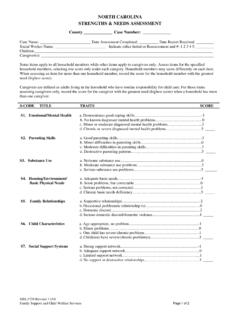
NORTH CAROLINA STRENGTHS & NEEDS ASSESSMENT
policies.ncdhhs.govWhen assessing an item for more than one household member, record the score for the household member with the greatest ... behavior and/or family dysfunction which result in a need for treatment. ... Child(ren) appears to be age appropriate, no problems. b. Minor problems. Child(ren) has minor physical, emotional, medical, educational, or ...

What is Evidence, and What It Takes to Prove Discrimination
www.bgsu.edureligion and age, and the other discussing evidence requirements for disability. A. SEX, RACE, NATIONAL ORIGIN, COLOR, RELIGION, AND AGE . In order for an employment action to be unlawful under either Title VII of the 1964 Civil Rights Act or the Age Discrimination in Employment Act, that action much have been
Child and Adolescent Screening and Assessment Tools
www.mycasat.orgThe CBCL and TRF can be used for children 6-18 years of age. The YSR can be used with youth 11-18 years of age. Preschool versions include the Child Behavior Checklist for Ages 1 ½ - 5 and the Caregiver-Teacher Report Form for Ages 1 ½ -5. 3,500 research articles have studied the CBCL and related measures in 50 cultures.