Probability, Random Processes, and Ergodic Properties
of random processes. These in turn provide the means of proving the ergodic decomposition of certain functionals of random processes and of characterizing how close or di erent the long term behavior of distinct random processes can be expected to be. Of particular interest are
Download Probability, Random Processes, and Ergodic Properties

Information
Domain:
Source:
Link to this page:
Documents from same domain
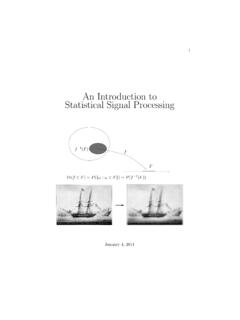
AnIntroductionto StatisticalSignalProcessing - Stanford EE
ee.stanford.edu2.7 Elementary conditional probability 70 2.8 Problems 73 3 Random variables, vectors, and processes 82 3.1 Introduction 82 3.2 Random variables 93 3.3 Distributions of random variables 102 3.4 Random vectors and random processes 112 3.5 Distributions of random vectors 115 3.6 Independent random variables 124 3.7 Conditional distributions 127

Realism and Morality in Politics - ee.stanford.edu
ee.stanford.eduRealism and Morality in Politics Andrei V. Kortunov ... attendant political relations would wipe out historical modes of interactions, nationalism, cultural differences, and ideologies. Instead, it has become ... Over the Years International Relations Are Becoming More Complex.

Optical Physics of Quantum Wells - Stanford EE
ee.stanford.eduOptical Physics of Quantum Wells David A. B. Miller Rm. 4B-401, AT&T Bell Laboratories Holmdel, NJ07733-3030 ... All of the physics and devices that will be discussed here are based on properties of direct gap semiconductors near the center of the Brillouin zone. For all of the semiconductors of interest ... 3 Linear Optical Properties of ...
Entropy and Information Theory - Stanford EE
ee.stanford.eduinformation theory text include asymptotic mean stationary sources, one-sided sources as well as two-sided sources, nonergodic sources, d -continuous channels, and sliding block or stationary codes .

The Evolution of Cooperation* - Stanford EE
ee.stanford.eduThe Evolution of Cooperation** Robert Axelrod Professor of Political Science and Public Policy, University of Michigan, Ann Arbor. Dr. Axelrod is a member of the American National Academy of Sciences and the American Academy of Arts and Sciences. His honors include a MacArthur Foundation Fellowship for the period 1987 through 1992.

The Physics of Nuclear Weapons
ee.stanford.eduNatural uranium, with only 0.7% U-235, is not useful as either bomb or power plant primary fuel, with an important exception. That is the Magnox reactor, which is a gas-cooled, graphite-moderated reactor. Magnox reactors can run on natural, unenriched uranium and produce bomb-
NOVEMBER New Directions in Cryptography
ee.stanford.edu644 IEEE TRANSACTIONS ON INFORMATION THEORY, VOL. IT-22, NO. 6, NOVEMBER 1976 New Directions in Cryptography Invited Paper WHITFIELD DIFFIE AND MARTIN E. HELLMAN, MEMBER, IEEE Abstract-Two kinds of contemporary developments in cryp-
Related documents
Gaussian processes - Stanford University
cs229.stanford.eduprocesses are the extension of multivariate Gaussians to infinite-sized collections of real-valued variables. In particular, this extension will allow us to think of Gaussian processes as distributions not justover random vectors but infact distributions over random functions.7 3.1 Probability distributions over functions with finite domains

Topic 7: Random Processes
www.ece.tufts.eduMultiple random processes: Cross-covariance and cross-correlation functions For multiple random processes: † Their joint behavior is completely specifled by the joint distributions for all combinations of their time samples. Some simpler functions can be used to partially specify the joint behavior. Consider two random processes X(t) and Y(t).
Random Processes for Engineers 1 - University of Illinois ...
www.ifp.illinois.edu8 Random Processes in Linear Systems and Spectral Analysis 262 8.1 Basic de nitions 263 8.2 Fourier transforms, transfer functions and power spectral densities 266 8.3 Discrete-time processes in linear systems 273 8.4 Baseband random processes 275 8.5 Narrowband random processes 278 8.6 Complexi cation, Part II 285 9 Wiener ltering 297
Signals, Systems and Inference, Chapter 9: Random Processes
ocw.mit.edua class of signals referred to as random signals (alternatively referred to as random processes or stochastic processes). Such signals play a central role in signal and system design and analysis, and throughout the remainder of this text. In this chapter we define random processes via the associated ensemble of signals, and be

Discrete Stochastic Processes, Chapter 7: Random Walks ...
ocw.mit.eduprocesses, which we have already studied and which will provide additional insight into the general study of random walks. After this, Sections 7.2 and 7.3 show how two major application areas, G/G/1 queues and

Chapter 9 Random Processes - Concordia University
users.encs.concordia.caDefinition of a Random Process Assume the we have a random experiment with outcomes w belonging to the sample set S.To each w ∈ S, we assign a time function X(t,w), t ∈ I, where I is a time index set: discrete or continuous. X(t,w) is called a random process. If w is fixed, X(t,w) is a deterministic time function, and is called a realization, a sample path, or a

Probabilityand RandomProcesses
web.math.princeton.eduRamon van Handel Probabilityand RandomProcesses ORF309/MAT380LectureNotes PrincetonUniversity This version: February 22, 2016
1 Chapter 6: Random Processes - NTPU
web.ntpu.edu.twY. S. Han Random Processes 1 Definition of a Random Process • Random experiment with sample space S. • To every outcome ζ ∈ S, we assign a function of time according to some rule: X(t,ζ) t ∈ I. • For fixed ζ, the graph of the function X(t,ζ) versus t is a sample function of the random process.
Gaussian Random Variables and Processes
www.ee.iitb.ac.inGaussian Random Process Definition A random process fX(t) : t 2Tgis Gaussian if its samples X(t1);:::;X(tn) are jointly Gaussian for any n 2N. Properties The mean and autocorrelation functions completely characterize a Gaussian random process. Gaussian WSS processes are stationary. If the input to an LTI system is a Gaussian RP, the output is