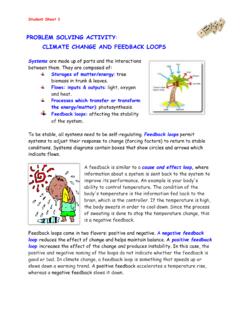
PROBLEM SOLVING ACTIVITY CLIMATE CHANGE AND …
ability to control temperature. The condition of the body's temperature is the information fed back to the brain, which is the controller. If the temperature is high, the body sweats in order to cool down. Since the process of sweating is done to stop the temperature change, this is a negative feedback.
Download PROBLEM SOLVING ACTIVITY CLIMATE CHANGE AND …

Information
Domain:
Source:
Link to this page:
Documents from same domain

PROBLEM SOLVING ACTIVITY: HOW DO EARTH’S SPHERES …
gml.noaa.gov1. After discussing the information in the introduction section, give students an opportunity to put the process to work by analyzing a sample event. Images can be handed out or projected for the class. 2. Each pair/small group will select/be assigned/select …

living organisms, the oceans, the atmosphere, and the ...
gml.noaa.govliving organisms, the oceans, the atmosphere, and the Earth’s crust in what is known as the carbon cycle. The directions taken by carbon atoms through this cycle are very complicated and can take millions of years to make a full circle.

solar radiation, electromagnetic radiation spectrum. Solar ...
gml.noaa.govradiation spectrum. Solar radiation includes visible light, ultraviolet light, infrared, radio waves, X-rays, and gamma rays. The Electromagnetic Spectrum Radiation is one way to transfer heat. To “radiate” means to send out or spread from a central location. Whether it is light, sound, waves, rays, flower petals, wheel spokes or pain,

CRITICAL THINKING ACTIVITY: THE ELECTROMAGNETIC …
gml.noaa.gov8 Student Sheet 8 RESEARCH GUIDE GROUP 5: ULTRAVIOLET RADIATION 1. Define ultraviolet radiation: 2. Describe where ultraviolet is found on the EMS compared to the other six forms of radiation. In your description, compare and contrast its wavelength, frequency and energy with those of other regions of the EMS. 3.

LAB ACTIVITY: HEAT, TEMPERATURE AND CONDUCTION
gml.noaa.gov2 Student Sheet 2 Cooling things by conduction works the same way as warming. This time, a hot metal spoon is put in room-temperature water. The faster-moving atoms in the spoon contact the slower-moving molecules in the water. The atoms in the spoon transfer some of their energy to the molecules in the water. The spoon will get
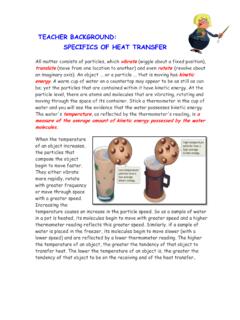
TEACHER BACKGROUND: SPECIFICS OF HEAT TRANSFER
gml.noaa.govIn a new scenario, a metal can containing hot water is placed in a Styrofoam cup containing cold water. Heat is transferred from the hot water to the cold water until both samples have the same temperature. The transfer of heat from the hot water through the metal can to the cold water is referred to as conduction.

The Lithosphere--contains all of the cold, hard solid land ...
gml.noaa.govBelow that is a liquid outer core of nickel and iron. At the center of Earth is a solid inner core of nickel and iron. The Hydrosphere-- contains all the solid, liquid, and gaseous water of the planet. It ranges from 10 to 20 kilometers in thickness. The hydrosphere extends from Earth's surface

MODELING EARTH’S ATMOSPHERIC
gml.noaa.govEarth's surface. Measure and draw a line 80 mm from the Earth's surface. Label this layer mesosphere. Color it red. Draw pictures to help show characteristics. Draw the ionosphere. This is the fourth layer of the atmosphere. It extends 80km-400km from the surface. Label it the ionosphere and color it pink.
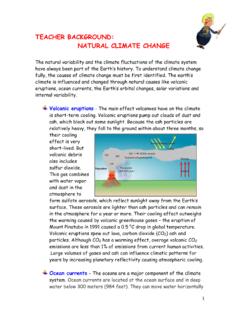
TEACHER BACKGROUND: NATURAL CLIMATE CHANGE
gml.noaa.govmeans cooler summers and milder winters. Slow changes in the Earth’s orbit lead to small but climatically important changes in the strength of the seasons over tens of thousands of years. Climate feedbacks amplify these small changes, thereby producing ice ages. Solar variations - The Sun is the source of energy for the Earth’s climate system.

Coral reef calcification and climate change: the effect of ...
gml.noaa.govcorals display different sensitivities to changes in aragΩ and SST [Reynaud et al., 2003]. Considering that both these environmental parameters are likely to change considerably in the future, additional experiments on a variety of differing coral species will be crucial to obtain a better understanding of future coral reef stability.
Related documents
Temperature Homeostasis (thermoregulation)
biologymad.comTemperature Homeostasis (thermoregulation) One of the most important examples of homeostasis is the regulation of body temperature. Not all animals can do this physiologically. Animals that maintain a fairly constant body temperature (birds and mammals) are called endotherms, while those that have a variable body temperature (all
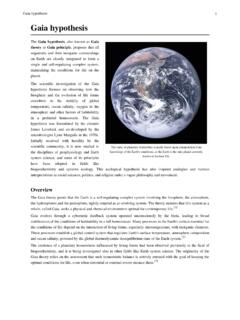
Gaia hypothesis - Harvard University
courses.seas.harvard.edutemperature, ocean salinity, oxygen in the atmosphere and other factors of habitability in a preferred homeostasis. The Gaia hypothesis was formulated by the chemist James Lovelock and co-developed by the microbiologist Lynn Margulis in the 1970s. Initially received with hostility by the scientific community, it is now studied in

High School Science Virtual Learning Biology
sites.isdschools.org1. Homeostasis is the ability to maintain constant internal conditions when outside conditions change. 2. Homeostasis is important because if it is disrupted, a disease or disorder may result. 3. Negative feedback is a control system that helps the body maintain homeostasis by sending a signal to stop a response. 4.

Teacher notes and Hands-on Activity for Homeostasis ...
msnickelbiology12.weebly.comhomeostasis. There are a variety of mechanisms and vital functions that are maintained through homeostasis; blood glucose, blood pH, blood pressure, body temperature, O2 and CO2 levels, etc. Key Terms Homeostasis, negative feedback, stimulus, receptor, integrating center,
Interactions of Human Body Systems
neprisstore.blob.core.windows.nethomeostasis. In the beginning of this lesson, you read that temperature homeostasis is maintained by producing thermal energy. The endocrine, nervous, and muscular systems work together and maintain temperature homeostasis. Insulin, a hormone released from the pancreas, works with the digestive system and maintains energy homeostasis. Visual ...

Human Physiology/Homeostasis
resources.saylor.orgHuman Physiology/Homeostasis 1 Human Physiology/Homeostasis ... thermometer in the thermostat waits to sense a temperature change either too high above or too far below the 70 degree set point. When this change happens the thermometer will send a …

4.5 Homeostasis and Response Name: Higher
www.crownhills.comhigh body temperature. Data was collected to find out whether paracetamol, ibuprofen or a combination of these two medicines was the best to reduce high body temperature in children. Children who were ill with high body temperatures were identified at doctors‟ surgeries. These children were put into three treatment groups:

Homeostasis in Plants
www.houstonisd.orgPlant Regulation Regulation and coordination systems in plants are much simpler than in animals Homeostatic regulation of plants seeks to: Maintain an adequate uptake of water and nutrients form soil into leaves Control stomatal opening so that water loss is minimised and carbon dioxide is maximised When plants respond to environmental conditions

HOMEOSTASIS: POSITIVE AND NEGATIVE FEEDBACK …
www.michigan.govHomeostasis refers to the maintenance of relatively constant internal conditions. For example, your body shivers to maintain a relatively constant body temperature when the external environment gets colder. To maintain homeostasis, your body adapts two types of feedback mechanisms: Negative feedback occurs when a change in a