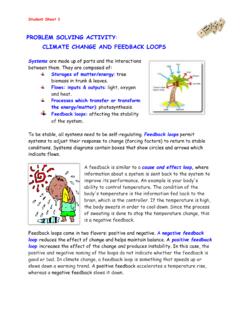
PROBLEM SOLVING ACTIVITY CLIMATE CHANGE AND …
At an international conference on climate change, new information was presented by a team of scientists from Great Britain. Many of the people attending the conference are unclear about their findings and need more and better information. Your team of climate specialists has been asked to analyze their data and report back with your
Download PROBLEM SOLVING ACTIVITY CLIMATE CHANGE AND …

Information
Domain:
Source:
Link to this page:
Documents from same domain

PROBLEM SOLVING ACTIVITY: HOW DO EARTH’S SPHERES …
gml.noaa.gov1. After discussing the information in the introduction section, give students an opportunity to put the process to work by analyzing a sample event. Images can be handed out or projected for the class. 2. Each pair/small group will select/be assigned/select …

living organisms, the oceans, the atmosphere, and the ...
gml.noaa.govliving organisms, the oceans, the atmosphere, and the Earth’s crust in what is known as the carbon cycle. The directions taken by carbon atoms through this cycle are very complicated and can take millions of years to make a full circle.

solar radiation, electromagnetic radiation spectrum. Solar ...
gml.noaa.govradiation spectrum. Solar radiation includes visible light, ultraviolet light, infrared, radio waves, X-rays, and gamma rays. The Electromagnetic Spectrum Radiation is one way to transfer heat. To “radiate” means to send out or spread from a central location. Whether it is light, sound, waves, rays, flower petals, wheel spokes or pain,

CRITICAL THINKING ACTIVITY: THE ELECTROMAGNETIC …
gml.noaa.gov8 Student Sheet 8 RESEARCH GUIDE GROUP 5: ULTRAVIOLET RADIATION 1. Define ultraviolet radiation: 2. Describe where ultraviolet is found on the EMS compared to the other six forms of radiation. In your description, compare and contrast its wavelength, frequency and energy with those of other regions of the EMS. 3.

LAB ACTIVITY: HEAT, TEMPERATURE AND CONDUCTION
gml.noaa.gov2 Student Sheet 2 Cooling things by conduction works the same way as warming. This time, a hot metal spoon is put in room-temperature water. The faster-moving atoms in the spoon contact the slower-moving molecules in the water. The atoms in the spoon transfer some of their energy to the molecules in the water. The spoon will get
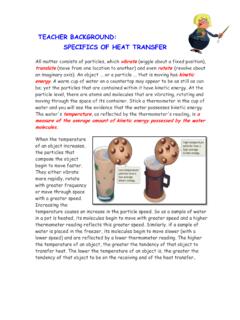
TEACHER BACKGROUND: SPECIFICS OF HEAT TRANSFER
gml.noaa.govIn a new scenario, a metal can containing hot water is placed in a Styrofoam cup containing cold water. Heat is transferred from the hot water to the cold water until both samples have the same temperature. The transfer of heat from the hot water through the metal can to the cold water is referred to as conduction.

The Lithosphere--contains all of the cold, hard solid land ...
gml.noaa.govBelow that is a liquid outer core of nickel and iron. At the center of Earth is a solid inner core of nickel and iron. The Hydrosphere-- contains all the solid, liquid, and gaseous water of the planet. It ranges from 10 to 20 kilometers in thickness. The hydrosphere extends from Earth's surface

MODELING EARTH’S ATMOSPHERIC
gml.noaa.govEarth's surface. Measure and draw a line 80 mm from the Earth's surface. Label this layer mesosphere. Color it red. Draw pictures to help show characteristics. Draw the ionosphere. This is the fourth layer of the atmosphere. It extends 80km-400km from the surface. Label it the ionosphere and color it pink.
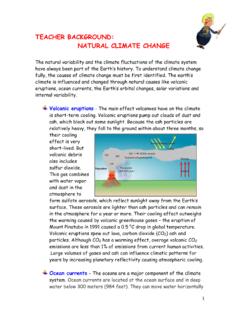
TEACHER BACKGROUND: NATURAL CLIMATE CHANGE
gml.noaa.govmeans cooler summers and milder winters. Slow changes in the Earth’s orbit lead to small but climatically important changes in the strength of the seasons over tens of thousands of years. Climate feedbacks amplify these small changes, thereby producing ice ages. Solar variations - The Sun is the source of energy for the Earth’s climate system.

Coral reef calcification and climate change: the effect of ...
gml.noaa.govcorals display different sensitivities to changes in aragΩ and SST [Reynaud et al., 2003]. Considering that both these environmental parameters are likely to change considerably in the future, additional experiments on a variety of differing coral species will be crucial to obtain a better understanding of future coral reef stability.
Related documents

Myanmar Climate Change Strategy (2018 2030)
myanmar.un.orgMyanmar Climate Change Policy that provides longterm direction and guidance for - government, civil society, and the private sector to undertake and promote climate ... COP Conference of Parties CSAS Climate-smart Agriculture Strategy DMH Department of Meteorology and Hydrology DRM Disaster Risk Management DRR Disaster Risk Reduction
What Is Climate Change? - University of Colorado Boulder
sciencepolicy.colorado.eduConference of Parties to the FCCC, held December 1 to 12, 2003, in Milan, Italy, which took place amid uncertainty about whether the ... climate change, there is precious little room for uncertainty about the climate future; it is either dan-gerous enough to warrant action or it is not. Claims about the exis-
UNITED NATIONS FRAMEWORK CONVENTION ON CLIMATE …
unfccc.int1. “Adverse effects of climate change” means changes in the physical environment or biota resulting from climate change which have significant deleterious effects on the composition, resilience or productivity of natural and managed ecosystems or on the operation of socio-economic systems or on human health and welfare. 2.
CLIMATE CHANGE: IMPACTS, VULNERABILITIES AND …
unfccc.intJul 25, 2006 · in adapting to the effects of climate change. This book outlines the impact of climate change in four developing country regions: Africa, Asia, Latin America and small island developing States; the vulnerability of these regions to future climate change; current adaptation plans, strategies and actions; and future adaptation options and needs.

Section 5.3: Climate change - United Nations
unstats.un.org5.3 Climate change 1 The Conference of the Parties of the UNFCCC has affirmed that climate change is one of the greatest challenges of our time.1 Climate change is a change of climate which is attributed directly or indirectly to human activity that alters the composition of the global

NRDC: The Paris Agreement on Climate Change (PDF)
www.nrdc.orgCopenhagen climate change conference produced the Copenhagen Accord. This Accord was expanded and formally adopted in 2010 as the Cancun Agreements where dozens of countries—including
Impacts of Climate Change on the Environment
www.tamuk.edu• In December 2009, The United Nations Climate Change Conference (COP15) in Copenhagen ended with an agreement, The Copenhagen Accord, which recognizes the importance of a two-degree increase in global temperatures for staving off the worst effects of climate change. • According to The Copenhagen Accord, developed