
PROBLEM SOLVING ACTIVITY: HOW DO EARTH’S SPHERES …
atmosphere can cause a change in the hydrosphere, and vice versa. Below are a few examples: •Humans (biosphere) built a dam out of rock materials (lithosphere). •Water in the lake (hydrosphere) seeps into the cliff walls behind the dam, becoming groundwater (lithosphere), or evaporating into the air (atmosphere).
Download PROBLEM SOLVING ACTIVITY: HOW DO EARTH’S SPHERES …

Information
Domain:
Source:
Link to this page:
Documents from same domain

living organisms, the oceans, the atmosphere, and the ...
gml.noaa.govliving organisms, the oceans, the atmosphere, and the Earth’s crust in what is known as the carbon cycle. The directions taken by carbon atoms through this cycle are very complicated and can take millions of years to make a full circle.
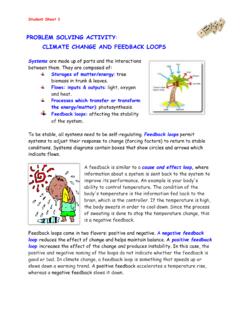
PROBLEM SOLVING ACTIVITY CLIMATE CHANGE AND …
gml.noaa.govability to control temperature. The condition of the body's temperature is the information fed back to the brain, which is the controller. If the temperature is high, the body sweats in order to cool down. Since the process of sweating is done to stop the temperature change, this is a negative feedback.

solar radiation, electromagnetic radiation spectrum. Solar ...
gml.noaa.govradiation spectrum. Solar radiation includes visible light, ultraviolet light, infrared, radio waves, X-rays, and gamma rays. The Electromagnetic Spectrum Radiation is one way to transfer heat. To “radiate” means to send out or spread from a central location. Whether it is light, sound, waves, rays, flower petals, wheel spokes or pain,

CRITICAL THINKING ACTIVITY: THE ELECTROMAGNETIC …
gml.noaa.gov8 Student Sheet 8 RESEARCH GUIDE GROUP 5: ULTRAVIOLET RADIATION 1. Define ultraviolet radiation: 2. Describe where ultraviolet is found on the EMS compared to the other six forms of radiation. In your description, compare and contrast its wavelength, frequency and energy with those of other regions of the EMS. 3.

LAB ACTIVITY: HEAT, TEMPERATURE AND CONDUCTION
gml.noaa.gov2 Student Sheet 2 Cooling things by conduction works the same way as warming. This time, a hot metal spoon is put in room-temperature water. The faster-moving atoms in the spoon contact the slower-moving molecules in the water. The atoms in the spoon transfer some of their energy to the molecules in the water. The spoon will get
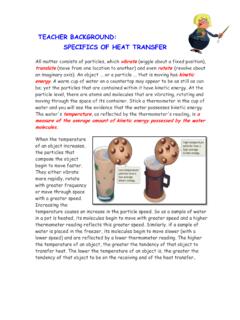
TEACHER BACKGROUND: SPECIFICS OF HEAT TRANSFER
gml.noaa.govIn a new scenario, a metal can containing hot water is placed in a Styrofoam cup containing cold water. Heat is transferred from the hot water to the cold water until both samples have the same temperature. The transfer of heat from the hot water through the metal can to the cold water is referred to as conduction.

The Lithosphere--contains all of the cold, hard solid land ...
gml.noaa.govBelow that is a liquid outer core of nickel and iron. At the center of Earth is a solid inner core of nickel and iron. The Hydrosphere-- contains all the solid, liquid, and gaseous water of the planet. It ranges from 10 to 20 kilometers in thickness. The hydrosphere extends from Earth's surface

MODELING EARTH’S ATMOSPHERIC
gml.noaa.govEarth's surface. Measure and draw a line 80 mm from the Earth's surface. Label this layer mesosphere. Color it red. Draw pictures to help show characteristics. Draw the ionosphere. This is the fourth layer of the atmosphere. It extends 80km-400km from the surface. Label it the ionosphere and color it pink.
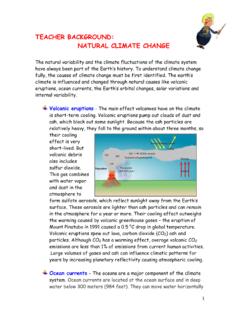
TEACHER BACKGROUND: NATURAL CLIMATE CHANGE
gml.noaa.govmeans cooler summers and milder winters. Slow changes in the Earth’s orbit lead to small but climatically important changes in the strength of the seasons over tens of thousands of years. Climate feedbacks amplify these small changes, thereby producing ice ages. Solar variations - The Sun is the source of energy for the Earth’s climate system.

Coral reef calcification and climate change: the effect of ...
gml.noaa.govcorals display different sensitivities to changes in aragΩ and SST [Reynaud et al., 2003]. Considering that both these environmental parameters are likely to change considerably in the future, additional experiments on a variety of differing coral species will be crucial to obtain a better understanding of future coral reef stability.
Related documents

The International Standard Atmosphere (ISA)
fisicaatmo.at.fcen.uba.aratmosphere: Figure 1 International Standard Atmosphere temperature variation [2]. Temperature decreases with altitude at a constant rate of -6.5°C/1000m (-1.98°C/1000ft) up to the tropopause. The standard tropopause altitude is 11,000 m (36,089 ft). Therefore, the air which is considered as a perfect gas in the ISA model presents the following
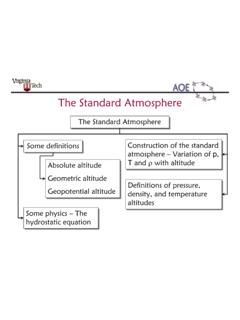
The Standard Atmosphere - Virginia Tech
www.dept.aoe.vt.edudefining the Standard Atmosphere •W we to kntanow p(h), T(h), and ρ(h) • The fundamental idea behind the standard atmosphere is a defined variation of temperature T = T(h) • The figure to the right defines the temperature variation – Isothermal and gradient regions • Most aircraft fly below 20 km, but balloons, sounding rockets,

Part 1: Oxidation and OH radicals - Harvard University
courses.seas.harvard.eduatmosphere and climate. Because of this we use it here in the Climate Encyclopaedia. However, the correct unit is 1 nmol mol-1 (equivalent to 1 ppb) or 1 µmol m-1 (for 1 ppm) since mole is the standard unit of concentration. Part 2: Night and nitrate Night-time conditions and chemistry The chemistry of the atmosphere depends not only on the ...

CRITICAL THINKING ACTIVITY: THE METHANE CYCLE
gml.noaa.govthe atmosphere clean of pollutant molecules and break them down. For this reason OH is known as the ‘cleanser of the atmosphere’. After reacting with OH, atmospheric methane is converted to CO 2 by a long series of chemical reactions.) Some of the methane present in the troposphere passes into the stratosphere where the same process

ATMOSPHERE COMPOSITION AND STRUCTURE
nios.ac.inThe atmosphere is the mixture of different types of gases, including water vapour and dust particles. Nitrogen and Oxygen are the two main gases of the atmosphere. 99 percent part of it is made up of these two gases. Other gases like organ, carbon dioxide, hydrogen, nion, …

Climate Change: Evidence & Causes 2020 - Royal Society
royalsociety.orgatmosphere and oceans have warmed, which has been accompanied by sea level rise, a strong decline in Arctic sea ice, and other climate-related changes. The impacts of climate change on people and nature are increasingly apparent. Unprecedented ooding, heat waves, and wild˚res have cost billions in damages.