Problems and solutions - MIT Mathematics
Problem 5.3. If SˆV be a linear subspace of a vector space show that the relation on V (5.3) v 1 ˘v 2 ()v 1 v 2 2S is an equivalence relation and that the set of equivalence classes, denoted usually V=S;is a vector space in a natural way. Problem 5.4. In case you do not know it, go through the basic theory of nite-dimensional vector spaces.
Download Problems and solutions - MIT Mathematics

Information
Domain:
Source:
Link to this page:
Documents from same domain
Introduction to Linear Algebra, 5th Edition
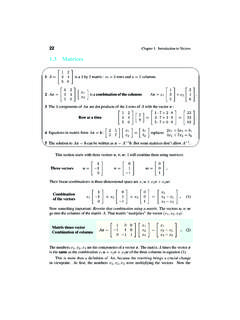
math.mit.edu1.3 Matrices 1 A = ... Linear Equations One more change in viewpoint is crucial. Up to now, the numbers x 1,x 2,x 3 were known. The right hand side b was not known. We found that vector of differences by multiplying A times x. Now we think of b as known and we look for x.
Eigenvalues and Eigenvectors
math.mit.eduSpecial properties of a matrix lead to special eigenvalues and eigenvectors. That is a major theme of this chapter (it is captured in a table at the very end). 286 Chapter 6.
Eigenvalues and Eigenvectors - MIT Mathematics
math.mit.edu6.1. Introduction to Eigenvalues 287 Eigenvalues The number is an eigenvalue of Aif and only if I is singular: det.A I/ D 0: (3) This “characteristic equation” det.A I/ D 0 involves only , not x. When A is n by n,
4 Cauchy’s integral formula - MIT Mathematics
math.mit.edu4 Cauchy’s integral formula 4.1 Introduction ... 4 CAUCHY’S INTEGRAL FORMULA 4 4.3.1 Another approach to some basic examples Suppose Cis a simple closed curve around 0. We have seen that Z C 1 z ... Since an integral is basically a sum, this translates to the triangle inequality for integrals.
A FRIENDLY INTRODUCTION TO GROUP THEORY
math.mit.eduA FRIENDLY INTRODUCTION TO GROUP THEORY 3 A good way to check your understanding of the above de nitions is to make sure you understand why the following equation is correct: jhgij= o(g): (1) De nition 5: A group Gis called abelian (or commutative) if gh = hg for all g;h2G. A group is called cyclic if it is generated by a single element, that is,
4.3 Least Squares Approximations
math.mit.edu4.3. Least Squares Approximations 221 Figure 4.7: The projection p DAbx is closest to b,sobxminimizes E Dkb Axk2. In this section the situation is just the opposite. There are no solutions to Ax Db. Instead of splitting up x we are splitting up b. Figure 4.3 shows the big picture for least squares. Instead of Ax Db we solve Abx Dp.

Linear programming 1 Basics - MIT Mathematics
math.mit.edu2 subject to: 5x 1 + 7x 2 8 4x 1 + 2x 2 15 2x 1 + x 2 3 x 1 0;x 2 0: Some more terminology. A solution x= (x 1;x 2) is said to be feasible with respect to the above linear program if it satis es all the above constraints. The set of feasible solutions is called the feasible space or feasible region. A feasible solution is optimal if its ...
Square Roots via Newton’s Method
math.mit.eduSquare Roots via Newton’s Method S. G. Johnson, MIT Course 18.335 February 4, 2015 1 Overview ...
V7. Laplace’s Equation and Harmonic Functions
math.mit.eduA. Existence. Does there exist a φ(x,y) harmonic in some region containing Cand its interior R, and taking on the prescribed boundary values? B. Uniqueness. If it exists, is there only one such φ(x,y)? C. Solving. If there is a unique φ(x,y), determine it by some explicit formula, or approximate it by some numerical method.
The Limit of a Sequence - MIT Mathematics
math.mit.edu“obvious” using the definition of limit we started with in Chapter 1, but we are committed now and for the rest of the book to using the newer Definition 3.1 of limit, and therefore the theorem requires proof. Theorem 3.2B {an} increasing, L = liman ⇒ an ≤ L for all n; {an} decreasing, L = liman ⇒ an ≥ L for all n. Proof.
Related documents

Chapter 3 Formulation of FEM for Two-Dimensional Problems
users.metu.edu.trFormulation of FEM for Two-Dimensional Problems 3.1 Two-Dimensional FEM Formulation Many details of 1D and 2D formulations are the same. To demonstrate how a 2D formulation works well use the following steady, AD equation ⃗ in where ⃗ is the known velocity field, is the known and constant conductivity, is the known force ...

The Physical Basis of DIMENSIONAL ANALYSIS
web.mit.edu2.3 Unit and numerical value 10 2.4 Derived quantities, dimension, and dimensionless quantities 12 2.5 Physical equations, dimensional homogeneity, and physical constants 15 2.6 Derived quantities of the second kind 19 2.7 Systems of units 22 2.8 Recapitulation 27 3. Dimensional Analysis 29 3.1 The steps of dimensional analysis and Buckingham’s

Two Dimensional Analysis – Plane Stress and Plane Strain
academic.csuohio.eduproblems are really two dimensional. This reduces the number of equations to solve. Three types of two dimensional idealizations are employed: 1. Plane stress 2. Plane strain 3. Axisymmetry For example, simplifying approximations can be made in analyzing deformations in a thin plate subjected to in-plane forces.

Solving Applied Mathematical Problems with MATLAB
mechatronics.ucmerced.eduSOLVING APPLIED MATHEMATICAL PROBLEMS WITH MATLAB® Dingyü Xue YangQuan Chen C8250_FM.indd 3 9/19/08 4:21:15 PM

Description of Input for PHREEQC Version 3—A Computer ...
pubs.usgs.govVersion 3—A Computer Program for Speciation, Batch-Reaction, One-Dimensional Transport, and Inverse Geochemical Calculations Chapter 43 of Section A, Groundwater Book 6, Modeling Techniques. 1 0 320 seconds Distance, in centimeters Distance, in centimeters 10 10 5 0 0 5 Cerium(4), in millimoles per liter. Cover. Techniques and Methods 6–A43

Module 3: Calculating Medication Dosages - Practice ...
users.stlcc.eduModule 3: Calculating Medication Dosages - Practice Problems Answers Using Dimensional Analysis Problem Dimensional Analysis 1. Order = gr 3/4 Available = 30 mg tablets Give_____ tablets gr x gr mg mg tab xtablets 1.5 30 45 1 0.75 1 60 30 1 u Give 1.5 tablets 2. Order = 100 mg Available = 125 mg/5 mL 1 Give_____ mL mg x mg mL xmL 4 125 100 500 ...

Introduction to Inverse Problems
www.stat.uchicago.eduIntroduction to Inverse Problems Guillaume Bal 1 July 2, 2019 1University of Chicago, Chicago, IL 60637; guillaumebal@uchicago.edu