
PRODUCT DATA SHEET SikaQuick® VOH
suitability with the manufacturer of the bonding agent. Not a vapor barrier If a bonding agent is absolutely necessary, and surfaces are not scheduled to receive a vapor barrier coating, consider Sikadur® 32, Hi-Mod and moist cure for a minimum 24 hours prior to putting SikaQuick® VOH / SikaQuick® VOH LD into service.
Download PRODUCT DATA SHEET SikaQuick® VOH

Information
Domain:
Source:
Link to this page:
Documents from same domain
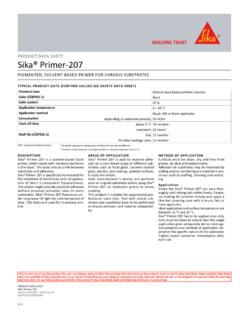
PRODUCT DATA SHEET Sika® Primer-207
usa.sika.comIMPORTANT NOTE If Sika® Primer-207 is used below 5 °C further testing under worst case conditions are man-datory. Sika® Primer-207 is a moisture reactive sys-

Sikadur Epoxies Application Guide - Sika …
usa.sika.comSikadur® Epoxies Application Guide LPL = Long Pot Life cps = centipoise Reference approximate viscosity water = 1 cps olive oil = 100 cps motor oil = 1000-2000 cps Crack Repair Patching Overlay Bonding Adhesive Anchor Bolts Base Plate Grouts USDA Approved Potable Water Approved ASTM C-881 Interior Exterior Int. Exterior Type …

Liquid Seam Sealant - Sika AG
usa.sika.comConstruction Sikaflex® 110 Liquid Seam Sealant Description Sikaflex 110 Liquid Seam Sealant is a non-shrinking, 100% solids, solvent free polyether based, moisture curing, elastomeric sealant. It forms a weather-tight seal when applied over sheathing board joints.

Part 1 - General - Sika AG
usa.sika.comA. Sikadur Injection Gel as manufactured by Sika Corporation, 1682 Marion Williamsport Road, Marion, Ohio 43302 is considered to conform to the requirements of this specification.
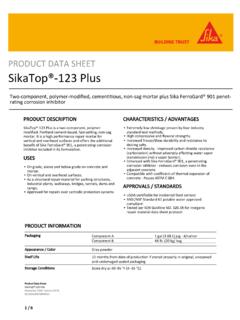
PRODUCT DATA SHEET SikaTop®-123 Plus
usa.sika.com0 g/l (EPA method 24) LIMITATIONS Do not use solvent-based curing compound. Size, shape and depth of repair must be carefully considered and consistent with practices recommended by ACI or ICRI. For additional information on substrate preparation, refer to ICRI Guideline No. 310.2R. If aggressive means of substrate preparation is

SikaSwell S-2 SikaSwell S-2
usa.sika.comApplication Recommended application temperatures: 50°-90°F. Extrude material using Sika MK-5 bulk caulking gun or other approved bulk gun. Cut the nozzle to obtain a triangular extrusion section with a size fulfilling effective needs (or use nozzle included in carton of SikaSwell S-2). Apply a uniform, continuous bead to the hardened concrete.
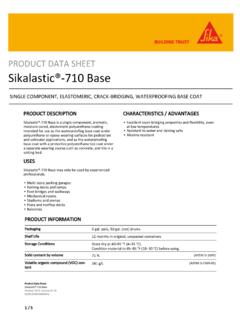
PRODUCT DATA SHEET Sikalastic®-710 Base
usa.sika.comMetal - Should be thoroughly cleaned by grinding or blast cleaning to near white metal (SSPC SPS-10). Priming Primer Selection - Determine maximum moisture content of concrete substrate by weight with a Tramex CME or CMExpert type concrete moisture meter. Sikalastic® Primer – For concrete decks with a maximum

PRODUCT DATA SHEET Sikaflex®-1A
usa.sika.comSpecification TT-S-00230C, Type II, Class A. Meets ASTM C-920, Type S, Grade NS, Class 35, use T, NT, O, M, G, I, A. Canadian standard CAN/CGSB 19.13-M87. USES Designed for all types of joints where maximum depth of sealant will not exceed 1/2 in. Excellent for small joints and fillets, windows, door

PRODUCT DATA SHEET Sika® FerroGard®-903
usa.sika.comreinforced, prestressed, precast, post tensioned or marine concrete. Use of Sika® FerroGard®-903: Steel-reinforced concrete, bridges and highways exposed to corrosive environments (deicing salts, weathering) Building facades and balconies Steel-reinforced concrete in or near a marine environment Parking garages

PRODUCT DATA SHEET Sikaflex®-1A
usa.sika.comJoint dimension should allow for 1/4 inch minimum and 1/2 inch maximum thickness for sealant. Proper design is 2:1 width to depth ratio, For use in horizontal joints in traffic areas, the absolute minimum depth of the sealant is 1/2 in. and closed cell backer rod is recommended. Removal Use personal protective equipment (chemical resistant
Related documents

Characterization of Polydimethylsiloxane (PDMS) Properties ...
web.mit.edudition. After curing, the cross-linked PDMS films were peeled from the silicon wafers, and 2mm2 pieces were cut from seventeen locations around the wafer in a region 3mmfrom the edge to the center of the wafer. The thick-ness of the cut PDMS sections was measured using SEM. Chemicalimmersion. Exposuretodifferentliquidchem-
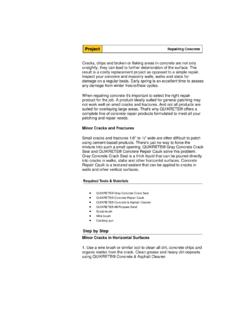
Minor Cracks and Fractures - QUIKRETE
quikrete.coma special latex powder and liquid latex bonding agent. This material is made for patching and smoothing concrete and masonry surfaces over larger areas. It can be applied from a thickness of 1/16" TO A FULL ¼". QUIKRETE® Latex Cement can be used indoors and out, and as an underlayment or finished wear surface. It is designed for

SPARK PLUG REMOVAL INSTRUCTIONS—4.6L TSB 08-7-6 …
www.aa1car.com4. Clean the applicator with Motorcraft Metal agent. Brake Parts Cleaner before the bonding agent starts to cure. 9. Add additional Loctite 638 , repeating Steps 6-8. 5. Reassemble a dry and clean collet and pin assembly. 10.Leave the pin fully inserted in the porcelain while the adhesive cures. Replace the steel tool 6.
Technical Data Sheet Application Guide - Jotun
www.jotun.comThe temperature of base and curing agent is recommended to be 18 °C or higher when the product is mixed. Ensure that pot life is not exceeded during application. Special care must be taken at temperatures above 40°C. The viscosity will increase very fast at such temperatures.
Project QUIK-TUBE® Pillar Foundations - QUIKRETE
www.quikrete.com1. Apply concrete release agent if the smoothest possible concrete surface is desired. 2. Mix and place the concrete in the form. Work it down and around any post or pillar set in the form, but do not use a mechanical vibrator to settle the concrete. 3. Carefully embed any anchor plates or bolts needed in the top of the form.
Issued December 20, 1990 32 - ThreeBond
www.threebond.co.jpThe curing of epoxy resin by amine curing agents is expressed by the formula shown below; the active hydrogen in primary amine reacts with an epoxy group to form secondary amine, and the secondary amine reacts with an epoxy group to cure. Then, the resultant tertiary amine polymerizes epoxy groups. In general, curing agent must have more than