
Programing the Finite Element Method with Matlab
Programing the Finite Element Method with Matlab Jack Chessa 3rd October 2002 1 Introduction The goal of this document is to give a very brief overview and direction
Download Programing the Finite Element Method with Matlab

Information
Domain:
Source:
Link to this page:
Documents from same domain
Thomas’ Calculus: Early Transcendentals , 12th …
www.math.purdue.eduHomework Assignment: MA 174 Spring 2011 Textbook: \Thomas’ Calculus: Early Transcendentals ", 12th edition, Addison Wesley Sections Problems 12.1 8, …
Notes on basic algebraic geometry - Purdue …
www.math.purdue.eduThese are my notes for an introductory course in algebraic geometry. I have trodden lightly through the theory and concentrated more on examples.

Compound Interest - Department of Mathematics
www.math.purdue.eduCOMPOUND INTEREST 3 In interest theory, the di erence between borrowing money and saving money is only in the point of view. When I open a bank account, I am in essence loaning the bank money. The interest I earn on the account is the interest the bank pays me on this loan. Thus, the only di erence between a bank loan and a bank account

Interest Theory Richard C. Penney Purdue University
www.math.purdue.edumathematical theory of interest, if we say that an account earns compound interest at a rate i, we are implicitly stating that we use formula (2) for partial periods as well: Definition 2. An quantity grows at a rate icompound interest if the amount at time tis given by (3) A(t)=(1+i)tP
Matrices and Systems of Linear Equations - Purdue University
www.math.purdue.edu“main” 2007/2/16 page 112 112 CHAPTER 2 Matrices and Systems of Linear Equations 2.1 Matrices: Definitions and Notation We begin our discussion of matrices with a definition. DEFINITION 2.1.1 An m×n (read “m by n”) matrix is a rectangular array of numbers arranged in m horizontal rows and n vertical columns. Matrices are usually denoted by uppercase

EXAM FM SAMPLE QUESTIONS - Purdue University
www.math.purdue.eduEXAM FM FINANCIAL MATHEMATICS EXAM FM SAMPLE QUESTIONS Interest Theory This page indicates changes made to Study Note FM-09-05. January 14, 2014: Questions and solutions 58–60 were added. June, 2014 Question 58 was moved to the Derivatives Markets set of sample questions. ...
EXAM FM SAMPLE SOLUTIONS - Purdue University
www.math.purdue.eduEXAM FM FINANCIAL MATHEMATICS . EXAM FM SAMPLE SOLUTIONS . This set of sample questions includes those published on the interest theory topic for use with previous versions of this examination. In addition, the following have been added to reflect the …

MA 611 Methods of Applied Mathematics: Final
www.math.purdue.eduYingwei Wang Methods of Applied Mathematics 1.1 Spectrum Question: Give the spectral representation of T. Solution: In class, we have known that T is compact and T = T∗
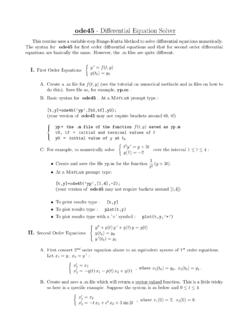
ode45 - Di erential Equation Solver
www.math.purdue.eduode45 - Di erential Equation Solver This routine uses a variable step Runge-Kutta Method to solve di erential equations numerically. The syntax for ode45 for rst order di erential equations and that for second order di erential

IEEE TRANSACTIONS ON BIOMEDICAL ENGINEERING 1 …
www.math.purdue.eduIEEE TRANSACTIONS ON BIOMEDICAL ENGINEERING 1 Spectral Features Selection and Classification for Bimodal Optical Spectroscopy Applied to Bladder
Related documents

9.3 THE SIMPLEX METHOD: MAXIMIZATION - Cengage
college.cengage.comREMARK: Note that for a linear programming problem in standard form, the objective function is to be maximized, not minimized. (Minimization problems will be discussed in Sections 9.4 and 9.5.) A basic solutionof a linear programming problem in standard form is a solution

Questions on Assignment 1? - Computer graphics
graphics.cs.cmu.edu6 Linear and Affine Maps • A function (or map, or transformation) F is linear if for all vectors A and B, and all scalars k. • Any linear map is completely specified by its effect on a set of basis
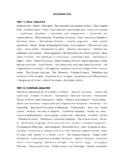
MATHEMATICS UNIT 1: REAL ANALYSIS
trb.tn.nic.inMATHEMATICS UNIT 1: REAL ANALYSIS Ordered sets – Fields – Real field – The extended real number system – The complex field- Euclidean space - Finite, Countable and uncountable sets - …
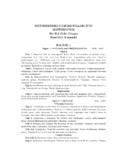
RECOMMENDED RECOMMENDED UNIFIED SYLLABUS …
www.kanpuruniversity.org( iii ) Unit Unit Unit 2222. .. . Differential equations of the first order but not of the first degree, Clairaut’s equations and singular solutions, Orthogonal trajectories, Simultaneous linear differential
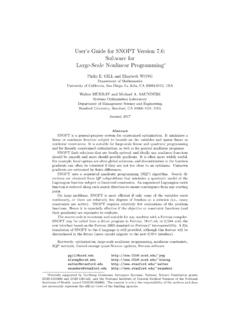
User’s Guide for SNOPT Version 7.6: Software for Large ...
www.sbsi-sol-optimize.comUser’s Guide for SNOPT Version 7.6: Software for Large-Scale Nonlinear Programming Philip E. GILL and Elizabeth WONG Department of Mathematics University of California, San Diego, La Jolla, CA 92093-0112, USA

OSQP: An Operator Splitting Solver for Quadratic Programs
arxiv.orgOSQP: An Operator Splitting Solver for Quadratic Programs Bartolomeo Stellato, Goran Banjac, Paul Goulart, Alberto Bemporad, and Stephen Boyd January 9, 2018

SUGI 30 Statistics and Data Anal ysis
support.sas.comPaper 196-30 Introducing the GLIMMIX Procedure for Generalized Linear Mixed Models Oliver Schabenberger, SAS Institute Inc., Cary, NC ABSTRACT This paper describes a new SAS/STAT procedure for fitting models to non-normal or normal data with correlations or nonconstant variability.